


Part 2 of the project requires the implementation of a B+-tree for the data dictionary; use of the PR quadtree and an adjacency list in an application; and the addition of the required commands to the command decoder.
Note that for full credit on part 2, the functions listed below must replace any with the same command name, as we will be adding parameters and changing the underlying structures from those used in part 1.
As before, each command spans exactly one line; commands will be uppercase, and reasonably sloppy syntax is to be supported (spaces and empty lines are allowed). Documentation and conformance is worth DOC points. Don't forget to check the BNF in section as well.
 ) [DD points] will indicate
the size of the
) [DD points] will indicate
the size of the  -tree
used in the data set. It will always be the first command in the data set.
Don't bother checking to see if some OTHER command is the first. We won't
do that. However,
you should detect that the B+ tree order has already been set if the
command appears again.
Your output should look like
-tree
used in the data set. It will always be the first command in the data set.
Don't bother checking to see if some OTHER command is the first. We won't
do that. However,
you should detect that the B+ tree order has already been set if the
command appears again.
Your output should look like
Error: B+ tree already initialized. The current order is:<current-order>
 to 0. Print ``All structures cleared.''
after execution, even if
this is the second command in the data file.
to 0. Print ``All structures cleared.''
after execution, even if
this is the second command in the data file.
 ) [DD points] adds the
name of the cell along with its
coordinate position into the
data dictionary. The data dictionary should be implemented as a B+-tree
with keys
in the natural ASCII order ( strcmp() order) of
the cell names. Cell names will be composed of
6 characters that are _ or alphanumeric. Coordinates will be
in the range [0, 1024). Print a confirmation message if this
command is processed successfully. There used to be an assumption about
the max number of cells which could be added. You may make no such assumption.
) [DD points] adds the
name of the cell along with its
coordinate position into the
data dictionary. The data dictionary should be implemented as a B+-tree
with keys
in the natural ASCII order ( strcmp() order) of
the cell names. Cell names will be composed of
6 characters that are _ or alphanumeric. Coordinates will be
in the range [0, 1024). Print a confirmation message if this
command is processed successfully. There used to be an assumption about
the max number of cells which could be added. You may make no such assumption.
As before, creating a cell that exists already is an error. However, there is no need to detect that two cells with different names have identical coordinates, and, there is no intention to put this specific error in the test data until Part 3.
{(bar)}
{(CELL3),(foo)}
{(CELL1,CELL2),(CELL3),(bar),(foo)}
Even at the leaves print only the key (the cellname). If the tree is empty, print
"Tree is empty." Your tree is not expected to match mine exactly. Your grade will
be based on your tree displaying the following properties(this does deviate somewhat
from shaffer, you are required do what what is listed below):
For our order m tree:
The leaves contain between 1 and m-1 keys. They may not have m keys.
Internal node internal nodes must have between ceiling(m/2) and m children. There must
be one fewer guide than children (no 'extra' key on the far left should be printed, even
if you used one in your implementation). Your tree, of course, must also contain the correct
data at the leaves!
 ) [MAP points] inserts the
specified cell into PR quadtree
just as the coordinates are listed when they are inserted in the
CREATE_CELL. An attempt to insert a cell already present in
the PR quadtree should result in an error message(same error as part1).
) [MAP points] inserts the
specified cell into PR quadtree
just as the coordinates are listed when they are inserted in the
CREATE_CELL. An attempt to insert a cell already present in
the PR quadtree should result in an error message(same error as part1).
Note: At the same time that a cell is inserted in the PR quadtree, the EnviroBot (EBOT) net connecting existing cells is extended to include the additional cell. Details of EBOT net development are included here for your convenience. When a cell is inserted in the PR quadtree successfully, the cell must be added to the EBOT net by finding the cheapest edge between the existing cell and all other cells already in the net.
The edge cost is computed according to the following algorithm for inserting the j-th cell into the path.
If  the cost is
  . For
. For  , the edge cost between cells A and
B having coordinates
, the edge cost between cells A and
B having coordinates  and
and  , respectively, is
![\begin{displaymath}{\rm cost}_{AB} = [(x_A) - (x_B)]^2 + [(y_A) - (y_B)]^2 + (\max(r_A,r_B))^j \end{displaymath}](img18.png)
where
 and
and  is defined similarly.
So, if cell B is being inserted in the PR quadtree and there are already  cells in the
service path, an edge will be inserted from cell B to the existing cell A
for which
cells in the
service path, an edge will be inserted from cell B to the existing cell A
for which
 is minimal. And, yes, that means the number
of cells already in the EBOT net also contributes to the cost. However,
once an edge has been inserted in the EBOT net, no attempt should be made
to recompute the cost.
is minimal. And, yes, that means the number
of cells already in the EBOT net also contributes to the cost. However,
once an edge has been inserted in the EBOT net, no attempt should be made
to recompute the cost.
Furthermore, as the cost increases, it may be more reasonable to keep the cost in two pieces--the portion that dominates, with the j-th power tucked in, and the portion from the difference in x and y coordinates...this will keep the need to use double precision to store humongous integers from introducing unneeded errors. Do what you think is right.
Were this a REAL application, you might suggest that the developers consider using a disconnected EBOT net once the number of cells makes the cost prohibitively large-on the other hand, we really don't know the units of the cost function, now do we, so these values might be what the customer expects.
Full credit will be given for brute force (meaning always compute all the distances to all cells in the net). However, up to 10 points extra credit may be given if your algorithm need not always check all known cells to find the closest-and sometimes, reasoning based on the size of a given portion of the cost function can allow you to prune the PR quadtree.
If you do choose this option, make sure you describe your algorithm within your code, and explain your algorithm and why it is better than brute force in the README. p.s. The cost function doesn't have any particular rationale, but ya gotta live with it ;)
Important: Last Minute Clarification of Ebot Net cost function
Since the last term of the cost function blows up quickly, the client has agreed to accept the following modification. Floating point may be used as an approximation to the cost and double precision gives best results. The BNF now reflects this change, with <float> replacing <int> as needed.
Furthermore, suppose you are adding cellname  to the EBOT NET.
When comparing cost
to the EBOT NET.
When comparing cost  , the cost of a potential
edge connecting
, the cost of a potential
edge connecting  to , to cost
  , the cost of a potential edge
between
, the cost of a potential edge
between  and , you find that the following is true:

Then, you may continue as if the cost to connect to either or
were identical, and use strcmp order of the cell name
to discern which of or gets
the connection. Please note that if you compute the function as written,
you will have a loss of precision when and differ by only a few
low order digits.
So, you might want to consider the following alternative if you need to preserve the actual difference for some other reason. This method can be evaluated without the loss of precision caused by subtracting two nearly equal floating point numbers.
If  , then the cost of the edge to A is treated as matching
that to B whenever
, then the cost of the edge to A is treated as matching
that to B whenever

 , then if
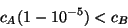
(Note that the previous
discussion assumes that and are non-negative.)
The cells should be listed in strcmp order, with the nodes linked to each individual cell listed in strcmp order afterwards. (Ok, not too helpful.) Try:
CELL1:   CELL2 CELL 3
CELL2:   CELL1
CELL3:   CELL1 CELL4
CELL4:   CELL3
 ) [AP points] identifies and
prints all cells within the closed circle of the specified radius around
the specified cell.
You are expected to use the PR quadtree efficiently
to guide your search process. For full credit, your output should also
include the path that you follow during the search, as defined in part 1
for RECTANGLE_CELL.
Programs that do not prune the search tree efficiently will
be penalized up to half credit. Note that you are not required to find the
best such algorithm; merely one that prunes the PR quadtree in some reasonable
way. It is acceptable to use your original rectangle function to prune. As before,
you must make sure that your tree behaves like that theoretical model- that is, even if
you use NULL pointers for children you should still print out the relevant directions, or
you will receive a giant 0 points. For instance on the following tree:
) [AP points] identifies and
prints all cells within the closed circle of the specified radius around
the specified cell.
You are expected to use the PR quadtree efficiently
to guide your search process. For full credit, your output should also
include the path that you follow during the search, as defined in part 1
for RECTANGLE_CELL.
Programs that do not prune the search tree efficiently will
be penalized up to half credit. Note that you are not required to find the
best such algorithm; merely one that prunes the PR quadtree in some reasonable
way. It is acceptable to use your original rectangle function to prune. As before,
you must make sure that your tree behaves like that theoretical model- that is, even if
you use NULL pointers for children you should still print out the relevant directions, or
you will receive a giant 0 points. For instance on the following tree:
NW
NE Foo at (5.000,6.000)
SW Bar at (1023.000,1023.000)
SE
the output of RADIUS_CELL(Foo,1000,1000) should be
NW
NE Foo at (5.000,6.000)
SW
SE
even though NW and SE may actually be NULL pointers. Please don't mess this up, I'll have no sympathy if you do.
 ,
,  ,
,  ,
,  ) [AP points] Ahh pseudo cells. Perhaps it is best to explain why these exist.
1. To get you to implement line intersection
2. To get you do do subdivision in your quadtree beyond the unit level.
These are warm-ups for project three, and not directly related to p2. That said,
read on...
Identify pseudocells within rectangle determined by plus or
minus
, and plus or minus . Next, name the pseudo
sites "+PSxxx" where xxx is the number of pseudo cells that have already
been created +1. ie, the first pseudo cell should be called +PS001, the
second pseudo cell should be +PS002 etc. Of course, I am limited in my ability
to force which order your cells are added in, so outputs may not neccessarily match. The "+"
will ensure that the user cannot enter such a name as a Cell name ahead of time, since
+ is not a valid character for the CREATE_CELL() command.
Then, insert the site information into the B+tree and insert the site into the quadtree. If
while inserting into the quadtree you find that for some point p already in the tree,
|p.x-x|<.0001 and |p.y-y|<.0001 you must disregard the point. It should then have no effect on
the PRTree or the BPTree or any other values.
Contrary to what I(brian) posted, Pseudo cells have absolutely no effect on the EBOT_NET.
PRINT_EBOT_NET should not display Pseudo Cells at all. The avoid a slew of error checking
and make our lives easier, after CREATE_PSEUDO_CELLS is called for the first time,
INSERT_CELL() *will not be called again* unless CLEAR_ALL() is called first. Any other
function may still be called, including another call to CREATE_PSEUDO_CELLS().
As this command is processed you should print out the pseudo cells you create. See the
sample io for proper formatting, but essentially it will look like either:
) [AP points] Ahh pseudo cells. Perhaps it is best to explain why these exist.
1. To get you to implement line intersection
2. To get you do do subdivision in your quadtree beyond the unit level.
These are warm-ups for project three, and not directly related to p2. That said,
read on...
Identify pseudocells within rectangle determined by plus or
minus
, and plus or minus . Next, name the pseudo
sites "+PSxxx" where xxx is the number of pseudo cells that have already
been created +1. ie, the first pseudo cell should be called +PS001, the
second pseudo cell should be +PS002 etc. Of course, I am limited in my ability
to force which order your cells are added in, so outputs may not neccessarily match. The "+"
will ensure that the user cannot enter such a name as a Cell name ahead of time, since
+ is not a valid character for the CREATE_CELL() command.
Then, insert the site information into the B+tree and insert the site into the quadtree. If
while inserting into the quadtree you find that for some point p already in the tree,
|p.x-x|<.0001 and |p.y-y|<.0001 you must disregard the point. It should then have no effect on
the PRTree or the BPTree or any other values.
Contrary to what I(brian) posted, Pseudo cells have absolutely no effect on the EBOT_NET.
PRINT_EBOT_NET should not display Pseudo Cells at all. The avoid a slew of error checking
and make our lives easier, after CREATE_PSEUDO_CELLS is called for the first time,
INSERT_CELL() *will not be called again* unless CLEAR_ALL() is called first. Any other
function may still be called, including another call to CREATE_PSEUDO_CELLS().
As this command is processed you should print out the pseudo cells you create. See the
sample io for proper formatting, but essentially it will look like either:
*****
 ==> CREATE_PSEUDO_CELLS(...)
New pseudo cells:
+PS001 at (...,...)
.
.
.

or

*****
 ==> CREATE_PSEUDO_CELLS(...)
No new pseudo cells discovered in the specified region.
Note that you will need either the C++ utilities on our 420 webpage, or SWING in Java. Please note that this ability will be very helpful for part 3. And, this function description will need to be updated, because the TA's have to decide how to grade this piece.