In this set of answers, I have taken the value to an actual integer. You will
not need to do this on the exam for these larger numbers because calculators are
not allowed, and I don't want to spend time testing if you know how to multiply. I have done it here so that if you used a different method, it should still
evaluate to reach the same integer value.
- Answer the following about the sequence of numbers between 5 and 125 (inclusive):
- How many integers are between 5 and 125 (inclusive)?
ANSWER:

- How many integers are between 5 and 125 (inclusive) which are divisible by 3?
ANSWER:


- How many integers are between 5 and 125 (inclusive) which are divisible by 5?
ANSWER:


- How many integers are between 5 and 125 (inclusive) which are divisible by both 3 and 5?
ANSWER:


- How many integers are between 5 and 125 (inclusive) which are divisible by either 3 or 5?
ANSWER:

- How many integers are between 5 and 125 (inclusive) which are divisible by neither 3 nor 5?
ANSWER: Total number - number that are divisible

- How many integers are between 5 and 125 (inclusive) which are divisible by 3 but not divisible by 5?
ANSWER: number divisible by 3 - number of those that are divisible by 5

- For the next set of questions, assume you have a of 6 dogs. Some dogs are big (marked with a b), some are middle sized (marked with a m), and some are small (marked with an s).
These dogs are {Alpi (b),Bingo (s), Congo (b), Delfi(s), Elf (s), Fred (m)}.
Answer the following questions about the dogs in your kennel.
- How many different ways can you select two dogs to take for a walk at the same time?
ANSWER:
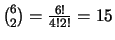
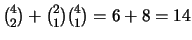
- How many different ways can you select two dogs to take for a walk at the same time assuming you can't handle 2 big dogs at the same time?
ANSWER: Partition and use Addition Rule
Two non-big dogs + One big and one non-big dog
- How many different ways can you assign the dogs all to leashes (assuming you have 6 leashes in 6 different colors)?
ANSWER: Steps and use multiplication rule
Select the leash for the first dog = 6
 Select the leash for the second dog = 5
...
Select the leash for the last dog = 1

- How many different ways can you assign the dogs all to leashes (assuming you have 6 leashes in 6 different colors), but also assuming you have only two leashes that can handle the big dogs?
ANSWER: Steps and use the multiplication rule
Select the leashes for the big dogs
Select the leashes for the other dogs

- How many different ways can you divide the dogs up for walking among your 3 volunteers - assuming each volunteer must walk 2 dogs each?
ANSWER: Steps and use the multiplication rule
Select the dogs for the first walker
select the dogs for the second walker
select the dogs for the third walker

- How many different ways can you line up the dogs (single file) for a dog show?
ANSWER: Linear permutation of all 6 dogs

- How many different ways can you line up the dogs (single file) for a dog show assuming the large dogs must come first, followed by the mediup then the small dogs?
ANSWER: Multiplication rule of the Linear permutations for the individual sizes

- How many different ways can you create a line in the dog show of four finalists?
ANSWER: r-Permutation :

- How many different ways can you distribute the 15 doggie treats you have (assuming the doggie treats are indistinguishable)? (note: it can be that one dog gets all of the treats - you are not trying to distribute them evenly.)
ANSWER: 15 indistinguishable doggie treats into 6 categories

- How many diffent ways can you assign them to the 4 run areas at your kennel? (note: these ``runs'' are distinguishable, but you could be assinging them all to the same run or as evenly as possible.)
ANSWER: 6 distinguishable dogs into 4 distinguishable runs
number of ways for each dog to select one of the four runs
Dog 1 has 4 runs to select from, dog 2 has 4 runs to select from ..., Dog 6 has 4 runs to select from

- Assuming you have 6 collars (6 different colors) and 6 leashes (6 different colors), how many ways can you assign the collars and leashes to your six dogs so they can go for a walk?
ANSWER: Use the multiplication rule with the two individual steps of assigning collars and then assigning leashes.

- Assuming you have 5 families interested in adopting dogs, how many different ways can the dogs be given to those families? (note: you are assuming there is no personal preference taken into account.)
ANSWER: r-Permutation of assigning 5 of the 6 dogs to distinguishable families

- Assuming all of your dogs are male, and the neighbor's dog turns out to be pregnant, how many different ways could your dogs be the father of her puppies?
ANSWER: Select the one of your dogs that is the father

If you want to assume it may be another dog from somewhere else (none of yours are the father this is just one more possibility

- Assuming you must take one dog of each size with you, how many diffent ways do you have to select your companions?
ANSWER: select the one dog from each set and use the multiplication rule to get the whole

This document was generated using the
LaTeX2HTML translator Version 2K.1beta (1.61)
Copyright © 1993, 1994, 1995, 1996,
Nikos Drakos,
Computer Based Learning Unit, University of Leeds.
Copyright © 1997, 1998, 1999,
Ross Moore,
Mathematics Department, Macquarie University, Sydney.
The command line arguments were:
latex2html -show_section_numbers -split 0 -no_navigation -no_footnode countingpracticeans
The translation was initiated by Fawzi Emad on 2003-04-24
Fawzi Emad
2003-04-24
Web Accessibility