 ,
,
 ,
,
 ,
,  ,
,  , and
, and  ). In addition to these,
you may also use mathematical, grouping and
set notations symbols as needed.
On the next line write the
negation of the original statement using formal notation.
Note: On the negation, no quantifier nor quantitified expression
(parentheses) may be negated in the final answer.
). In addition to these,
you may also use mathematical, grouping and
set notations symbols as needed.
On the next line write the
negation of the original statement using formal notation.
Note: On the negation, no quantifier nor quantitified expression
(parentheses) may be negated in the final answer.
| There are more than two people with green hair. |
| Domain: P = {All people} |
| Predicate: G(x) = ``x has green hair'' |
| statement: |
 |
| negation: |
 |
| There are not two people who both like the same person. |
| Domains: P = {All people} |
| Predicate: L(x,y) = ``person x likes person y'' |
| statement: |
 . . |
| negation: |
 . . |
| Every dog has a month. |
| Domains: D = {all dogs}, M = {all months} |
| Predicate: H(d,m) = ``dog d has month m'' |
| statement: |
 |
| negation: |
 . . |
| P1 |
 |
| P2 |
 |
| P3 |
 |
| P4 |
 |
Therefore
 |
| line | Statement | Reason | Line #s |
| 1 | |||
 |
Inst. |
P3 | |
| 2 | |||
 |
Simp. |
1 | |
| 3 | |||
 |
Simp. |
1 | |
| 4 | |||
 |
MP |
2, P4 | |
| 5 | |||
 |
MT |
4, P2 | |
| 6 | |||
 |
De Morgan's | 5 | |
| 7 | |||
 |
Syll. |
2, 6 | |
| 8 | |||
 |
+ |
4, 7 | |
| 9 | |||
 |
De Morgan's | 8 | |
| 10 | |||
 |
MT |
9, P1 | |
| 11 | |||
 |
+ |
10 | |
| 12 | |||
 |
Alt. Def. |
11 | |
| 13 | |||
|
|
Gen. |
12 | |
| 14 | |||
| 15 | |||
| 16 | |||
| 17 | |||
| 18 | |||
| 19 | |||
| 20 | |||

Base Case:  |
|
 and and
 . . |
|
Inductive Hypothesis: |
|
 |
|
Inductive Step: |
|
| Show: | |
 . . |
|
| Proof: | |
 . . |
|
 , and , and |
|
 . . |
|
Hence,
 . . |
|
=
 . . |
|
Since  , we can replace the , we can replace the  term in the fraction with term in the fraction with
 , and we will not decrease the size of the fraction: , and we will not decrease the size of the fraction: |
|
 . . |
|
| By the IH,
. |
|
Substituting these two inequalities into the value of
 , it follows that , it follows that |
|
 . . |
|
Assume the values are defined according to this:
Let
 ,
,

Prove or give a counter example for the statement:

.
Base Case: |
|
 and and  . .  and and  . . |
|
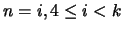
Inductive Hypothesis:
 |
|
 . . |
|
| Inductive Step: . |
|
| Show: | |
 . . |
|
| Proof: | |
 |
|
Since
 , by the IH, , by the IH,
 |
|
Since
 , by the IH, , by the IH,
 . . |
|
Hence,
 . . |
|
Since  , ,
 , so , so
 , so , so
 |
|
Hence,
 |
|
Let
 .
.

The statement is true.
Proof:
Let
be arbitrarily chosen such that
 .
.
Since  , by the definition of
  ,
,  , so by the
definition of divides,
, so by the
definition of divides,
 ,
,  .
.
Since  , by the definition of divides,

 .
.
Substituting into the equation , we obtain  .
.
Since  , by the definition of
  ,
,  , so by the
definition of divides,
, so by the
definition of divides,
 ,
,  .
.
Since  , by the definition of divides,

 .
.
Substituting into the equation , we obtain  .
.
Now, we add the two equations: and to obtain


Since
 and
and  is closed under addition and multiplication,
so by the definition of divides
is closed under addition and multiplication,
so by the definition of divides  , so by the definition of
 ,
,  .
.
By the definition of ,
You own 10 black socks, 10 brown socks, and 10 orange socks. Assume socks of the same color are indistinguishable.
- How many ways are there to randomly select 5 socks to put into your
suitcase?
ANSWER:
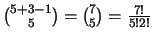
This is a problem where we have 3 categories of things and we select 5 of them so we are placing 5 numbers into 3 categories. Therefore, this is a combination with repetition (an X's and |'s problem), so the formula is
 , or
, or
 .
.
- How many ways are there to put ALL of your socks in a row on the
clothesline?
ANSWER:
This is a permutation with repetition problem. The idea is you first pick 10 spaces out of 30 for the black socks, then 10 spaces out of 20 for the brown and then the orange socks go into the last 10 spots.
 after cancellation of terms.
- You put ALL of your socks into the dryer knowing that the dryer will
randomly consume 4 of them. What is the probability that the dryer
will consume two socks of one color and two socks of another color.
ANSWER:
The total number of ways to do choose 4 socks from the 30 here is
 , so that is our denominator.
The number of ways to pick 2 socks of 2 different colors is as follows:
First, pick the two colors of socks we will pick socks from. There are
 ways to do this.
Then, within each color, we have
 ways to pick 2 socks out of
the 10 that are there. We must pick 2 socks from 2 colors, so we will square
this amount in the final answer:
ways to pick 2 socks out of
the 10 that are there. We must pick 2 socks from 2 colors, so we will square
this amount in the final answer:

You are the manager of 24 baseball players. There are 9 unique "positions"
(jobs) that make up a single baseball team.
You do not have to do the arithmetic, you can leave the answer in a format that includes combinations using the format  , permutations using the format
  , addition, subtraction, multiplication, division,exponents and/or factorials.
- In how many ways can you select a team?
(Assume the team is just a group of nine players - the ``position'' each team member is playing doesn't matter.)
ANSWER:
We pick 9 people out of the 24 and order doesn't matter so it's a combination.
 .
.
- In how many ways can you select a team?
(Assume the team here is defined as which position each player is assigned to - for example Joe playing on your team as the catcher and Bill as the pitcher should be considered a different team than if Bill is the catcher and Joe the pitcher.)
ANSWER:
We pick 9 people out of the 24, and now order does matter, so it's a permutation.
 .
.
- If Jerry Hairston and Jay Gibbons
(two of the 24 players you may select from) refuse to play
on the same team, then how many ways can you select a team?
(Assume for this question the second definition of team - where teams
are distinct based on the ``positions'' of the players.)
ANSWER:
If both of the players are on the same team, the number of ways they can be put onto the team is
 .
.
That leaves 7 positions left over for 22 players to fill, and the number of ways that those positions can be filled is
 .
.
So, the total number of ways to avoid having them on the same team is:
 .
.
 indicates the complement of the set
  and
and  indicates the powerset of :

True.
Proof by contrapositive:
Let
 be arbitrarily chosen such that
 .
.
Suppose that
 .
.
Then,
 ,
,  .
.
By the definition of complement,  .
.
Therefore
 ,
,
and so by the definition of power set,  .
.
Since  ,
,  , by the definition of complement.
So
 , which means that
 .
.
Since and
,
 .
.
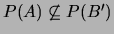
The negation of this statement is
 , which is the
definition of
.
, which is the
definition of
.
Since the negation of the statement is true,
 .
.
 be defined as follows:

- Either prove that f is one-to-one or explain why it isn't.
ANSWER:
It is not 1-1 because
 and
and  , which means that two
elements of the domain map to the same element of the codomain.
, which means that two
elements of the domain map to the same element of the codomain.
- Either prove that f is onto or explain why it isn't.
ANSWER:
 is onto because
 .
.
Hence, given any integer
 , there is an
 such that
 . In particular, that element is
  . (Although there are many
other possi
. (Although there are many
other possi
- Either prove that f is a bijection or explain why it isn't.
ANSWER:
is not a bijection because bijections are 1-1 and onto, and is not
1-1.
 where the sets needed are defined below assuming
  indicates the size of the set X:
(Assume the sets are finite.)
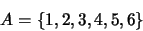
A is a set of elements.

B is another set of elements.

 size:
size: 
 size:
size: 
 size:
size: 
 size:
size:  .
.
G is a function from D to F, so the function maps from a set of size
, to a set of size .
The ratio of the sizes of the two sets (domain/codomain) is:

- If G is onto, what relationship must hold between
 and
and  ?
?
ANSWER:
If the function is onto, then the domain must be as large as the codomain, so we need
 , or
, or  , or
, or  .
.
- If G is one-to-one, what relationship must hold between and ?
ANSWER:
If the function is 1-1, then the domain must be no larger than the codomain, so in this case, we need
 , or
, or  , or
, or  .
.
- If G is a bijection, what relationship must hold between and ?
ANSWER:
In this case, the domain and the codomain must have the same size.
In this case, we need
 , or
, or  , or
, or  .
.
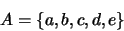
 over the set given as
  , answer each of the following questions.

- YES(Yes or No) Is this relation transitive?
- NO (Yes or No) Is this relation irreflexive?
- YES (Yes or No) Is this relation symmetric?
- YES (Yes or No) Is this relation reflexive?
- NO (Yes or No) Is this relation antisymmetric?
- NO (Yes or No) Is this relation a ``partial order
relation''?
Which of the above properties do you have to consider to determine if it is a ``partial order relation''?ANSWER:
Reflexive, Antisymmetric, Transitive.
- YES (Yes or No) Is this relation an ``equivalence
relation''?
Which of the above properties do you have to consider to determine if it is an ``equivalence relation''?
Reflexive, Symmetric, Transitive.

- Draw the directed graph that represents this relation:
![\includegraphics[]{final1.eps}](img173.png)
- Draw the Hasse diagram that represents this partial order relation:
![\includegraphics[]{final2.eps}](img174.png)