Disprove by Counter Example or Prove each of the following :
  1. $\forall a,b,c \in Z, a \vert b \wedge a \vert c \rightarrow a\vert bc$
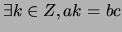
    show: when $a\vert b \wedge a\vert c$ it must be true that $\exists k \in Z, ak=bc$
    proof:
    $a \vert b \rightarrow \exists m \in Z, am = b$
    $am = b$
    $(am)c = bc$
    $a(mc) = bc$ where $mc \in Z$
    THEREFORE $\exists k \in Z, ak=bc$
    THEREFORE $a \vert bc$
  2. $\forall a,b,c \in Z, a \not \vert b \wedge a \not \vert c \rightarrow a \not \vert bc$
    False by Counter Example: $a = 4$ and $b = 10$ and $c=14$
    $a \not \vert b$ means $4 \not \vert 10$ this is true
    $a \not \vert c$ means $4 \not \vert 14$ this is true
    $a \not \vert bc$ means $4 \not \vert (10*14)$ means $4 \not \vert 140$ this is false
  3. $\forall q,r \in Q, qr \in Q$
    show: $\exists a,b \in Z, qr = \frac{a}{b}$ where $b \neq 0$
    proof:
    $ q \in Q $ means $\exists c,d \in Z, d \neq 0, q = \frac{c}{d}$
    $ r \in Q $ means $\exists e,f \in Z, f \neq 0, r = \frac{e}{f}$

    $qr = (\frac{c}{d})(\frac{e}{f})$
    $qr = \frac{ce}{df}$
    $df \neq 0$
    $cd \in Z$
    $df \in Z$
    THEREFORE $qr \in Q$
  4. $\forall a \in Q, a \not \in Z \rightarrow (\lfloor a \rfloor \neq \lceil a \rceil)$
    proof:
    $\lfloor a \rfloor \rightarrow \exists r \in Q, 0<r<1, \lfloor a \rfloor = a-r$
    $\lceil a \rceil \rightarrow \exists s \in Q, 0<s<1, \lceil a \rceil = a+s$
    ASSUME: $\lfloor a \rfloor = \lceil a \rceil$
    $a - r = a + s$ $-r = s$ where $ 0<r<1$ and $0<s<1$
    $\rightarrow \leftarrow$
    THEREFORE: $\lfloor a \rfloor \neq \lceil a \rceil$
  5. $\forall a \in Q, \exists q \in Z, aq \in Z$
    proof:
    $a \in Q \rightarrow \exists c,d \in Z, d \neq 0, a = \frac{c}{d}$
    ASSUME: $\forall q \in Z, \frac{c}{d}q \not \in Z$
    let $q = d$
    $\frac{c}{d} q = \frac{c}{d} d = c$ where $c \in Z$
    $\rightarrow$$\leftarrow$
    THEREFORE: $\forall a \in Q, \exists q \in Z, aq \in Z$
  6. $\forall a,b,c \in Z, a \vert b \vee a \vert c \rightarrow a\vert bc$
    show: $\exists k \in Z, ak=bc$
    proof:

    case 1:
    $a \vert b \rightarrow a\vert bc$
    $a \vert b \rightarrow \exists m \in Z, am = b$ $am = b$
    $(am)c = bc$
    $a(mc) = bc$ where $mc \in Z$
    THEREFORE: $a \vert bc$

    case 2:
    $a \vert c \rightarrow a\vert bc$
    $a \vert c \rightarrow \exists n \in Z, an = c$ $an = c$
    $(an)b = bc$
    $a(nb) = bc$ where $nb \in Z$
    THEREFORE: $a \vert bc$

    THEREFORE: $a\vert b \vee a\vert c \rightarrow a\vert bc$
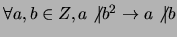
  7. $\forall a,b \in Z, a \not \vert b^2 \rightarrow a \not \vert b$
    proof:
    CONTRAPOSITIVE: $\forall a,b \in Z, a\vert b \rightarrow a\vert b^2$
    $a\vert b $ means $\exists k \in Z, ak = b$
    $ak = b$
    $(ak)^2 = b^2$
    $a^2k^2 = b^2$
    $a(ak^2) = b^2$ where $ak^2 \in Z$
    THEREFORE: $a\vert b^2$

About this document ...

This document was generated using the LaTeX2HTML translator Version 2K.1beta (1.61)

Copyright © 1993, 1994, 1995, 1996, Nikos Drakos, Computer Based Learning Unit, University of Leeds.
Copyright © 1997, 1998, 1999, Ross Moore, Mathematics Department, Macquarie University, Sydney.

The command line arguments were:
latex2html -show_section_numbers -split 0 -no_navigation -no_footnode practicenumans

The translation was initiated by Fawzi Emad on 2003-03-11


Fawzi Emad 2003-03-11

Web Accessibility