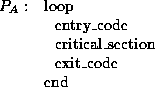
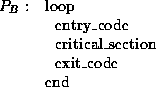
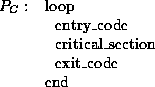
Assume the following:
 and
and  use busy-waiting (e.g. with test-and-set loops).
is 0 if no process in its
use busy-waiting (e.g. with test-and-set loops).
is 0 if no process in its  (e.g. the lock is free).
,
, and loop branch is 10 ms.
(e.g. the lock is free).
,
, and loop branch is 10 ms.(b) What can you say about the waiting time of a process, i.e. the time
taken to execute
.
2. [5 pts] Using semaphores, modify the following so that
at any time at most three of the processes,  , are executing their
  's.
's.


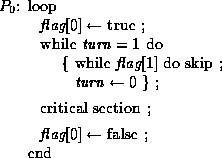
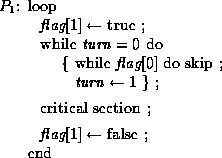
3. [5 pts] Is the following following a correct solution to the 2-process mutual exclusion problem? Justify your answer.
 : array [0..1] of { true, false }. Initialized to false.
 : 0..1. Initialized to 0.
4. [8 pts] You have to solve the 4-process mutual exclusion problem by repeatedly applying Peterson's 2-process mutual exclusion solution. Assume the following constructs for Peterson's solution:
,  ,
,  . /* of appropriate type and
initial value */
. /* of appropriate type and
initial value */ /* executed by process 0 */
 /* executed by process 1 */
 /* executed by process 0 */
 /* executed by process 1 */
 // shared variables
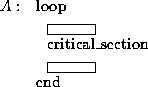
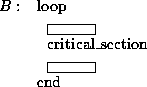
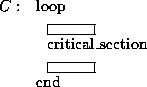
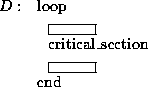
Hint: think of a binary tree with four leaves representing A, B, C, and D.
5. [5 pts] In project 2, the top of the stack of a ready process contained the address of dispatch(), and you had the following:
void scheduler ()
 { ...
   /* get next ready process,
      put it in run queue,
      update \_SP and \_SS to process's stack */
      asm retf  /* go to dispatcher */
 }

void dispatch ()
 { asm {
    mov sp, bp
    pop bp
    pop bp
    pop di
    ...
  }
If you replaced the asm retf in the scheduler by dispatch(),
what changes would be required elsewhere?
6. [5 pts] In project 2, you had
void interrupt system_service ( sbp, sdi, ssi, sds, ses, sdx, ... , proc, argc, argv )
What is the purpose of specifying all these parameters in the definition of system_service?
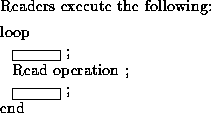
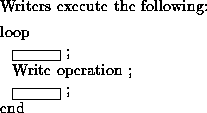
7. [15 pts] You have to solve a variation of the readers-writers problem, in which multiple writers can write at the same time. Specifically, there are readers and writers. Multiple reads at the same time are allowed. Multiple writes at the same time are allowed. A read and a write at the same time is not allowed.
Provide a solution using semaphores with the following properties:
 integer initialized to 0. /* number
of reads currently executing */
integer initialized to 0. /* number
of reads currently executing */
 integer initialized to 0.
/* number of readers currently waiting */
integer initialized to 0.
/* number of readers currently waiting */
 semaphore initialized to 0. /* readers wait
here */
semaphore initialized to 0. /* readers wait
here */
 integer initialized to 0. /* number
of writes currently executing */
integer initialized to 0. /* number
of writes currently executing */
 integer initialized to 0.
/* number of writers currently waiting */
integer initialized to 0.
/* number of writers currently waiting */
 semaphore initialized to 0. /* writers wait here
*/
semaphore initialized to 0. /* writers wait here
*/
Assume without loss of generality that round-robin queue has processes in the order A, B, and C. Here is the evolution starting from time 0.
A executes
till time
5 ms A
waited 0 ms
B
executes
till time
10 ms B starts
wait at 5 ms
C
executes
till time
15 ms C starts wait at
10 ms
A executes ,
till time 20 ms
A completes
B executes
till time
25 ms B waited 15 ms
C executes
till time
30 ms
A executes
till time
35 ms A starts wait at 30 ms
B executes
,
till time 40 ms B
completes
C executes
till time
45 ms C waited 30 ms
A executes
till time
50 ms
B executes
till time
55 ms B starts wait at 50 ms
C executes
,
till time 60 ms C
completes
and so on
(a) [5 pts] one
executed every 20 ms, or equivalently 50 per second.
(b) [2 pts] average waiting time is 30 ms (ignoring initial transient).
2. [5 pts] Introduce the following: a semaphore, say gate,
initialized to 3; P(gate) before every
; and V(gate) after every
.
3. [5 pts] No. It allows both processes to enter CS as follows.
 executes
 |
-  true
true
- while  do
do
- while
do skip
(
at  )
) |
 executes
 |
-  true
true
- while  do
do
(
at CS) |
|
executes |
-
- while
do
(
at CS) |
Can also have starvation as follows:
(1)
(2)
(3)Steps (2), (3), (2), (3), ... can repeat endlessly. Each process is getting a share of CPU, but
starves.
4. [8 pts] Introduce three sets of variables, say,  ,
, 
 ,
, 
 ,
, 
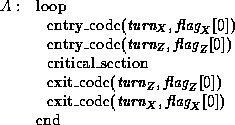
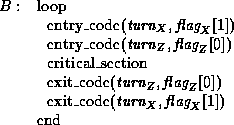
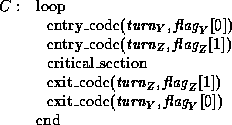
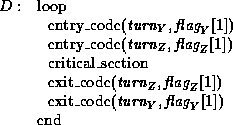
[3 points for recognizing three applications of Peterson's algorithm, 2 points for declaring the variables, 3 points for the entry and exit code.]
5. [5 pts] Calling dispatch() instead of using retf places the return address (a location within scheduler) on the stack, after which dispatch() puts its frame on the stack.
The simplest fix is to modify dispatch() so that it removes the frame (as is currently done), then removes the next 4 words on stack (skipping return address and address of dispatch on stack), and continue as before (restore registers).
A more natural fix is to not have the address of dispatch() on top of a ready process's stack. proc_start and defer should not put address of dispatch () on stack. The beginning of dispatch() should be modified to remove the frame (as is currently done) and the return address to scheduler.
6. [5 pts] To access variables that are already on the process's stack, and have the compiler generate the addressing code.
7. [15 pts]
Add semaphore  initialized to 1 to protect the variables.
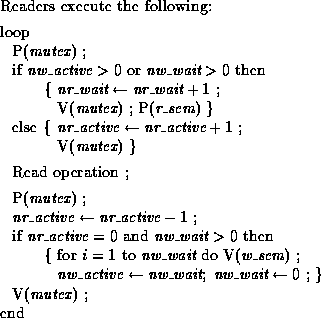
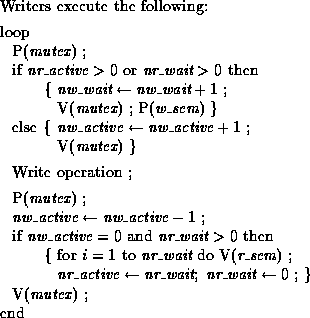
[2 points for
, 4 for updating  and
and  (consitently), 3 for updating
  and
and  , 2 for P(
  and P(
  , 4 for P(
and P(
.]
, 4 for P(
and P(
.]
Common mistakes: Using more than one
. Doing only one V when last reader (or writer) leaves (causes readers
and writers to alternate in heavy load, readers can be left stranded if
no writers show up, ...).