cmsc 412 f98
|
Exam 1
|
name:
|
Total points 30. Total time 75 mins. 3 problems over 3 pages. No
book, no notes, no calculator.
Unless otherwise mentioned, assume read-write atomicity and weak
fairness scheduling.
Program elegance counts. You lose points for long/inelegant code.
1. [10 pts] Threads B, C, and D cooperate to add up the contents
of an array x of size 20 as follows. B adds up the even elements, x[0],
x[2],  . C adds up the odd elements, x[1], x[3],
. D adds up the results of B and C:
. C adds up the odd elements, x[1], x[3],
. D adds up the results of B and C:
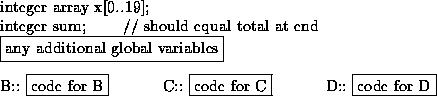
Supply variables and code for the boxes so that
-
Each thread terminates after finishing its work; it does not wait for other
threads to finish.
-
B and C are able to access (different entries of) the array concurrently.
-
Counting semaphores are the only synchronization constructs (no
access to interrupts, process queues, etc.).
-
No busy waiting.
-
The code for B, C and D together does not exceed 20 lines.
2. [10 pts] Processes B and C share a pool of N buffers
organized in two queues, a queue  of empty buffers and a queue
  of full buffers. B repeatedly gets a buffer from eQ, writes it,
and puts it in
. C repeatedly gets a buffer from fQ, reads it, and puts it in
.
of full buffers. B repeatedly gets a buffer from eQ, writes it,
and puts it in
. C repeatedly gets a buffer from fQ, reads it, and puts it in
.
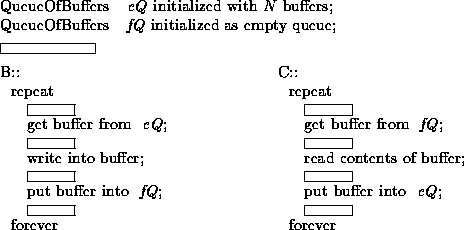
Supply the variables and code for the boxes so that
-
``get buffer'' is never executed on an empty queue.
-
``put buffer'' is never executed on a queue with N buffers.
-
A queue is never accessed by two processes at the same time.
-
A ``get buffer'' attempt on a non-empty queue eventually succeeds.
-
A ``put buffer'' attempt on a queue with less than N buffers eventually
succeeds.
-
Counting semaphores are the only synchronization constructs you
can use. No busy waiting.
3. [10 pts] The following is an attempt to solve the 2-process
critical section problem in which process P0 has priority over process
P1. The idea here is that if P1 and P0 are both hungry then P1 backs off
for a while.
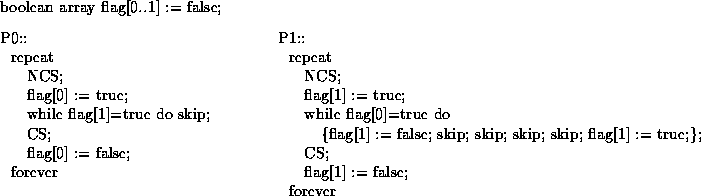
For each claim below, decide whether or not it holds. If it holds give
a proof. If it does not, give an execution that falsifies the claim.
-
a.
-
Claim: At any time at most one process is in its CS.
-
b.
-
Claim: If P0 attempts to enter its CS then eventually it enters the CS.
A. Udaya Shankar
Sun Oct 18 15:47:00 EDT 1998