CMSC 828F - Fall 2004
Prof Guimbretière
Advanced Introduction to HCI
Homework #2 (due
10/21/04)
1) (20 points) Fitts' law to design a keyboard

(10 points) Use Fitt's law to compute the time it will take to key in the following key sequence (starting with the finger on top of the "ON" key):
3, 6, "ENTER" key (on top of the first E), 5, +, 8, ÷, "Öx". (HPs use the Inverse Polish Notation. The sequence represents SQRT((36+5)/8)).
You might assume IM = 100ms, each key is .3"x.3", row are .44" apart center to center, column are .44" apart center to center and a 200ms dwell time (delay) between keys. Explain your answer.
(5 points) The manufacturer of this device decides to increase the device dimensions by 25% (uniform scaling of all parts). How will this influence the time it takes to perform the sequence above? Explain your answer.
(5 points) The manufacturer decides to increase the distance between each key by 25% (in both directions), but to save money use the exact same key size as in the original device. How will this influence the time it takes to perform the sequence above? Explain your answer.
2) (15 points) The Human Information Processor
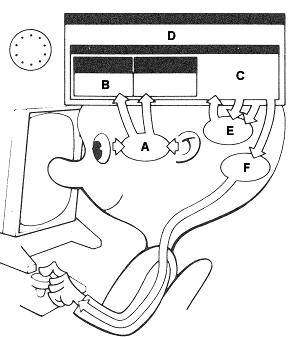
(5 points) Using the following figure, name and describe briefly each element of the Human Information Processor.
(10 points) In an experiment, subjects are presented with 2 numbers in sequence and instructed to press the “Y” key only if the two number have the same parity (One might assume that once a symbol is recognized as a number, the parity can be recognized in one cognitive cycle). In one trial, a 15 is presented on the screen, and then 121 presented. Describe how the different elements of the Human Information Processor interact up to the point where the key is pressed by the subject (no computations is required).
3) (10 points) Echo
You are standing in front of a large concrete wall. Behind you, a friend is blowing a horn creating short pulse of sound every 5 seconds. How far from the wall shall you be to perceive an echo? Explain your answer. (you might assume that the speed of sound is 330 m/s).
4) (40 points) GOMS model
In this problem you will be providing a GOMS style analysis of the following task:
After finishing typing a document using MS Word, a user is trying to find and replace a misspelled word.
-
(5 points) Describe the goals and sub-goals used,
-
(5 points) Describe the operators used,
-
(10 points) For each goals and sub-goals describe which method(s) could be used. (If there is more than 3 possible methods for a given goal (or sub-goal) list at least 3 of the most commonly used methods),
-
(10 points) Describe the most probable selection rules for each goal (or sub-goal),
-
(10 points) Present a synthesis of your work using the standard CMN-GOMS to describe the search of the first misspelled word.
While answering questions bellow, please keep in mind the following facts about this task:
-
The text can be as small as a single sentence, or as big as a book,
-
The search and replace may apply to a any part of the document (including the whole document),
-
Depending on the type of misspelling, the search and replace might apply to all or a subset of possible matches. The subset might be context dependant and might not be described by a regular expression (you might assume that during the search process, new match are always presented with enough context on the screen for the user to make a decision without navigating the document),
-
You may assume that the search is only concerned with characters (not character attributes such as style and the like) and that the search style (such as Match case, Whole words only... and the like) has been set once and for all before starting the search.
Please note: In a way, one may think about this analysis as writing a program to perform a task using basic operators. Accordingly grading will take into account the style of the decomposition and the comments/explanations provided.
5) (15 points) KLM model
Below is a simple interface to convert temperature between Fahrenheit and Celsius. To perform a conversion, the user selects the type of conversion with a mouse, then type a value to be converted on the left side and read the conversion result on the right. The conversion starts when the user press “Enter”.

Using the KLM model, predict the time that a user will take to:
-
(6 points) convert 24.5 if she does not need to set the type of conversion,
-
(9 points) convert -78.4 if she does need to set the type of conversion.
In both case, you can assume that the user is starting the interaction with her hands on the keyboard, and need to click on the left text field to set the focus. Be careful to explain your derivation (including which rule you are using) for partial credit. You can ignore the system response time and assume the following values for the KLM parameters: tK = .15s, tP =1s, tH = .3s, tD = (9*n + .16*l)s, tM = 1.2s.