


Next: About this document ...
CMSC 250 (0201 & 0202) Homework 1 Fall 2005
Due Wed September 6 at the beginning of your discussion
section.
You must write the solutions to the problems
single-sided on your own lined paper,
with all sheets stapled together,
and with all answers written in sequential order
or you will lose points.
- Translate the following to logical expressions assuming ``a'', ``b'', and
``c'' are used to represent the propositions given below. (You may also
assume that Abe, Bob and Carl are the only people who could possibly like or
not like me.):
- a = ``Abe likes me.''
- b = ``Bob likes me.''
- c = ``Carl likes me.''
- Abe likes me, but Bob does not.
- Somebody likes me.
- Everybody likes me.
- Nobody likes me.
- Determine which of the following are statements and which are not.
- What time is it?
- This is my homework paper.

- This is a true statement.
- This is not a true statement.
- For each of the following, translate the logical expression to an English statement and then give the set of values which would make the statement true.
Assuming the following variables:
- p = ``n is at least -3.''
- q = ``n is not equal to 0.''
- r = ``n is less than 4.''

-
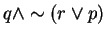
-

- Write the complete truth table for the following statement:
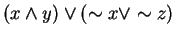 .
.
- Write the complete truth table for the following statement:
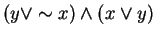 .
.
- Use a truth table to determine if the statements
``
 '' and ``
 ''
have the same truth value in all possible worlds - in other words,
under every possible interpretation of the propositions ``x'', ``y'' and ``z''.
''
have the same truth value in all possible worlds - in other words,
under every possible interpretation of the propositions ``x'', ``y'' and ``z''.
Next: About this document ...
Chang Hu
2005-09-28
Web Accessibility