


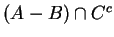
 |
Alt. Rep. of Set Diff. |
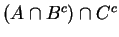 |
Alt. Rep. of Set Diff. |
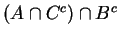 |
Associatve and Commutative |
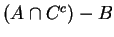 |
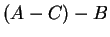
Alt. Rep. of Set Diff. |
 |
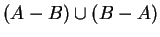
Alt. Rep. of Set Diff. |
 |
Given. |
 |
Alt. Rep. of Set Diff. |
 |
Distributive |
 |
Distributive |
 |
Distrib. and Assoc. |
 |
Union with complement. |
 |
Intersect w/  |
 |
De Morgan's |
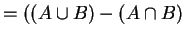 |
Alt. Def. of Set Diff. and Commut. |
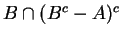 |
DeMorgans law |
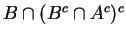 |
Alt. Rep. of Set Diff. |
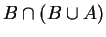 |
DeMorgans law |
| B | Absorption law |
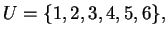
 then
then
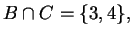 so that
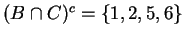 and
and

 and
and  be sets such that B
 . Suppose that
 , that is, suppose there is an element
  such that
 Then
Then  and
and  by the definition of intersection. But
  by hypothesis, so since ,
  by definition of subset. Thus x
 and also , which is a contradiction. Hence our supposition is false which means that


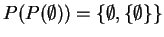

 and
and  and
and  have no elements in common.
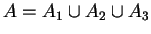 , and the sets are mutually disjoint.
 , then none of the sets contain
  . Another example,
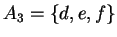 and
and
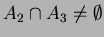 , so the sets are no longer mutually disjoint.
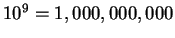 SSN's in all.
 different SSN's with no repeated symbol.
Thus the probability the a SSN chosen at random contain no repeated numbers is
different SSN's with no repeated symbol.
Thus the probability the a SSN chosen at random contain no repeated numbers is
 therefore approximately 0.36