


You must write the solutions to the problems single-sided on your own lined paper, with all sheets stapled together, and with all answers written in sequential order or you will lose points.
 and
and  be the relation on
  defined as follows. Draw the directed graphs for and and indicate which relations are antisymmetric.


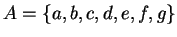 . Let
. Let  be a binary relation on
  with the following pairs related:
  ,
,  ,
,  ,
,  . Write the following sets using ordered pair notation.
.
.
.
be a relation defined by
| 1 | 0 | 0 | 0 | 1 | 0 |
| 0 | 1 | 1 | 0 | 0 | 1 |
| 1 | 1 | 1 | 0 | 0 | 1 |
| 1 | 0 | 1 | 1 | 1 | 0 |
| 0 | 0 | 0 | 0 | 1 | 1 |
| 0 | 1 | 1 | 1 | 0 | 0 |
Write the matrices representing the reflexive and symmetric closures of . Is asymmetric? Is antisymmetric? Is reflexive? Is irreflexive? Give reasons for your answers.
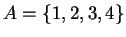 . Let be a binary relation defined on defined by:
  if
if
 . Write the the relation using ordered pair notation, and show that the relation is antisymmetric.

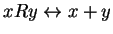 is even.
Is R a partial order relation? Prove or give counterexample.
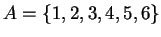 . Let be the partial order relation defined by inclusion of subsets of . Write a chain
  of maximal length contained in .
be a partial order relation on
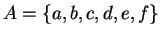 given by:

Draw the Hasse diagram for .
is an equivalent relation on the set .
Find the distinct equivalence classes of .
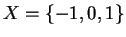 and
and  . is defined on
  as follows:
For all sets
as follows:
For all sets  and
and  in ,
in ,
 is the set of all strings of length 2 in 0's, 1's, and 2's. is defined on as follows:
For all strings
is the set of all strings of length 2 in 0's, 1's, and 2's. is defined on as follows:
For all strings  and
and  in ,
in ,

 be the set of all points in the Cartesian plane except the origin. is the relation defined as follows:
For all
be the set of all points in the Cartesian plane except the origin. is the relation defined as follows:
For all  and
and  in ,
in ,
 be a binary relation on a set and suppose is symmetric and transitive. Prove the following:
If for every
be a binary relation on a set and suppose is symmetric and transitive. Prove the following:
If for every  in there is a
  in such that
  , then is an equivalence relation.
on the set
, then is an equivalence relation.
on the set  of all integers as follows: For all
 ,
,
 on the set
  of all real numbers as follows: For all
 ,
,
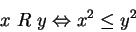
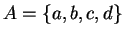 , and let be the relation
 a total order on ? justify your answer.