CMSC 421
Artificial Intelligence -- Fall 2005
HOMEWORK TWO
due 10/13/05
1. Constraint Satisfaction (25 pts.)
In this question, you
will be solving a map-coloring problem. In this domain, each of the
regions on a map must be colored either black, gray, or red. The
regions
must be colored in such a way that no adjacent regions are the same
color. Two regions are considered to be adjacent if they touch along an
edge. (Two regions that touch only at a corner are not adjacent.)
Here is the map that you'll be using for all of the questions in this
section:
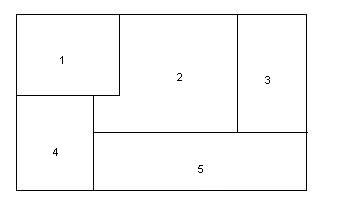
a. Backtracking search (10 pts)
Suppose we decide to use simple
backtracking search to find a solution to this constraint satisfaction
problem. The variable ordering heuristic we use is simply to instantiate
the variables in numbered order. The value ordering heuristic is to
consider the values in the order black, gray, red. You can use any
reasonable shorthand to indicate the instantiations (e.g., "1=B" can mean region
1 is instantiated to the color black).
(i) Show the complete search tree, circling the solution node, if one is found.
(ii) Show the final coloring, if one is found, on the map above or on a copy
of the map.
(iii) How many variable instantiations (search steps) are tried by this search
method?
b. Forward checking (10 pts)
Now suppose we use forward checking to
eliminate illegal values from the domains of uninstantiated variables.
(Recall that in forward checking, only the constraints immediately connected to
instantiated variables are checked.) Furthermore, suppose we use a
variable ordering heuristic that chooses the variable with the fewest legal
instantiations remaining to instantiate next. If more than one such
variable exists, the one earlier in the numbered order is selected. The
same value ordering heuristic is used as in backtracking search (i.e., consider
first black, then gray, then red).
(i) Show the complete search tree for forward checking search. At
each node, show the remaining legal values for the uninstantiated variables.
For example, at the first node below the root, only region 1 will be colored,
so you should indicate the legal values for variables 2, 3, 4, and 5. Continue
until your search finds a solution or fails.
(ii) Show the final coloring, if one is found, on a copy of the map above.
(iii) How many variable instantiations are tried by this search method?
c. Solution spaces (5 pts)
(i) How large is the search space for this problem? That is, how
many different colorings, legal or illegal, are there for the blank map
shown above?
(ii) For this map, how many different solutions (legal colorings) are
there?
2. Game Playing (15 pts)
Recall the game of Nim that we
played in class. Initially, there are k piles, each containing
nk sticks. Two players alternate turns, and at
each turn the current player removes any positive number of sticks from
one of the piles. At least one stick must be removed during a turn.
The last player to remove a stick loses. We will represent a state in this
game as a k+1-tuple:
[s1 ... sk p],
where si is in the interval [0,nk], and represents the number
of sticks remaining in pile i; and p is either A (MAX) or B (MIN),
representing which player's move is next.
For those problem, you will be considering Nim211,
a variation of Nim with three piles, one containing two sticks, and the others
each containing one stick. Player A goes first, so the initial state is
[211A].
a. Game Tree (10 points)
Draw the complete game tree for Nim211. The left-to-right order of
actions taken should always be: remove 1 stick from pile 1, remove 2 sticks
from pile 1, remove 1 stick from pile 2, remove 1 stick from pile 3.
(Obviously you should only have branches for actions that are legal in a particular
state.) We will ignore the issue of repeated states for this problem, so
it's OK if a state appears in more than one place in your tree.
b. Minimax and Alpha-Beta (5 points)
(i) Mark the terminal nodes in the game tree you drew for Question II.1
with their utility values, using +1 to indicate a win for A (MAX), and -1 to
indicate a win for B
(MIN).
(ii) Annotate each of the nodes in the tree with its backed-up minimax
value.
(iii) Circle the nodes that would be pruned by alpha-beta pruning using
depth-first (left-to-right) search. (You should assume that the alpha values
are initialized to -1, rather than -infinity, and that the beta values are initialized
to +1, rather than +infinity.
3. Propositional Logic - Models (9 points)
Russell and Norvig, question 7.5, p. 237
4. Propositional Logic - Validity (16 points)
Russell and Norvig, question 7.8, p. 237
5. Proposition Logic - Resolution (30 points)
Russell and Norvig, question 7.9, p. 238
Write as a propositional knowledgebase, convert to clausal form and use resolution
refutation.
5. First Order Logic - Representation (25 points)
Russell and Norvig, question 8.6, p. 269
Web Accessibility