Next: About this document ...
CMSC 250 Homework 2 Spring 2006
Due Wed Feb 8 at the beginning of your discussion
section.
You must write the solutions to the problems single-sided on your own lined paper, with all sheets stapled together, and with all answers written in sequential order or you will lose points.
- Give in complete English sentences the negations of the following statements. Apply DeMorgan's Law so that the statements only have the smallest possible unit negated.
- Neither cats nor dogs are allowed here.
- Both poodles and dobermans make good pets.
- Fish and birds are allowed, but dogs are not.
- For each of the following statements, state ``inverse,'' ``converse,'' ``contrapositive,'' or ``none.'' I may have changed verb tenses to make so that the statements sound right, but tell if the form matches.
- If you like dogs, then you will love Freddie.
You loved Freddie, so you must like dogs.
- If the bear is white, it must be a Polar Bear.
Since the bear is not white, it must not be a Polar Bear.
- You will need help, if you intend to finish.
If you do not intend to finish, you must not need help.
- You will get there on time if you leave now.
If you leave now, then you will get there on time.
- You will be accepted only if you wear this hat.
If you wear this hat, then you will be accepted.
- If you do not like this house, don't live there.
If you live here, you must like this house.
- Don't do that if it rains.
If it rains, do that.
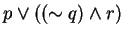
- Write the complete truth table for each of the following:
-
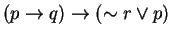 .
.
-
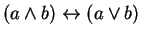
- For each of the following state the one single rule from
Theorem 1.1.1 (page 14) or Table 1.3.1 (Page 39) that could be used to go directly from the statement(s) to the conclusion, or ``none'' if there is no one
single rule. (note: the answer if ``none'' even if a series of rules can be applied)
- statement:
 /
/  / with conclusion:
  .
.
- statements:
/
 / with conclusion:
  .
.
- statements:
 /
/  / with conclusion: .
- statements:
 / / with conclusion:
 .
.
- statements:
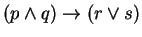 /
/
 / with conclusion:
.
/ with conclusion:
.
- statements:
 / / with conclusion:
  .
.
- statements:
 /
/  / with conclusion: .
- statements:
 /
/  / with conclusion: .
- Use a truth table to determine if the following argument is valid or not. State whether or not it is valid, and give your reasons why it is valid or not.
- Use the rules of inference you were given to prove the following:
-
-
-
Next: About this document ...
Chang Hu
2006-02-07
Web Accessibility