


You must write the solutions to the problems single-sided on your own lined paper, with all sheets stapled together, and with all answers written in sequential order or you will lose points.
For each of the following statements, prove that the statement is true, or give a counterexample to show that it is false.
FALSE.
Proof (by contradiction).
Let  be an even prime number larger than two. be an even prime number larger than two. |
Then
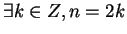 , by definition of even. , by definition of even. |
Since  , ,  , by substitution. , by substitution. |
 , by algebra. , by algebra. |
Since  , ,  , by algebra (adding , by algebra (adding  to both sides). to both sides). |
So  , by substitution. , by substitution. |
Thus,  , by combining inequalities. , by combining inequalities. |
Since,  by the hypothesis, there esits two integers, by the hypothesis, there esits two integers, |
each strictly between  and whose product is . and whose product is . |
| Therefore, is not prime. |
| QED |
TRUE.
Proof (by construction).
There are an infinite number of odd primes
 , , |
since there an infinite number of primes and  is the only even one (by problem 1). is the only even one (by problem 1). |
Consider the set
 . . |
Each element  is composite since is composite since
 , by the definition of composite. , by the definition of composite. |
The set is infinite, since  is infinite and no two elements are equal. is infinite and no two elements are equal. |
(If  for for  , then , then  and and  ,
by substitiion and algebra.) ,
by substitiion and algebra.) |
No number is a perfect square, since its prime factors  both have degree in its prime factorization.
 |
| QED |
 ,
,
 .
.
TRUE.
Proof (by dilemma).
Let be arbitrary in  , by universal instantiation. , by universal instantiation. |
 ,
by the definition of mod and quotient remainder theorem. ,
by the definition of mod and quotient remainder theorem. |
Cases 0, 2:  , ,  . . |
| is even, so the antecedent is false. |
| So the statement is true.
Case 1: |
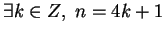 , by the definition of mod. , by the definition of mod. |
 , by substitution and algebra. , by substitution and algebra. |
 is an integer, since the integers are closed under addition and multiplication. is an integer, since the integers are closed under addition and multiplication. |
 , by the definition of mod. , by the definition of mod. |
| QED |
Case 3:  |
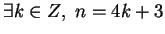 , by the definition of mod. , by the definition of mod. |
 , by substitution and algebra. , by substitution and algebra. |
 is an integer, since the integers are closed under addition and multiplication. is an integer, since the integers are closed under addition and multiplication. |
|
, by the definition of mod. |
So,
 , by dilemma. , by dilemma. |
|
,
, by universal generalization. |
| QED |
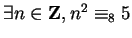 .
.
FALSE.
We will show
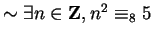 is TRUE,
which is equivalent to
is TRUE,
which is equivalent to
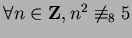 .
.
Proof (by dilemma).
| Let be arbitrary in , by universal instantiation. |
 |
| by the Quotient Remainder Theorem |
Case 0:  |
 , therefore , therefore
 , by algebra , by algebra |
Case 1:  |
|
, therefore
, by algebra |
Case 2:  |
 , therefore
, by algebra , therefore
, by algebra |
Case 3:  |
 , therefore
, by algebra , therefore
, therefore
, by algebra |
Case 4:  |
 , therefore
, by algebra , therefore
, therefore
, by algebra |
Case 5:  |
 , therefore
, by algebra , therefore
, therefore
, by algebra |
Case 6:  |
 , therefore
, by algebra , therefore
, therefore
, by algebra |
Case 7:  |
 , therefore
, by algebra , therefore
, therefore
, by algebra |
 , by dilemma. , by dilemma. |
|
, by universal instantiation. |
| QED |
 such that
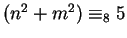 .
.
Let and  . . |
Then
 , by substitution and algebra. , by substitution and algebra. |
| But there are an infinite number of integers satisfying , |
| and an infinite number of integers satisfying ,
by the definition of mod. |
| So there are an infinite number of pairs of integers
such that
. |
| QED |
 ,
,  is odd if and only if is odd.
TRUE.
We must show that if is even then  is odd then is odd,
and if is odd then is odd.
For the first statement, we construct the contrapositive
and show that if is even then is even.
So we need to prove the following two statements:
is odd then is odd,
and if is odd then is odd.
For the first statement, we construct the contrapositive
and show that if is even then is even.
So we need to prove the following two statements:
, if is even then is even.
, if is odd then is odd.
Proof.
| Let be arbitrary in .
|
 Then
, by definition of even. Then
, by definition of even. |
Let satisfy  , by existential instantiation. , by existential instantiation. |
 , by substitution and algebra. , by substitution and algebra. |
 is an integer, by closure of under multiplication. is an integer, by closure of under multiplication. |
| So, is even, by the definition of even. |
So, is even  is even, CCW w/o contradiction. is even, CCW w/o contradiction. |
| So, is odd is odd, by contrapositive. |
| Assume is odd. |
Then
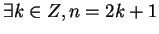 , by definition of odd. , by definition of odd. |
Let satisfy  , by existential instantiation. , by existential instantiation. |
 ,
by substitution and algebra. ,
by substitution and algebra. |
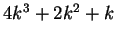 is an integer, by closure of under multiplication. is an integer, by closure of under multiplication. |
| So, is odd, by the definition of odd. |
| So, is odd is odd, CCW w/o contradiction. |
So, is odd is odd  is odd is odd, by conjuctive addition.
 |
So, is odd
 is odd, by the definiton of biconditional. is odd, by the definiton of biconditional. |
|
, is odd if and only if is odd, by universal generalization. |
| QED |
 ,
, ![$\sqrt[3]{p}$](img80.png) is irrational.
is irrational.
TRUE.
Proof (by contradiction).
Let  be arbitrary in be arbitrary in  . . |
| Assume is rational. |
Then
![$\exists a,b \in Z, b \ne 0 ~\wedge ~ \sqrt[3]{p} = \frac{a}{b}$](img83.png) ,
by the definition of rational. ,
by the definition of rational. |
Let  satisfy satisfy
![$b \ne 0 ~\wedge ~ \sqrt[3]{p} = \frac{a}{b}$](img85.png) ,
by existential instantiation. ,
by existential instantiation. |
Then
 , by algebra. , by algebra. |
So  , by algebra. , by algebra. |
 ,
by the prime factorization theorem. ,
by the prime factorization theorem. |
 ,
by the prime factorization theorem. ,
by the prime factorization theorem. |
Hence,
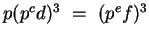 , by substitution. , by substitution. |
Hence,
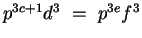 , by algebra. , by algebra. |
So  , since , since  and and  . . |
So 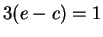 , by algebra. , by algebra. |
So  , by definition of divides. , by definition of divides. |
| Which is false. |
| So is irrational, CCW with contradiction. |
|
, is irrational, by universal generalization. |
| QED |
 ,
, ![$\sqrt[n]{7}$](img98.png) is irrational.
is irrational.
TRUE.
Proof (by contradiction).
Let be arbitrary in  . . |
| Assume is rational. |
Then
![$\exists a,b \in Z, b \ne 0 ~\wedge ~ \sqrt[n]{7} = \frac{a}{b}$](img100.png) ,
by the definition of rational. ,
by the definition of rational. |
Let satisfy
![$b \ne 0 ~\wedge ~ \sqrt[n]{7} = \frac{a}{b}$](img101.png) ,
by existential instantiation. ,
by existential instantiation. |
Then
 , by algebra. , by algebra. |
So  , by algebra. , by algebra. |
 ,
by the prime factorization theorem. ,
by the prime factorization theorem. |
 ,
by the prime factorization theorem. ,
by the prime factorization theorem. |
Hence,
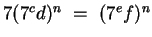 , by substitution. , by substitution. |
Hence,
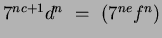 , by algebra. , by algebra. |
So 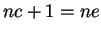 , since , since  and and  . . |
So 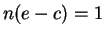 , by algebra. , by algebra. |
So  , by definition of divides. , by definition of divides. |
Which is false, since  . . |
| So is irrational, CCW with contradiction. |
|
, is irrational, by universal generalization. |
| QED |
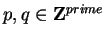 such that
  .
Then
such that
.
Then
such that  ,
it is not the case that
,
it is not the case that  and
and  .
.
TRUE.
Proof.
Let  be arbitrary in be arbitrary in  . . |
Let  , where , where  . . |
| Assume . |
Then there exists  such that such that  by definition of divides. by definition of divides. |
 , by substitution, since . , by substitution, since . |
So,  , by algebra. , by algebra. |
 , since . , since . |
 , since is prime. , since is prime. |
Thus,  , by the prime factorization theorem. , by the prime factorization theorem. |
So,  , by substitution. , by substitution. |
Thus,
 , CCW without contradiction. , CCW without contradiction. |
So,
 by definition of conditional. by definition of conditional. |
So,
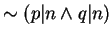 , by deMorgan. , by deMorgan. |
| Thus,
such that ,
,
by universal generalization. |
| QED |
 such that
  , and let be a prime number. If
  , then
  .
.
TRUE.
Proof (by contradiction).
 ,
by the prime factorization theorem. ,
by the prime factorization theorem. |
 ,
by the prime factorization theorem. ,
by the prime factorization theorem. |
So,
 , by substitution. , by substitution. |
So,
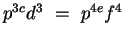 , by substitution. , by substitution. |
So,  |
 , since , by the prime factorization theorem. , since , by the prime factorization theorem. |
So,  , by algebra. , by algebra. |
So,  , by substitution. , by substitution. |
So,  , since , since  is an integer. is an integer. |
So,  , by the prime factorization theorem. , by the prime factorization theorem. |
| QED |
