Next: About this document ...
CMSC 250 Homework 8 Spring 2003
Due Wed March 29 at the beginning of your discussion
section.
You must write the solutions to the problems single-sided on your own lined paper, with all sheets stapled together, and with all answers written in sequential order or you will lose points.
For each of the following statements say whether it is TRUE or FALSE.
If true, use mathematical induction to prove it.
If false, give a specific counter example.
-
 TRUE.
Proof (by mathematical induction)
TRUE.
Proof (by mathematical induction)
Base Case: (n=1)
LHS:

RHS:

LHS = RHS since  .
.
Inductive Hypothesis:
Assume true for  .
.

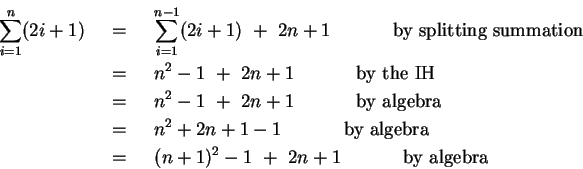
Inductive Step:
QED
-
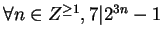 .
TRUE.
Proof (by mathematical induction)
.
TRUE.
Proof (by mathematical induction)
Base Case: (n=1)
 .
.
 .
.
Inductive Hypothesis:
Assume true for .
Then
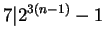 .
Inductive Step:
.
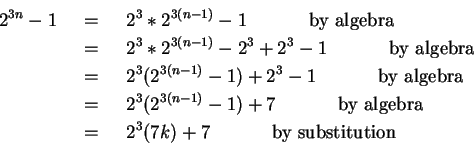
Inductive Step:
Since
, there exists  such that
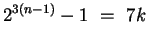 .
.
QED
-
 TRUE.
Base Case: (n=1)
TRUE.
Base Case: (n=1)
LHS:

RHS:
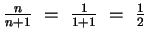
LHS = RHS since
 .
Inductive Hypothesis:
.
Inductive Hypothesis:
Assume true for  .
Then
.
Then
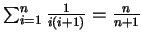 .
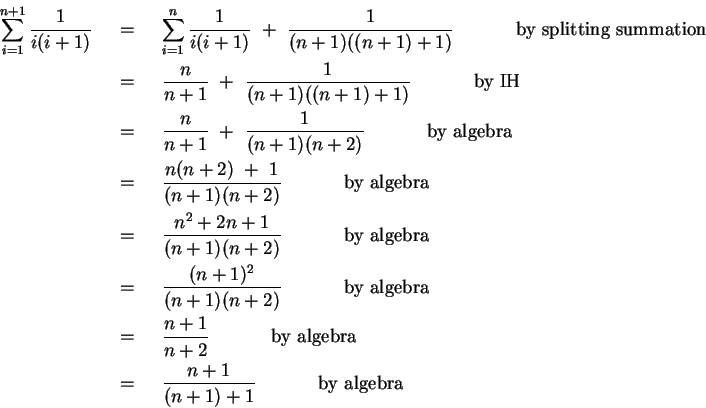
Inductive Step:
.
Inductive Step:
QED
-
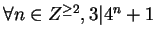 .
FALSE.
Proof (by counterexample)
.
FALSE.
Proof (by counterexample)

 .
.
 .
.
QED
-
 TRUE.
Proof (by mathematical induction)
TRUE.
Proof (by mathematical induction)
Base Case: (n=3)
LHS:

RHS:

LHS  RHS since
  .
.
Inductive Hypothesis:
Assume true for .
Then
 .
Inductive Step:
.
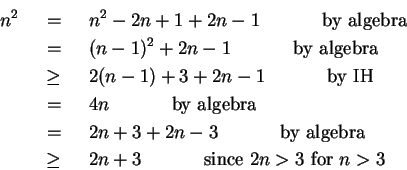
Inductive Step:
QED
-
 TRUE.
Proof (by mathematical induction)
TRUE.
Proof (by mathematical induction)
Base Case: (n=0)
LHS:

RHS:

LHS  RHS since
  .
.
Inductive Hypothesis:
Assume true for .
Then
 or
or
 .
Inductive Step:
.
Inductive Step:
We reverse the inequality.
QED
-
 FALSE.
Let
FALSE.
Let  .
.
LHS:
 .
.
RHS:
 .
.
LHS  RHS since
  .
.
-
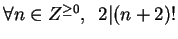 TRUE.
Proof (by mathematical induction)
TRUE.
Proof (by mathematical induction)
Base Case: (n=0)
 .
.
 .
.
Inductive Hypothesis:
Assume true for .
Then
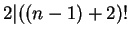 or
or  .
Inductive Step:
.
Inductive Step:
Since (by IH), there exists
such that 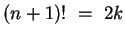 (by definition of divides).
Thus .
Thus
 .
.
Thus
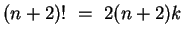 .
.
Since  is closed under addition and multiplication,
 is an integer.
So  by definition of divides.
QED
Next: About this document ...
Chang Hu
2006-04-05
Web Accessibility