


Next: About this document ...
CMSC 250 Homework 13 Spring 2006
Due Wed May 3 at the beginning of your discussion
section.
You must write the solutions to the problems single-sided on your own lined paper, with all sheets stapled together, and with all answers written in sequential order or you will lose points.
- Let
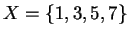 and
and
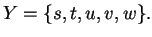 Define
 by the following arrow diagram
![\includegraphics[height=3cm]{h101.eps}](img4.png)
- write the domain and the co-domain of f.
Domain:

Co-domain: 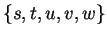
- what is the range of
 ?
?

- what is the inverse image of s? Of u?
 :
: 
 :
: 
- Define f:
 by the rule
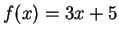 for all
  .
.
- Is onto? Prove or give a counterexample.
YES.
Proof.
Let
 be arbitrary in
  (the co-domain). Universal instantiation.
Let 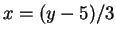 .
.
Then
 since the reals are closed under subtraction and division.
So  is in the domain.
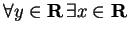 such that
  Universal generalization.
So is onto.
QED
- Is one-to-one? Prove or give a counterexample.
YES.
Proof.
Let
 be arbitrary in (the domain). Universal instantiation.
 Assume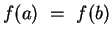
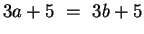 by definition of .
 by algebra.
 by algebra.
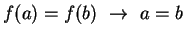 CCW without contradiction
 Universal generalization.
So is one-to-one.
QED
- Find its inverse function or state why no such function can exist.

So the inverse function is
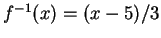 .
.
- How many one-to-one functions are there from a set with three elements to a set with four elements?
 .
.
- How many one-to-one functions are there from a set with six elements to a set with five elements?
None.
- How many onto functions are there from a set with three elements to a set with two elements?
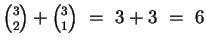
- How many onto functions are there from a set with four elements to a set with two elements?

- In a group of 687 people, must there be two who have same first name and last name initials? Why or why not?
Yes. There are
 possible pairs of initials.
Since there are 687 people, by the pigeon hole principle
some two people must have the same initials.
possible pairs of initials.
Since there are 687 people, by the pigeon hole principle
some two people must have the same initials.
- If 5 distinct integers are chosen from between 2 and 10 inclusive, must at least 1 of them be a prime? Why or why not?
No. Consider the set
 .
It has five numbers, and none of them is prime.
.
It has five numbers, and none of them is prime.
- I have a bag filled with marbles. There are 15 red marbles, 9 blue marbles, 12 green marbles, 15 yellow marbles, 4 black marbles, and 3 white marbles. How many marbles would I have to pick out of the bag to guarantee that I have 5 marbles of the same color?

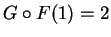
- If each function F and G are defined by formulas find
 and
and  and determine whether equals
- F(x)
 ; G(x)


They are not equal.
Let  :
Then
:
Then
 and
and
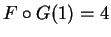 .
.
- F(x)
 ; G(x).


They are equal.
- Let
 . Find examples of functions for each of the parts below. Find algebraic expressions for the functions. You may wish to use algebraic equations taken mod
  to construct your functions.
Do not list ordered pairs of elements, or the identity function for any of your answers.
to construct your functions.
Do not list ordered pairs of elements, or the identity function for any of your answers.
- Find
 such that
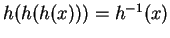 .
Let
.
Let 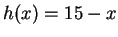 .
.
- Find
 such that
 , and is not a constant function.
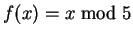
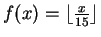
- Find
 such that
 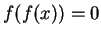 , but
, but
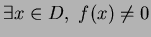 .
.
Next: About this document ...
Chang Hu
2006-05-09
Web Accessibility
