Next: About this document ...
| Name (PRINTED): |
|
| Student ID #: |
|
| Section # (or TA's: |
|
| name and time) |
|
|
CMSC 250 |
Quiz #13 |
Wed., Apr. 26, 2006 |
|
Write all answers legibly in the space provided. The number of points
possible for each question is indicated in square brackets - the total
number of points on the quiz is 30, and you will have exactly 15 minutes
to complete this quiz. You may not use calculators, textbooks or any other
aids during this quiz.
Note: you only need to take the answer as far as a mathematical expression including addition, subtraction, multiplication, division, exponents and factorials.
- [12 pnts.] For each of the following give a function that meets all of the criteria stated - if something is not specified, you can take either. If it is not possible, write ``NOT POSSIBLE''.
-
 such that f is one-to-one and onto.
-
 such that g is onto.
-
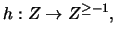 such that h is onto.
-
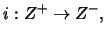 such that i is one-to-one.
TURN OVER
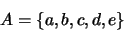
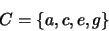
For the questions on this page - consider the sets:
- [9 pnts.] For each of the following - state ``not a function'' if it is not a function at all, ``not a total'' if it is not a total. Otherwise, if it is a total function you must state either ``ONTO'' or ``NOT ONTO'' as appropriate.
-

-

-

- [9 pnts.] For each of the following - state ``not a function'' if it is not a function at all, ``not a total'' if it is not a total. Otherwise, if it is a total function you must state either ``ONE-TO-ONE'' or ``NOT ONE-TO-ONE'' as appropriate.
-
-
-
Next: About this document ...
Chang Hu
2006-04-25
Web Accessibility