next up previous
Next: About this document ...

Name (PRINTED):

Student ID #:

Section # (or TA's:
name and time)  


CMSC 250 Quiz #5 Wed., Feb.. 22, 2006


Write all answers legibly in the space provided. The number of points possible for each question is indicated in square brackets - the total number of points on the quiz is 30, and you will have exactly 20 minutes to complete this quiz. You may not use calculators, textbooks or any other aids during this quiz.
  1. [6 pnts.] Use an Euler diagram to determine if each of the following represents an invalid argument. Make sure to label the parts of the diagram. If the argument is valid, draw any diagram where the premises and conclusion are all true.

    Some rational numbers are not integers. No positive integers are irrational numbers.
    Pi is not a rational number. No positive integers are negative integers.
    ----- -----
    therefore: Pi is not an integer. therefore: No irrational numbers are negative integers.
       
    Circle One: Valid Invalid Circle One: Valid Invalid


  2. [10 pnts.] For each of the following, translate the argument to symbolic notation using quantification. The quantification must indicate that the objects come from the domain ``U'' which includes all things. Then tell if the argument given matches the form: Universal Modus Ponens, Universal Modus Tollens, or NONE (if it matches neither). You must use a universal quantifier if at all possible since that is the only way it could directly match one of these argument forms.

    Premises: All students like to do logic problems.  
      Bob is a student.  
      ------------ ---------
    Conclusion: Bob likes to do logic problems.  
    Argument Form:
     
    Premises: All even integers are equal to 2 times another integer.  
      24 is equal to 2 times another integer.  
      ------------ ---------
    Conclusion: 24 is an even integer.  
    Argument Form:
     

    $\downarrow$ TURN OVER $\downarrow$

  3. [14 pnts.] For each of the following prove that it is a Valid Argument by telling what rules would need to be applied. You may assume $a$ and $b$ are an elements in D.

    1. P1 $\forall x \in D, P(x) \rightarrow (Q(x) \wedge R(x))$
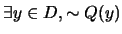
      P2 $\exists y \in D, \sim Q(y)$
      P3 $\forall z \in D, P(z) \vee S(z)$
        $ --------------$
        therefore $\exists x \in D,S(x)$

      Line # Logical Statement Name of Rule Line Numbers Used
      1      
             
      2      
             
      3      
             
      4      
             
      5      
             
      6      
             
      7      
             
      8      
             
      9      
             
      10      
             

    2. P1 $\forall x \in D, (P(x) \wedge Q(x)) \rightarrow R(x)$
      P2 $\exists x \in D, \sim (R(x) \vee M(x)) $
      P3 $\forall x \in D, (M(x) \vee G(x)) \rightarrow F(x)$
      P4 $\forall x \in D, \sim F(x) \vee Q(x)$
        $ --------------$
        therefore $\exists x \in D, P(x) \rightarrow \sim G(x)$

      Line # Logical Statement Name of Rule Line Numbers Used
      1      
             
      2      
             
      3      
             
      4      
             
      5      
             
      6      
             
      7      
             
      8      
             
      9      
             
      10      
             
      11      
             
      12      
             
      13      
             
      14      
             
      15      


next up previous
Next: About this document ...
Chang Hu 2006-02-22

Web Accessibility