|
Adi Acharya
I'm a recent Ph.D. graduate in Computer Science from the University of Maryland, College Park, advised by Prof. David Mount.
In my previous life, I was a lecturer in Computer Science at the University of Maryland, a computational scientist at IISc Bangalore, and an electrical engineer at IIT Kharagpur. |

|
ResearchMy research primarily lies in the field of computational geometry and topology, with a strong emphasis on theoretical foundations and their practical applications in machine learning. As of late, I have been working towards the development of efficient algorithms and optimized frameworks for analyzing high dimensional categorical and stochastic data. |
|
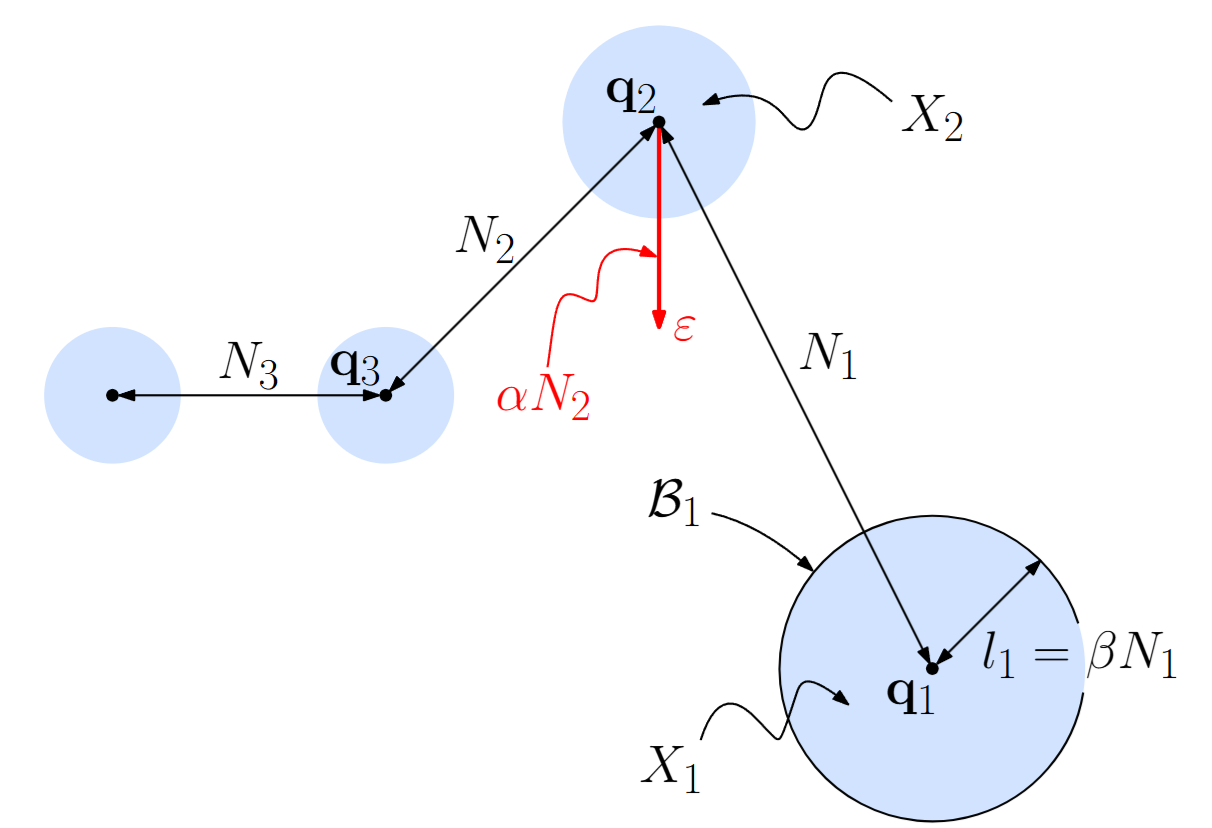
Evolving Distributions Under Local Motion
Aditya Acharya, David Mount 19th International Symposium on Algorithms and Data Structures (WADS 2025) We study algorithms for maintaining hypotheses of large, dynamically evolving geometric datasets, where objects move in d-dimensional space and their locations are uncertain. Using a motion model where each object's movement is limited by its nearest neighbor, we provide an algorithm that maintains a close approximation (measured by KL-divergence) to the true state, and prove its asymptotic optimality. Industry & AI/ML Impact: Provides a rigorous algorithmic framework for tracking dynamically shifting data distributions, addressing the critical challenge of concept drift. By leveraging KL divergence guarantees, this work enables machine learning models to maintain highly accurate representations in environments where data evolves continuously, which is essential for real time analytics and autonomous systems. |

|
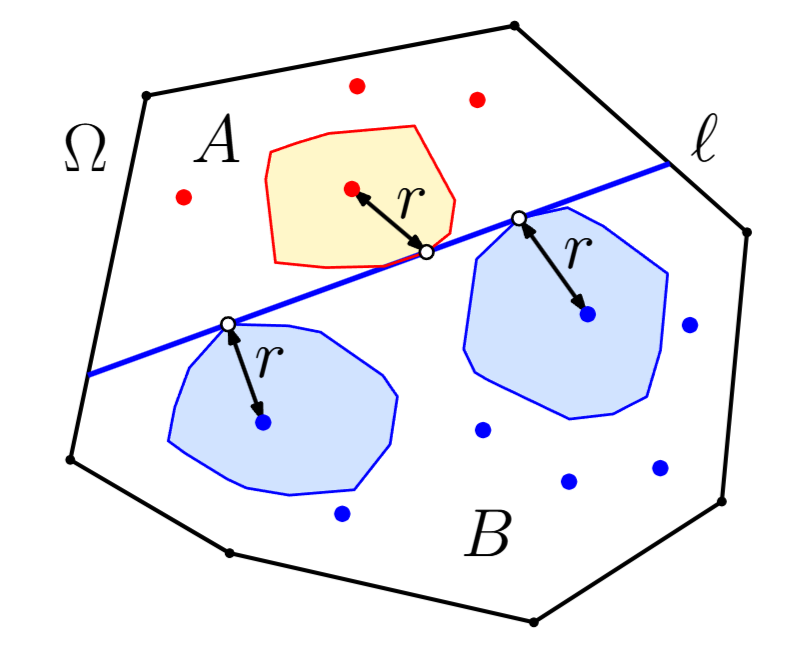
Classifiers in High Dimensional Hilbert Metrics
Aditya Acharya, Auguste H. Gezalyan, David Mount 20th Scandinavian Symposium on Algorithm Theory (SWAT 2026) We address classifying points in high dimensional Hilbert polygonal metric, a hyperbolic metric that has a diverse range of applications in machine learning and convex geometry. We present an efficient LP-based algorithm for the large-margin SVM problem, that runs in time polynomial to the number of points, bounding facets, and dimension. This is a significant improvement on previous works, which either provide no theoretical guarantees on running time, or suffer from exponential runtime. We also present efficient algorithms for the soft-margin SVM problem. Industry & AI/ML Impact: Advances large margin classification techniques for data constrained to bounded domains, such as probability simplices. Formulating a polynomial time SVM in a non-Euclidean, hyperbolic space allows for more accurate, computationally efficient classification of categorical and probabilistic data compared to standard Euclidean approaches. |
|
SVM problem in the Hilbert metric
Aditya Acharya, Auguste H. Gezalyan, Julian Vanecek, David M. Mount, and Sunil Arya 19th International Symposium on Algorithms and Data Structures (WADS 2025) We study the linear SVM problem in the Hilbert metric, a non-Euclidean geometry over convex bodies. We present efficient algorithms for SVM classification in this setting, for convex polygons in the plane and polytopes in higher dimensions, and also consider related problems in the Funk distance. Industry & AI/ML Impact: Extends the theoretical foundations of Support Vector Machines into non-Euclidean geometries. This is highly relevant for specialized machine learning tasks where alternative metric spaces improve margin maximization, model robustness, and feature representation. |
|
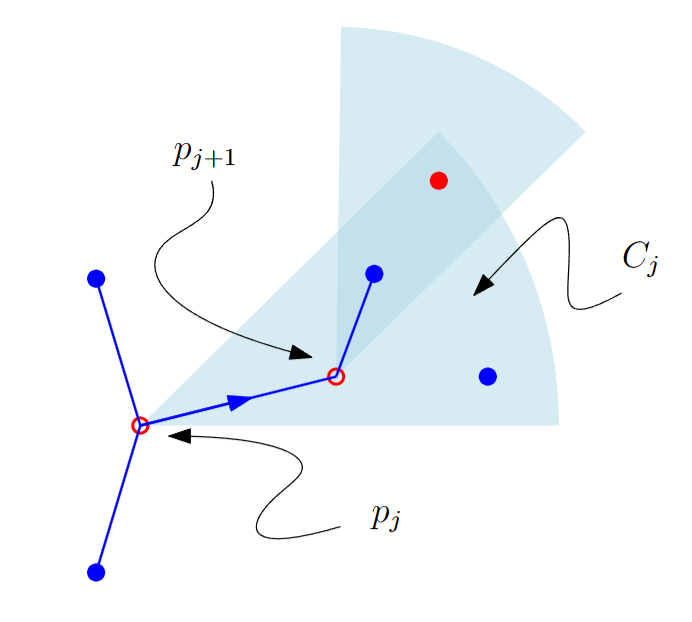
Tracking Evolving labels using Cone based Oracles
Aditya Acharya, David Mount Young Researchers Forum at The 39th International Symposium on Computational Geometry (SoCG 2023) The evolving data framework studies algorithms that maintain an approximate sketch of a structure as it changes over time. We focus on tracking labeled nodes in the plane, where labels can be swapped by an unseen evolver, and updates require physically moving them. Applications include tracking disease hot-spots and UAVs. Our approach uses an Oracle to guide efficient updates over a sparse graph. Industry & AI/ML Impact: Introduces efficient methods for tracking discrete labels in dynamic environments. This directly translates to spatio-temporal machine learning, multi-agent tracking systems, and dynamic graph neural networks where node features or labels undergo continuous updates. |
|
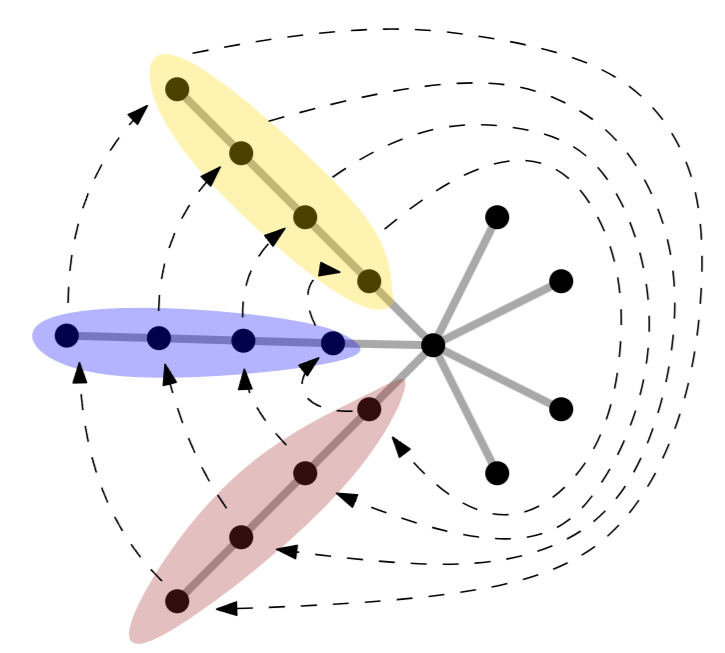
Optimally Tracking Labels on an Evolving Tree
Aditya Acharya, David Mount 34th Canadian Conference on Computational Geometry (CCCG 2022) We establish a novel framework for evolving geometric data. In this framework, we study maintaining labels on tree vertices as they evolve over time. Our results show the algorithm keeps labels close to their true locations, with nearly matching lower bounds. Industry & AI/ML Impact: Solves tracking optimization problems on tree structures. This is directly applicable to maintaining dynamic hierarchical clustering models and decision trees, allowing hierarchical machine learning frameworks to adapt instantly to streaming data without requiring a full model retrain. |
Pre PhD Research |
|
|
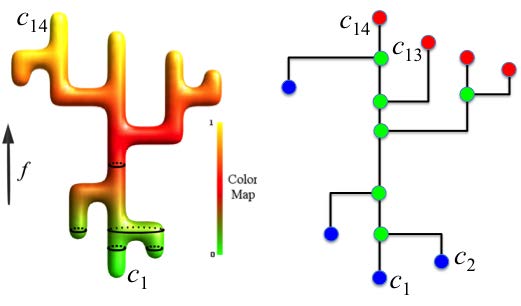
A Parallel and Memory Efficient Algorithm for Constructing the Contour Tree
Aditya Acharya, Vijay Natarajan IEEE Pacific Visualization Symposium 2015 The contour tree is a topological structure that tracks the connectivity of level sets in a scalar function, supporting visual exploration and analysis. This paper presents a fast, parallel, and memory-efficient algorithm for constructing contour trees on large datasets, outperforming existing methods in speed and memory usage. Industry & AI/ML Impact: Delivers a highly scalable, parallel algorithm for topological data analysis. Efficient topological feature extraction is increasingly vital in deep learning pipelines for capturing the complex structural properties of large scale datasets. |
|
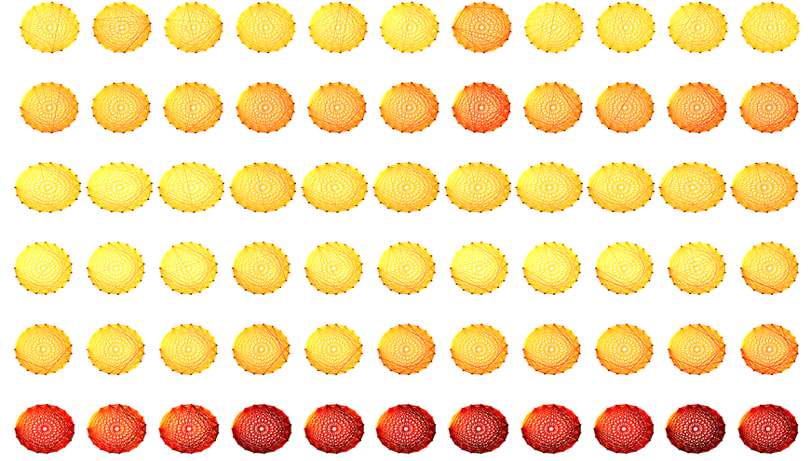
Phase Synchronization based Weighted Networks for Classifying levels of Fatigue and Sleepiness
Aditya Acharya, S.Kar, A.Routray IEEE International conference on systems in medicine and biology, 2010 This paper analyzes EEG signals during 36 hours of sleep deprivation using phase synchronization. Weighted networks are built from EEG data at different wavelet levels, and network parameters are tracked to study brain integration and segregation. Some parameters show clear patterns in specific frequency bands as sleepiness and fatigue increase. Industry & AI/ML Impact: Demonstrates applied machine learning and feature engineering in the healthcare and bioinformatics domain. Extracting phase synchronization features from time-series EEG signals enables the construction of robust predictive models for cognitive state classification and fatigue monitoring systems. |
|
Based on a modified version of Jon Barron's website. |