EPIC-KITCHENS-100verb · noun · action
1University of Maryland, College Park2Carnegie Mellon University3Massachusetts Institute of Technology
NeurIPS 2026
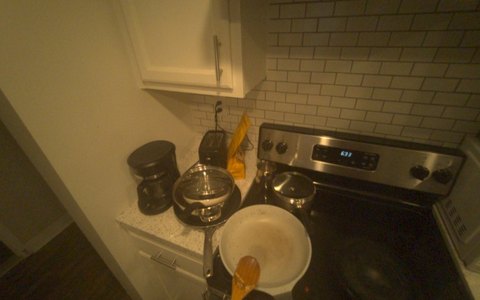
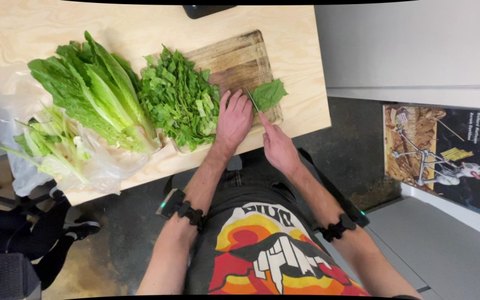
Computer vision models learn hand action only from its visual consequences, without access to the underlying embodied motor signals. We address this absence with MotorSense - the first large-scale paired egocentric video and surface electromyography (EMG) dataset. MotorSense pairs bimanual EMG bands with egocentric video and yields synchronized video, bimanual EMG and IMU, and audio across 100 hours of unscripted manipulation.
EMG offers a powerful scalable alternative to manual annotation: it captures finger movement, hand configuration, and the forces exerted between hand and environment as a dense signal free of occlusion and labeler bias, whereas manual annotation is costly, subjective, and unreliable under occlusion.
We use MotorSense to learn sensorimotor alignment, producing an organization of action that is shared across the visual and motoric spaces, through cross-modal pre-training between video and EMG. The resultant vision models are then transferred to downstream tasks that benefit from sensorimotor alignment: in this case, action recognition, 3D hand reconstruction, and 3D contact reconstruction.
We further demonstrate a generative application in which EMG motor signals are used to condition a video diffusion model, yielding videos of fine-grained hand manipulation. Across four action-centric computer vision tasks and seven popular video datasets, we demonstrate that sensorimotor alignment provides a stronger foundation for visual representation learning than conventional self-supervised learning methods over video, outperforming every reproducible baseline across all tasks and datasets evaluated.
Two eight-channel MindRove armbands record forearm EMG and IMU signals. Project Aria glasses or a head-mounted smartphone record egocentric video.
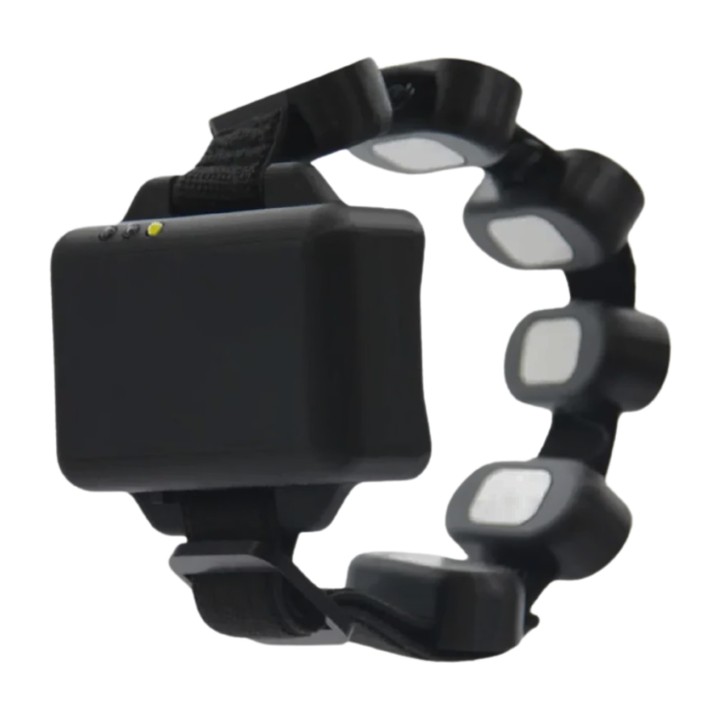
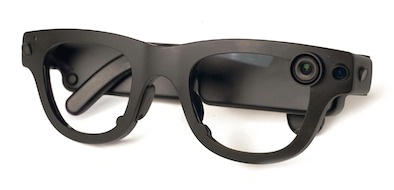
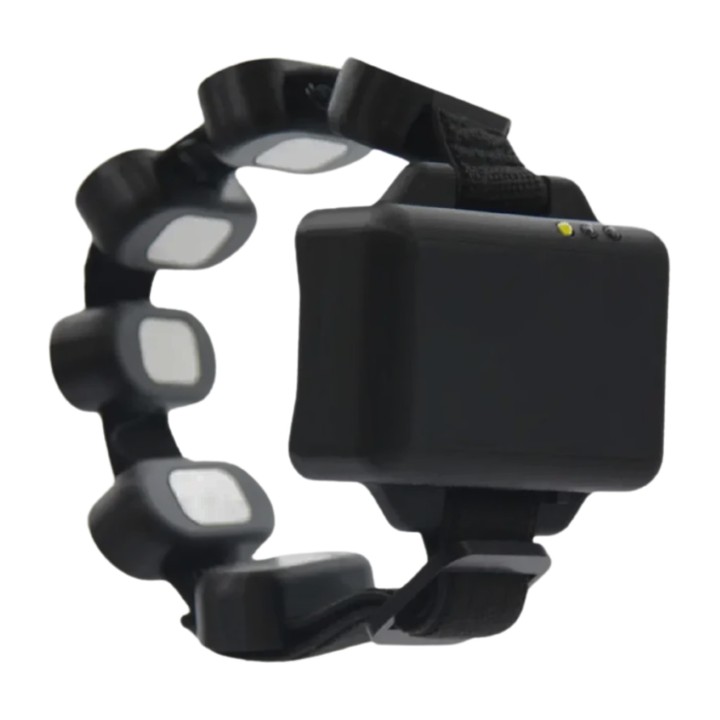
Product images: MindRove; Meta Project Aria.
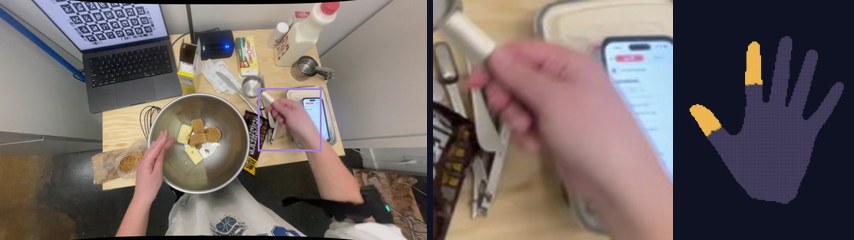
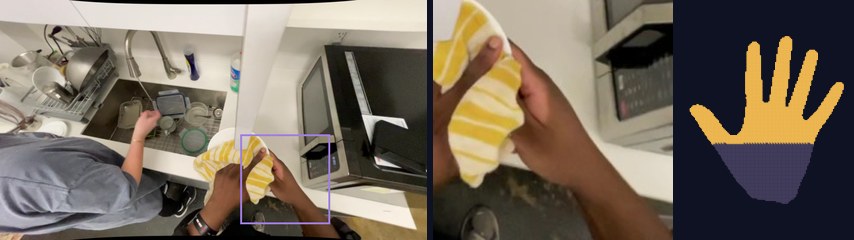
The dataset includes synchronized egocentric video, bimanual forearm EMG and IMU, camera timestamps, and hand bounding boxes.
| Stream | Description | Rate | Coverage |
|---|---|---|---|
| Egocentric video | RGB frames from a head-mounted camera | 10–30 fps | 5.97 M frames · 370 recordings |
| Surface EMG | 8 dry electrodes around each forearm, both arms | 500 Hz | all recordings |
| IMU | 3-axis accelerometer + 3-axis gyroscope in each armband | with EMG | all recordings |
| Camera timing & pose | 6-DoF device pose for Aria recordings | per frame | all recordings |
| Hand boxes | Left and right hand bounding boxes in frame pixels | per frame | all recordings |
| Action segments | Verb–noun segments with the acting hand, EPIC-KITCHENS-100 format; 57 verbs, 180 nouns | temporal | 10,418 segments · 85 recordings |
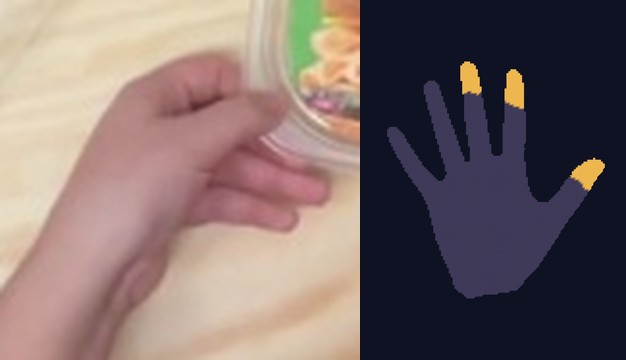
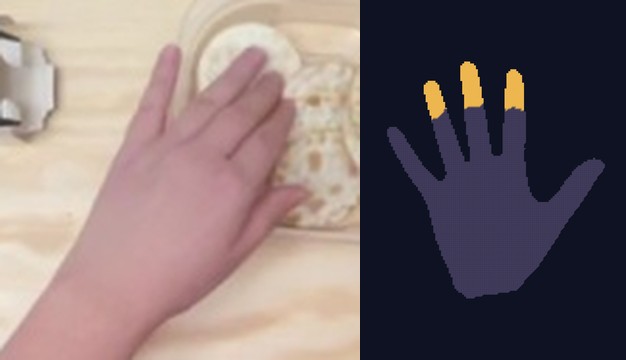
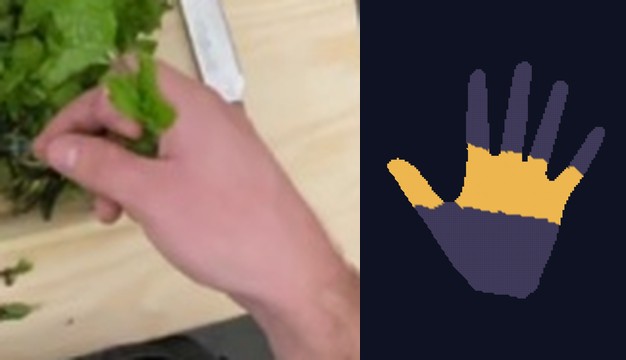
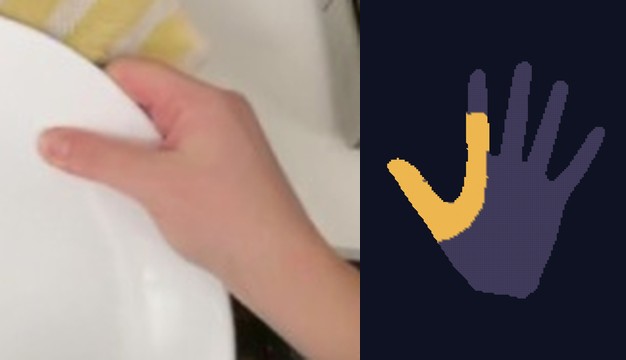
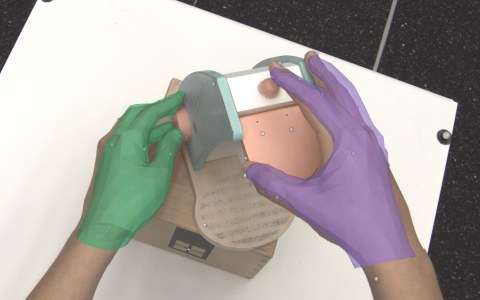
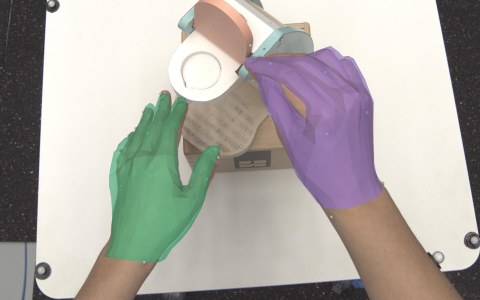
| Hand contact | Per-hand contact intervals with the touched vertices of a 6,173-vertex hand, or no contact | temporal | 9,400 intervals · 57 recordings |
| Capture setup | Recordings | Frame rate | Frame resolution |
|---|---|---|---|
| Project Aria Gen 1 glasses (rectified) | 18 | 15 fps | 704 × 704 |
| Project Aria Gen 2 glasses (rectified) | 19 | 10 / 30 fps | 1280 × 960 / 1008 × 756 |
| Head-mounted smartphone (ultra-wide) | 333 | 30 fps | 896 × 504 |
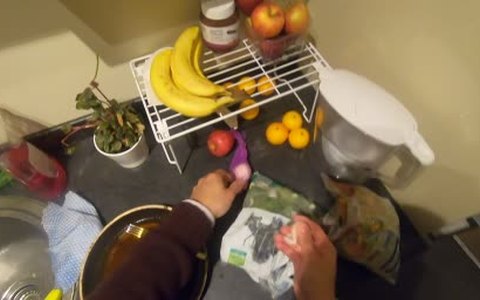
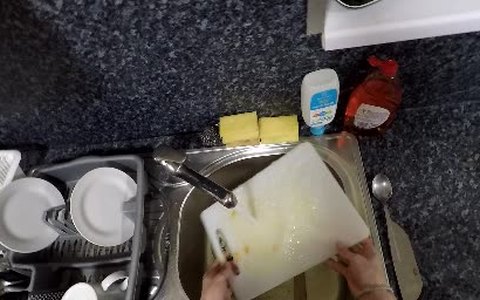
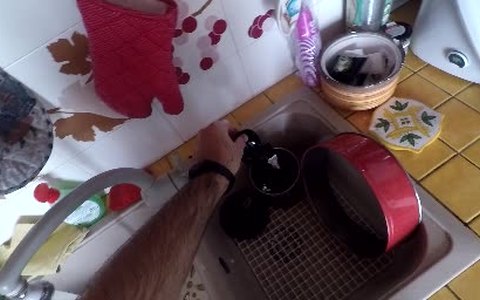
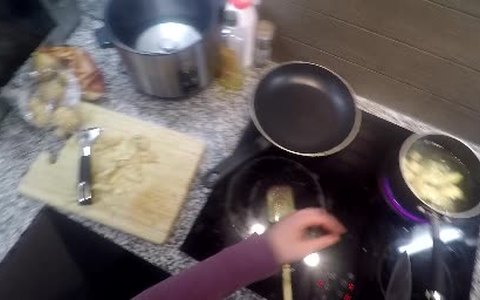
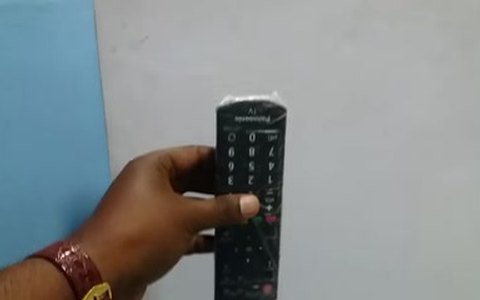
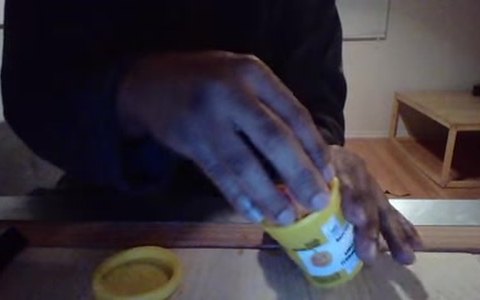
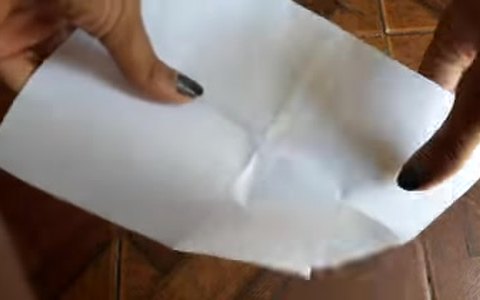
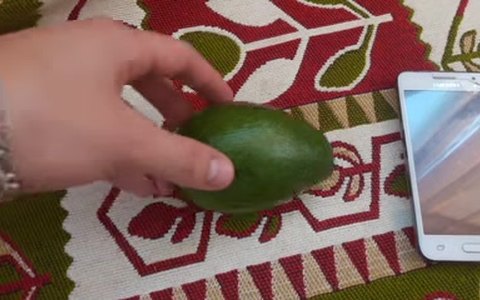
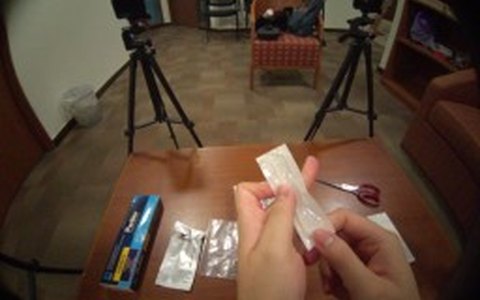
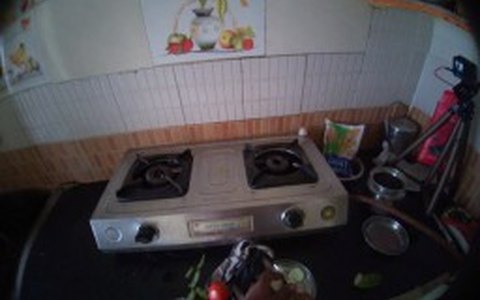
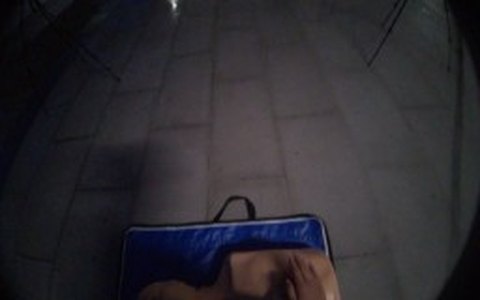
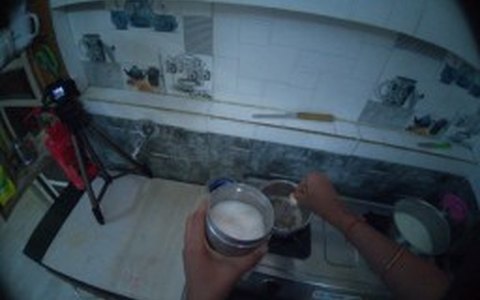
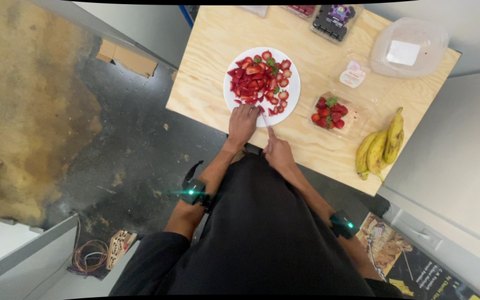
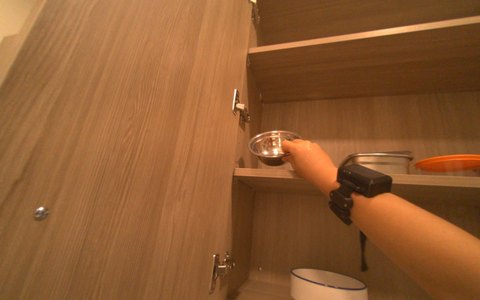
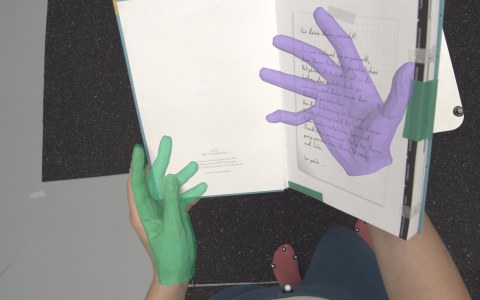
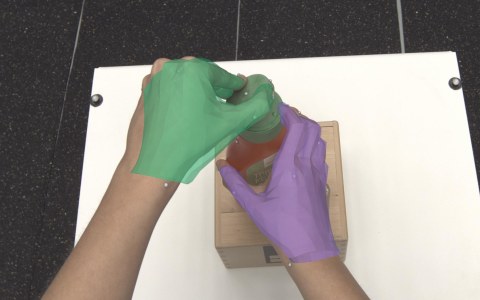
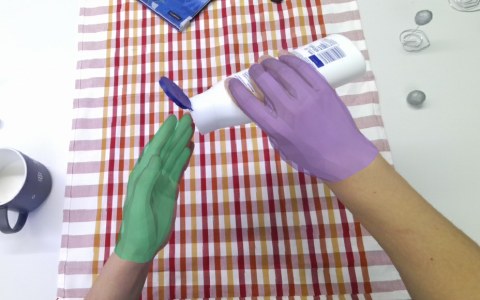
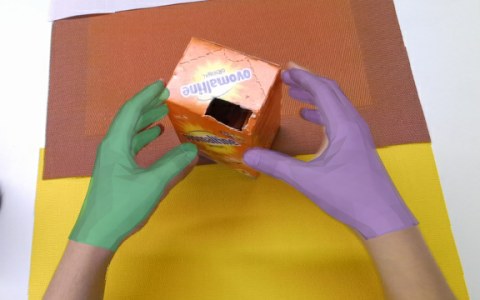
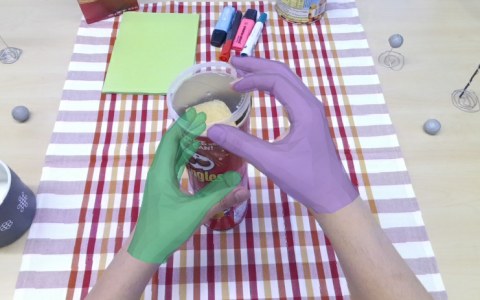
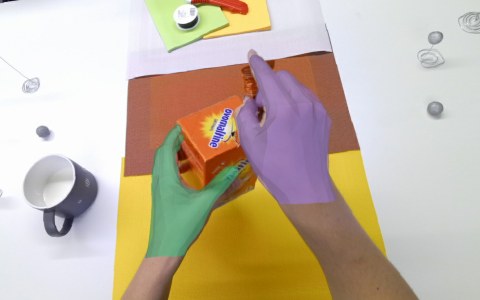
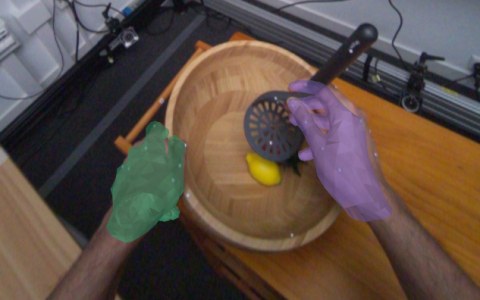
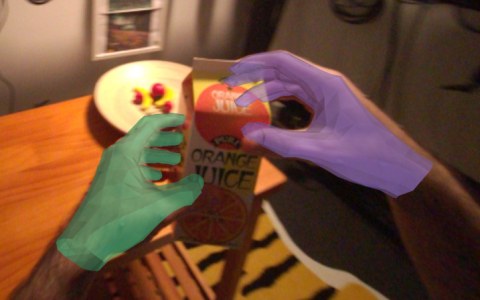
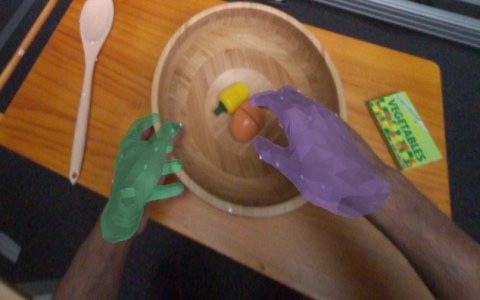
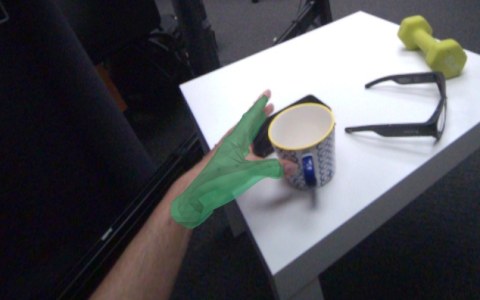
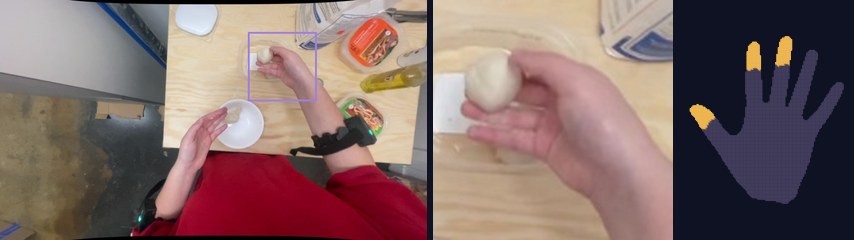
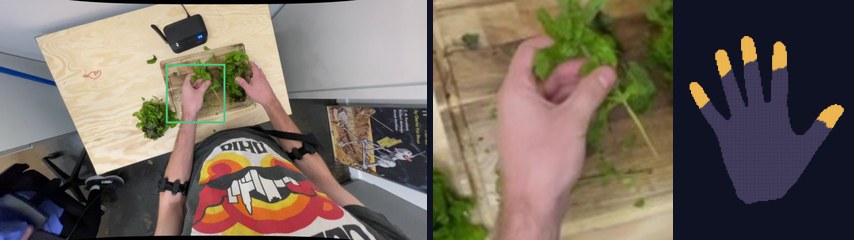
Sample clips from different participants and recording sessions. Each clip shows synchronized video and left- and right-forearm EMG across eight channels per arm.
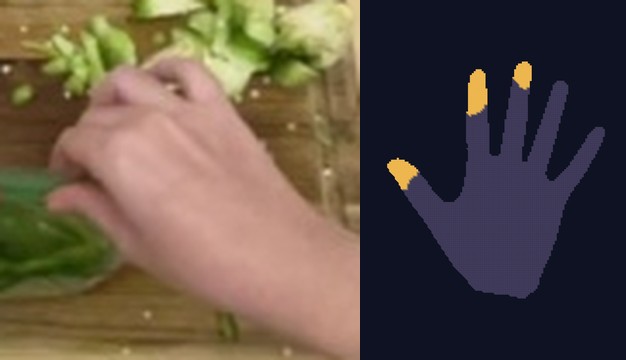
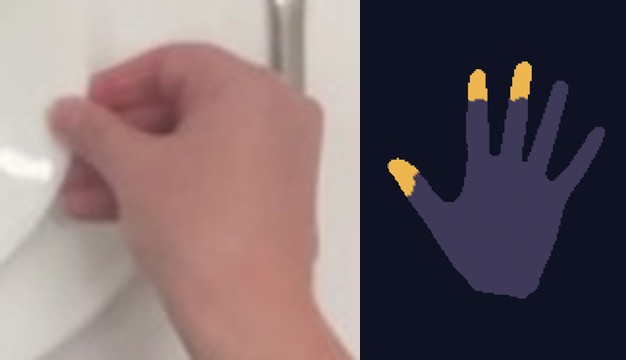
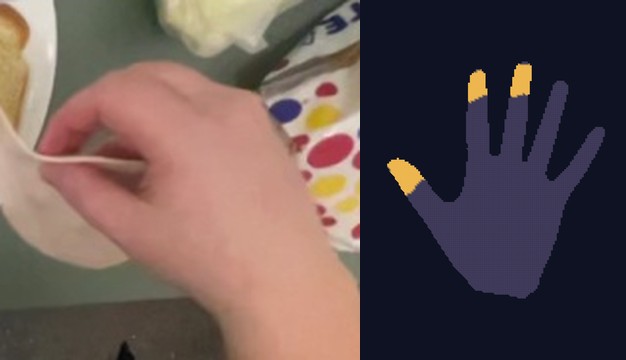
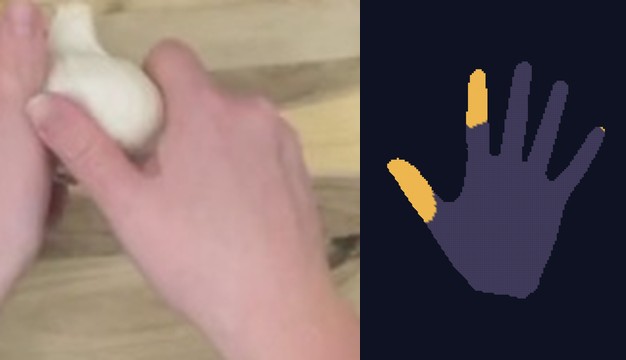
Verb–noun action segments in the EPIC-KITCHENS-100 format, and per-hand contact intervals that mark which vertices of a reference hand touch an object.
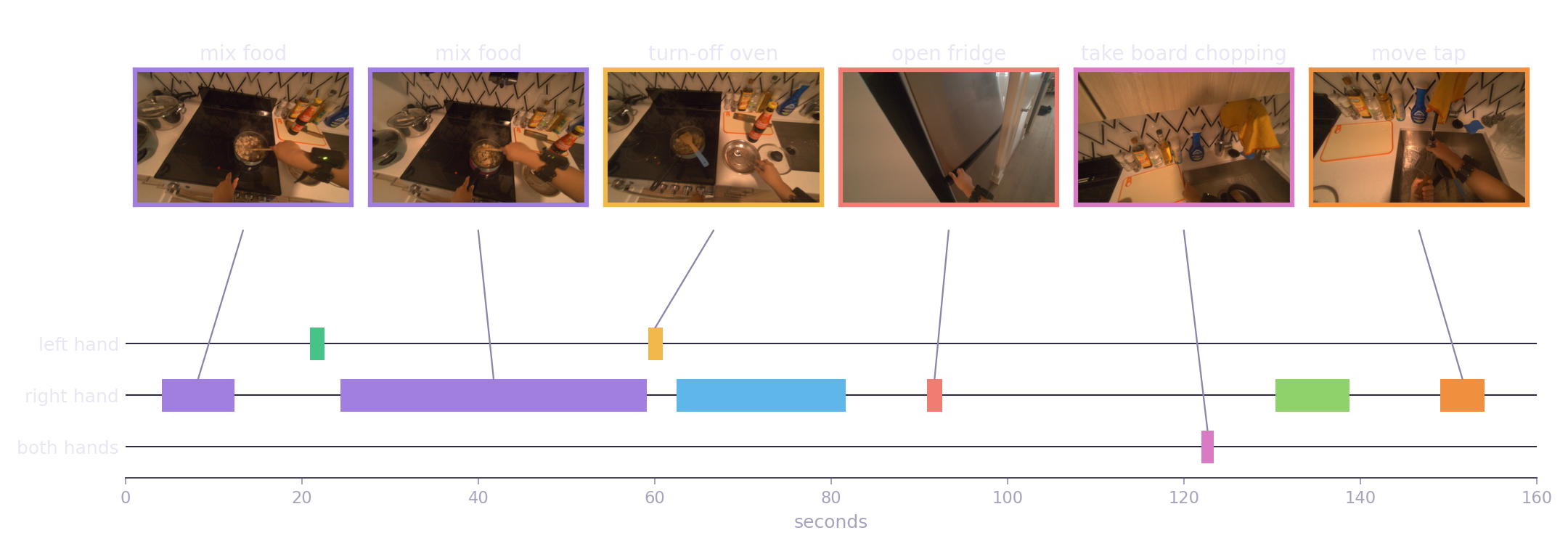
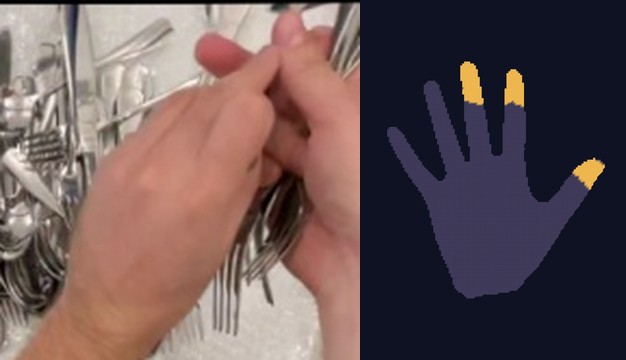
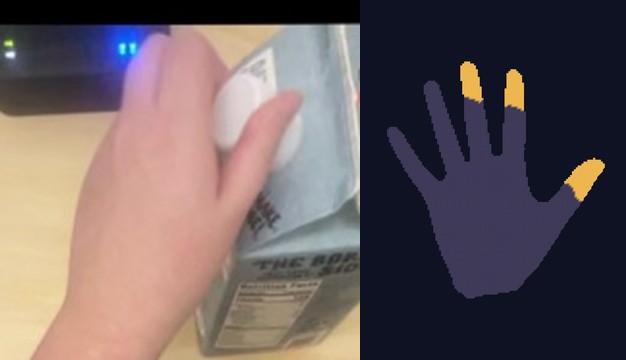
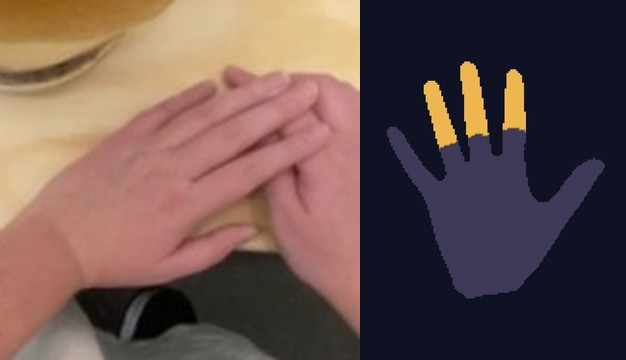
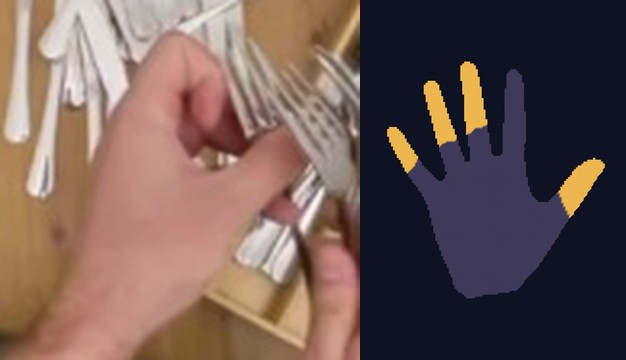
A contrastive objective aligns video and EMG embeddings from synchronized temporal windows. EMG is used during pre-training; downstream models use the video encoder.
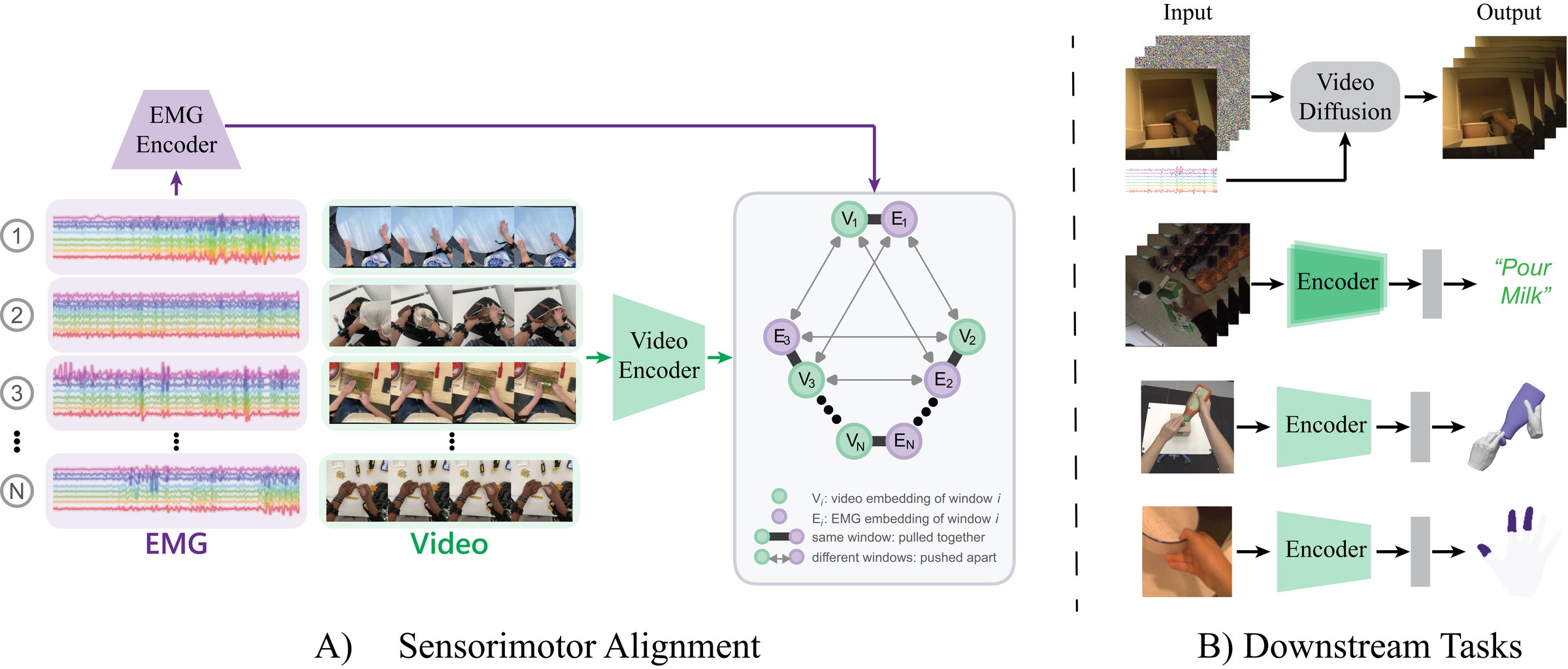
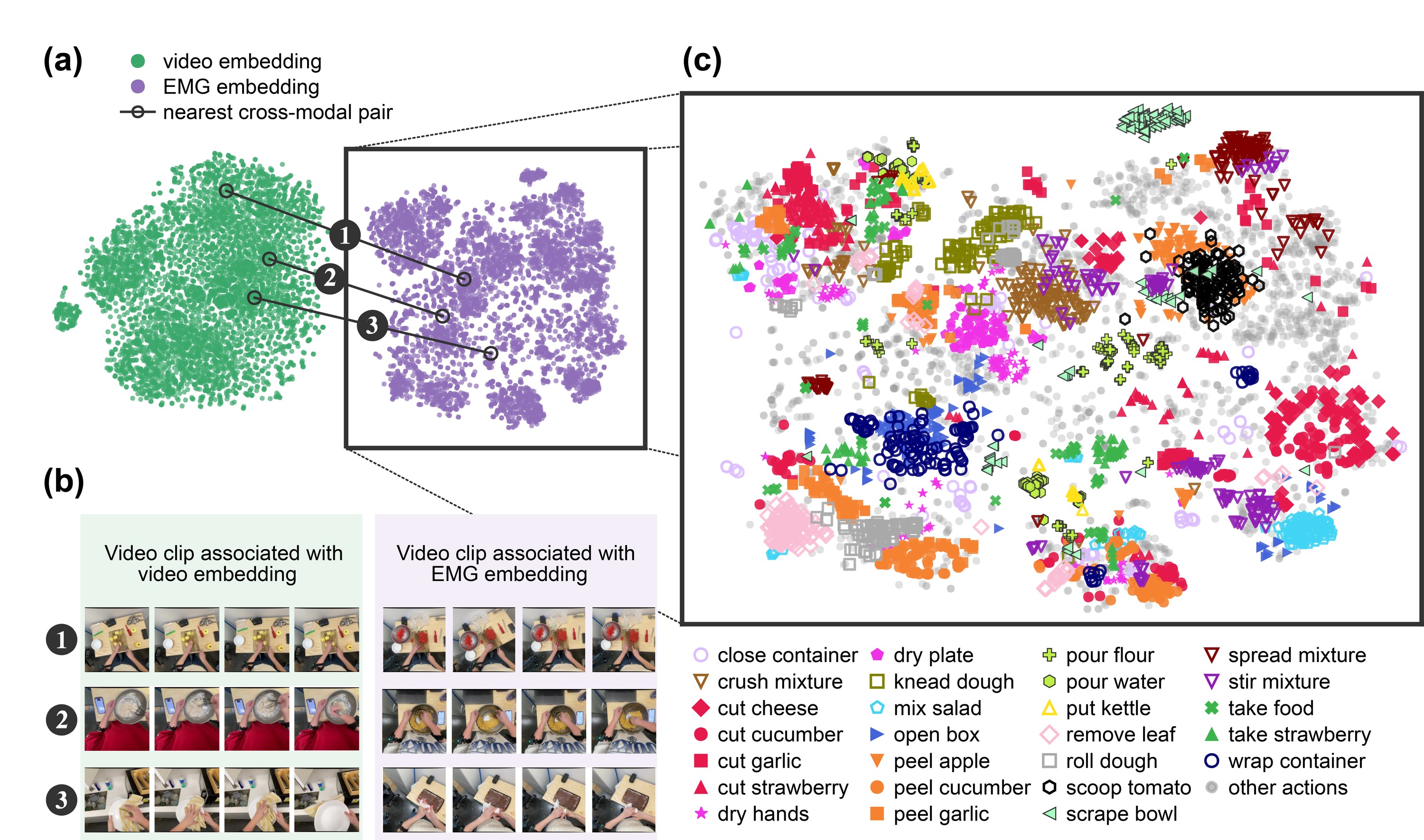
The pre-trained video encoder is fine-tuned or probed on each benchmark. Baselines use the initial encoder weights or RGB-only self-supervised pre-training on the same videos.
@inproceedings{dessalene2026motorsense,
  title     = {{MotorSense}: A Video-{EMG} Dataset of Motoric Representations for Action Understanding},
  author    = {Dessalene, Eadom and Maynord, Michael and Shahidzadeh, Amir-Hossein and He, Botao and Tabatabaee, Yasamin and Liu, Ruoshi and Gao, Ruohan and Liang, Paul Pu and Aloimonos, Yiannis},
  booktitle = {Advances in Neural Information Processing Systems (NeurIPS)},
  year      = {2026},
  url       = {https://arxiv.org/abs/2610.41127}
}
We thank Trace Labs for their help collecting data for MotorSense.