


The above experiments could not be done in the 17th century because of the lack of filters and light dimmers and photographic film. But the following one could have - and in essence it was.
If light coming from the left falls on a wall with one small hole and then whatever light gets through the hole falls on a second wall, one sees on the second wall (if there is no other source of light in the room) not just a single spot of light but rather a pattern of concentric light and dark regions, with the brightest being directly opposite the hole:
                           |                               *|  dark
                           |                             ***| bright
=====>                     |                               *|  dark
=====>                   hole                          *****|brightest
=====>                     |                               *|  dark
=====>                     |                             ***| bright
                           |                               *|  dark
It is a bit surprising that one gets dark areas and then lighter ones further from the center. But if we suppose light is a wave something like a water wave, and the first wall is a seawall that protects the beach (second wall) from the waves, then a hole in the seawall will in fact produce a series of smaller waves at the hole, that spreads out and hits the beach with points of more intensity and others of less intensity, just as in the above diagram. In fact, this can be explained mathematically in terms of peaks and troughs in the spreading waves; the math is simple trigonmetry.
So it seems that the wave-theory wins out here. In fact, it is even more dramatic. If we now put a second hole in the wall, close to the first, we get an even more surprising pattern, where some regions that had been bright are now dark! It is hard to see how, if light were little particles, opening another hole could prevent particles from hitting a place on the second wall where they had been going before. But the wave theory explains this in terms of more troughs and peaks, that can actually interfere with one another, just as with water waves.
But, if we now start to dim the light (this won't work with water! - and it was not do-able in the 17th century) we get a different surprise: we can dim the light as before so that only one light ``bundle'' arrives every hour - and we can check this by replacing the second wall with a photographic film. Now we only get one individual dot of brightness per hour, always the same intensity, but at lots of places as the hours go by. And if we graph all the results, we get back the exact same picture as above! So now what are we to think? The bundles seem very different from water waves, they do not appear to spread out, they do not have different intensities at different places. And yet, taken all together, they have a group behavior very much like water - even when they are an hour apart from each other! Some scientists have speculated that each bundle does manage to spread out somehow, in fact splits and goes through each of the two holes and then interferes with itself (or its twin) as it (or they) get back together again upon hitting the second wall. This is pretty wild stuff, and no one really knows. But the mathematics that has been developed in quantum mechanics is a kind of description that sounds very much like this speculation, and that very accurately allows prediction of what is observed, not only in this case but also for polarized light, for electrons, protons, entire atoms, and far more.
Let us state some lessons.
1. Observation of a system can sometimes change it so that a property (eg polarization) has a value (eg vertical) it did not have before. This seems clearly to have happened in the case of polarized light, where fully 50% of it passes through even though far less than 50% already had the correct polarization for the filter. In fact, 50% can get through even when none of the light has the correct polarization, as in the case of the 45-degree filter placed behind the vertical one. And yet the system does not always change: if we place a second vertical filter after the first vertical filter, the second filter introduces no changes.
2. We cannot predict just where a given light bundle will end up, but we can predict the pattern that large numbers of them will make. That is, we can state probabilities, and hence expected values, for where they end up.
Now let us move ahead a bit, to a theory that was developed in the 20th century, largely due to work of Einstein and of Schrodinger.
Einstein, and before him Planck, worried about an experimental result
that was hard to explain: when zinc is exposed to ultrviolet light,
electrons shoot out of the metal. This alone is not so surprising;
but if the intensity of the light is changed (ie we dim it!), the rate
of electrons (how many per second) changes but not how fast they
move. It is as if the light always contributes a fixed unit of energy
(or momentum) to an electron, no matter how dim the light is. This
seems to say that the light passes on energy to the metal in fixed
bundles. Planck argued that light energy is absorbed in special
energy bundles he called quanta; to mathematically explain the
precise experimental data he needed to introduce a special constant,
 , called Planck's constant, that gave precise meaning to these
bundles of energy. Specifically he posited
, called Planck's constant, that gave precise meaning to these
bundles of energy. Specifically he posited  where
where  is the
energy of each energy bundle, and
is the
energy of each energy bundle, and  is the frequency of the light
wave (related to the wavelength
is the frequency of the light
wave (related to the wavelength  by
by
 ).
).
Einstein went further, taking the results to be evidence that light always consists of little fixed bundles of energy, even when it is not hitting a zinc plate. We also saw this idea of light bundles in all the other cases of dimmed light above, but this one is more dramatic since it also involves a generally accepted kind of particle, the electron, with a known mass. And this new work of Planck and Einstein also had mathematical details that related light bundles to energy in a precise way. (Note that this work of Einstein - which incidentally won him the Nobel Prize - is not his relativity theory at all, but rather quite different work.)
So it seems that light does consist of particles, but ones that obey
strange rules, rules that give them a wavelike behavior when very very
many of the light particles are looked at, so that statistical
summaries of all of the behaviors can be used. Others then began to
postulate such wavelike behavior in all particles, not just light
particles (now called photons); de Broglie in particular argued that
there is a precise relation between the momentum  of an electron
and its associated wavelength (the wavelength of its wavelike
behavior, fuzzy as that notion is):
of an electron
and its associated wavelength (the wavelength of its wavelike
behavior, fuzzy as that notion is):
 . And such
wavelike behaviors for particles were found, in glorious
accuracy. Specifically, much the same experiments as above for light
were done for electrons, with much the same results. So
here we see a prime example of fuzzy conceptual underpinnings and yet a
precisely measured phenomenon.
. And such
wavelike behaviors for particles were found, in glorious
accuracy. Specifically, much the same experiments as above for light
were done for electrons, with much the same results. So
here we see a prime example of fuzzy conceptual underpinnings and yet a
precisely measured phenomenon.
Schrodinger next wondered what the strange rules might be that give rise to such wavelike behavior. What sort of mathematical representation might work for particles (photons, electrons, whatever), allowing precise expression of these rules so they could be compared to experimental data? He proposed a ``wave function'' that is, essentially, just a mathematical expression that has variables for position (x y z) and time (t), and that varies in a wavelike way, eg with sines and cosines. An example is easy to construct, and in fact in an elegant way using the identity
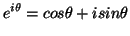
where
 . This simple case of a wavefunction has the form

Here  ,
,  , and the
  's are special constants. The 's in
particular have a wave-like interpretation in accord with the de
Broglie equation above: The three 's together form
a multiple of the momentum vector
's are special constants. The 's in
particular have a wave-like interpretation in accord with the de
Broglie equation above: The three 's together form
a multiple of the momentum vector
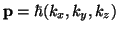 .
(Here
.
(Here  is
is  where is Planck's constant.)
Now this is well and good, but without rules it does little
good. Schrodinger noted that if we take the derivative of  with
respect to, say,
with
respect to, say,  , we get

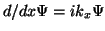
 is just
  times the -component
  of
momentum, and since
of
momentum, and since  , then
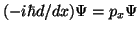
This is a simple case of the famous time-independent Schrodinger
equation, or TISE. It tells us that an actual physically observable
quantity, momentum (in the -direction), can be computed from the
wavefunction. And it
is computed by means of an operator -
 - that is
applied to the wavefunction, to yield back both the observable
quantity (the momentum in this case) and again.
- that is
applied to the wavefunction, to yield back both the observable
quantity (the momentum in this case) and again.
An equation of the form
 is
called an eigenvalue equation. Usually the operator is fixed and we
look for functions (so-called eigenfunctions) and constants
(eigenvalues) that make the equation true. But typically an eigenvalue
equation has more than one possible solution (ie more than one
eigenfunction and eigenvalue pair). This will play a key role below.
is
called an eigenvalue equation. Usually the operator is fixed and we
look for functions (so-called eigenfunctions) and constants
(eigenvalues) that make the equation true. But typically an eigenvalue
equation has more than one possible solution (ie more than one
eigenfunction and eigenvalue pair). This will play a key role below.
This brings us to our next lesson:
3. Values  of a physically measurable (or observable) quantity
  of a physical system can be computed by applying an appropriate
mathematical operator
of a physical system can be computed by applying an appropriate
mathematical operator  to the wavefunction for that
system. The result will be times that same wavefunction. This can
be written as a more general version of TISE:
to the wavefunction for that
system. The result will be times that same wavefunction. This can
be written as a more general version of TISE:

But we still have a bit more to describe, before we will be able to give an explanation for phenomena such as the polarized light experiment.