CMSC250, Spring 2004
Homework 2
Due Wednesday, February 11 at the beginning of your discussion section.
You must write the solutions to the problems single-sided on your own lined paper, with all sheets stapled together, and with all answers written in sequential order or you will lose points.
- For each of the following statements, give its converse, inverse, and contrapositive in English sentences; be sure to
label the three parts
of each answer. You may change verb tenses to make your answers sound better.
- ``If one thinks, one must reach conclusions.''1
- ``If you look good and dress well, you don't need a purpose in life.''2
- ``California is a fine place to live if you happen to be an orange.''3
- ``You can be free only if I am free.''4
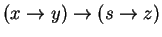
- Construct a complete truth table to help you determine if the following argument is valid or not. State
whether
it is valid or not,
indicate the entries in the truth table that led you to your answer, and explain why
those entries support your answer.
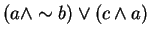
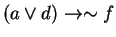
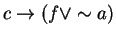
- Use the rules of inference you were given to complete the two proofs below. Use the same format as was shown in class
for these proofs -- each line of your proof must be justfied with the rule and line numbers you used to obtain that line.
-
-
- Indiana Jones, the famous archeologist, is off on another adventure. Indy knows that in all his adventures he always has
three tasks to accomplish: he must get the treasure, save the girl, and defeat the bad guy. However, being a college professor,
Dr. Jones is also a very logical person. In fact, he has developed a set of rules to determine which of his three tasks he
should complete first. The rules are:
- P1
- If Indy is in Europe or South America, he gets the treasure first.
- P2
- If Indy is in Asia or Africa, he saves the girl or defeats the bad guy first.
- P3
- Indy was almost squashed by a rolling boulder if and only if he is in South America or Africa.
- P4
- Indy is in neither Europe nor South America if he falls into a pit of snakes.
- P5
- Indy never defeats the bad guy first if he is in Africa.
Indy can't remember which continent he is currently on, but he does remember that earlier in this adventure he fell into
a pit of snakes and was almost squashed by a rolling boulder. Help him figure out which task he should do first.
You may use the following propositions:
|
|
 |
``Indy is in Europe.'' |
 |
``Indy gets the treasure first.'' |
|
|
 |
``Indy is in Africa.'' |
 |
``Indy saves the girl first.'' |
|
|
 |
``Indy is in South America.'' |
 |
``Indy defeats the bad guy first.'' |
|
|
 |
``Indy is in Asia.'' |
 |
``Indy falls into a pit of snakes.'' |
|
|
 |
``Indy is almost squashed |
|
|
|
|
by a rolling boulder.'' |
|
- Convert each of the rules P1-P5 to symbolic form using only the nine propositions defined above, and the operators
 , and
, and
 .
.
- Convert the statements from the paragraph above into symbolic expressions, using the same nine propositions and the same operators as in
part (a). Continue to list these as premises for your proof -- P6, etc.
- Use the rules of inference you learned in class to determine which of the three tasks Indy should complete first. Be sure
to use the same layout format as was shown in class for logic proofs -- same as in Question 3.
- Which task will Indy do first?
This document was generated using the
LaTeX2HTML translator Version 2002 (1.62)
Copyright © 1993, 1994, 1995, 1996,
Nikos Drakos,
Computer Based Learning Unit, University of Leeds.
Copyright © 1997, 1998, 1999,
Ross Moore,
Mathematics Department, Macquarie University, Sydney.
The command line arguments were:
latex2html -split 0 -nonavigation -antialias -antialias_text hw2
The translation was initiated by Phillip Kirlin on 2004-02-04
Footnotes
- ... conclusions.''1
- Helen Keller (1880-1968)
- ... life.''2
- Robert Pante
- ... orange.''3
- Fred Allen (1894-1956)
- ... free.''4
- Clarence Darrow (1857-1938)
Phillip Kirlin
2004-02-04
Web Accessibility