


Objective
This
class provides an introduction to programming, and does so in the context of
building full-featured web sites. Intended for students with no previous
programming experience who wish to understand the technologies making such
web sites possible, this course will provide a set of practical problem
solving skills necessary for the development of dynamic client-side web
content. The programming approach emphasizes procedural design (e.g.,
pseudocode, stepwise refinement, top-down design) as well as the syntax and
semantics of the JavaScript programming language. At the end of this course,
students will be able to write simple programs to solve their own problems;
understand fundamental issues related to the design and implementation of
web sites using HTML, CSS, and Javascript; have a fundamental understanding
of popular web authoring tools (e.g., Dreamweaver and FrontPage); and have
skills necessary to build their own web pages as portals for integrating
useful applications.
This class provides an opportunity for non-majors who have never done any
computer programming and would like to pick up both practical skills and a
general appreciation of information technology which is emerging at such a
tremendous rate. Topics covered by the course are:
-
HTML, CSS, and JavaScript concepts necessary for dynamic web site development
-
Problem solving in procedural programming languages
-
Object-Oriented concepts necessary for the development of class projects
-
JavaScript Programming language (in detail)
-
Basics of usability and art theory in web page design
-
Fundamentals of web authoring tools
-
Basics of e-commerce and tool integration in the web
Textbook
|
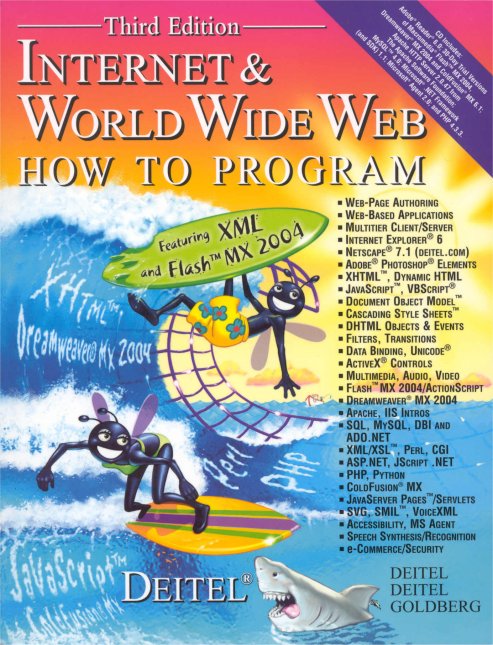
Title: Internet & World Wide Web How to Program Third Edition Author(s): H.M Deitel, P.J. Deitel, A.B. Goldberg ISBN: 0-13-145091-3 |
|
|
Projects
Projects
will be a combination of closed and open projects. Closed projects must be
completed individually whereas for open projects, collaboration is
permitted.
Grading
All projects are due at 6:00 pm on the specified due date. They are to be submitted electronically according to instructions given with the projects. All late projects will have points deducted as follows:
-20% One-day late (No assignments will be accepted after the one-day late period)
Your final grade will be computed using the following contributions:
40% Projects
30% Midterms (three midterms, 10% each)
15% Quizzes
15% Final Exam
Topics
-
Overview of computer languages/computer systems
-
HTML/CSS for dynamic web sites
-
Forms and Events
-
Web authoring tools I
-
Input/output in JavaScript
-
Variables and data types
-
Expressions and operators
-
Conditional statements
-
Iteration statements
-
Design I (pseudocode)
-
Basics of usability and art theory in web page design
-
Debugging and Debugging tools
-
Random values
-
Introduction to functions
-
Global vs. local variables
-
Web authoring tools II
-
Testing
-
1-dimensional arrays
-
Introduction to the JavaScript Object Model
-
Overview of DOM (Document Object Model)
-
Design II (Stepwise Refinement, Top-Down Design)
-
Basics of e-commerce and tool integration in the web
-
Nested Loops
-
2-dimensional arrays
-
Overview of Object-Oriented programming in JavaScript
Academic Honesty
All assignments, quizzes, and exams must be done on your own. Note that academic dishonesty includes not only cheating, fabrication, and plagiarism, but also includes helping other students commit acts of academic dishonesty by allowing them to obtain copies of your work. You are allowed to use the Web for reference purposes, but you may not copy code from any website or any other source. In short, all submitted work must be your own.
Cases of academic dishonesty will be dealt with harshly. Each such case will be referred to the University's Office of Judicial Programs. If the student is found to be responsible of academic dishonesty, the typical sanction results in a special grade "XF", indicating that the course was failed due to academic dishonesty. More serious instances can result in expulsion from the university. If you have any doubt as to whether an act of yours might constitute academic dishonesty, please contact your TA or the course coordinator.
The University of Maryland, College Park has a nationally recognized Code of Academic Integrity, administered by the Student Honor Council. This code sets standards for academic integrity at Maryland for all undergraduate and graduate students. As a student you are responsible for upholding these standards for this course. It is very important for you to be aware of the consequences of cheating, fabrication, facilitation, and plagiarism. For more information on the Code of Academic Integrity or the Student Honor Council, please visit:
http://www.studenthonorcouncil.umd.edu/whatis.html
Excused Absence and Academic Accomodations
Students claiming an excused absence from an exam/quiz must apply in writing and furnish documentary support (such as from a health care professional who treated the student) for any assertion that the absence qualifies as an excused absence. The support should explicitly indicate the dates or times the student was incapacitated due to illness. Self-documentation of illness is not itself sufficient support to excuse the absence. The course coordinator is not obligated to offer a make-up exam unless the failure to perform was due to an excused absence.
It is also the student's responsibility to inform the instructor of any intended absences from exams for religious observances in advance. Notice should be provided as soon as possible.
Any student eligible for and requesting reasonable academic accommodations due to a disability is requested to provide, to the instructor in office hours, a letter of accommodation from the Office of Disability Support Services.