High School Students Compete at UMD’s 36th Annual Programming Contest
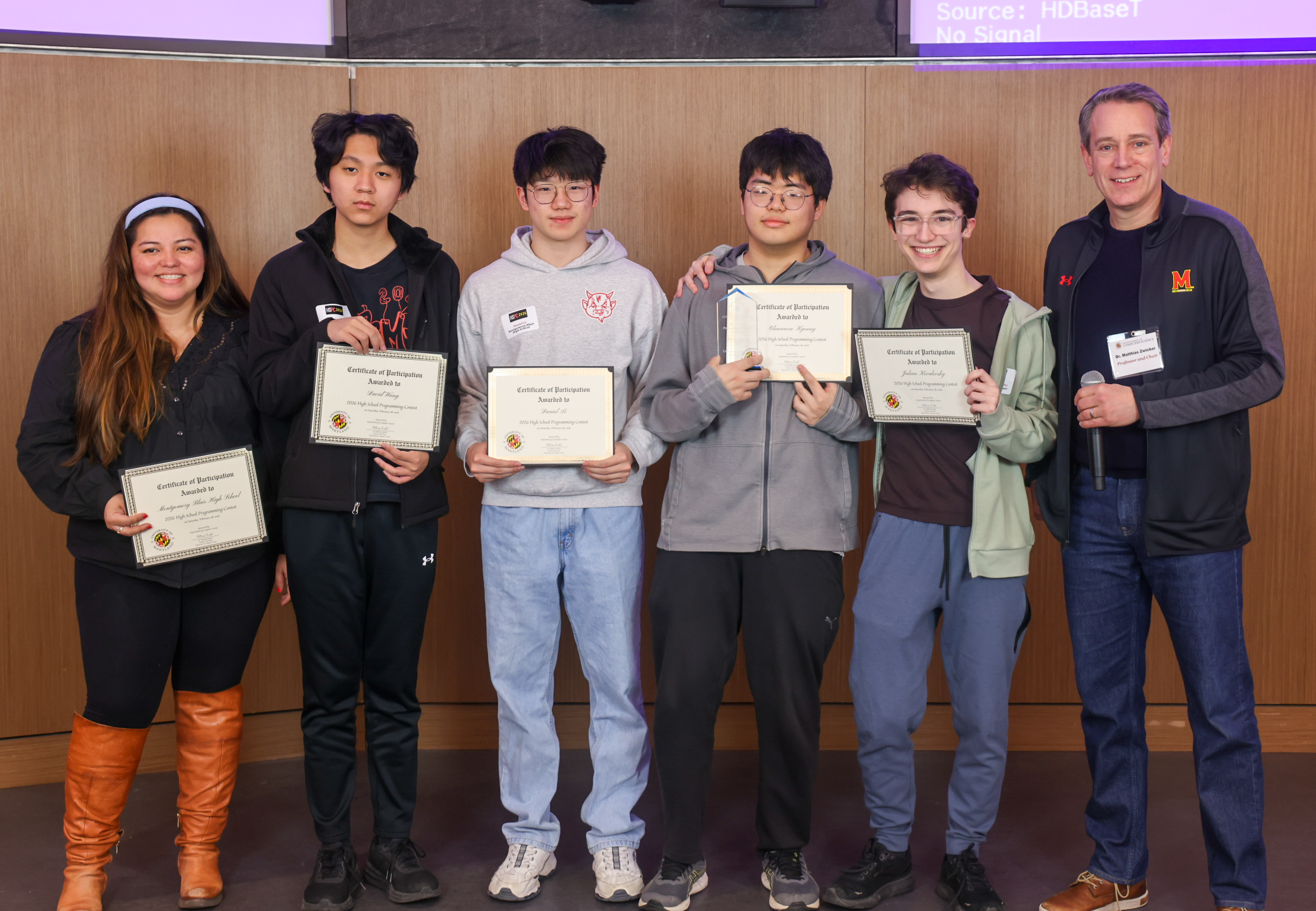
The University of Maryland’s Department of Computer Science welcomed more than 100 high school students from across the Washington metropolitan area on Saturday, Feb. 28, 2026, for the 36th Annual High School Programming Contest at the Brendan Iribe Center for Computer Science and Engineering.
 Twenty-four teams participated in the three-hour competition, working together to solve algorithmic and programming problems under timed conditions. The annual contest brings students to campus to apply coding knowledge in a collaborative setting while engaging with peers from across the region.
The top five teams were:
- 1st place: Montgomery Blair High School in Silver Spring, Maryland
- 2nd place: Poolesville High School in Poolesville, Maryland
- 3rd place: Centennial High School in Ellicott City, Maryland
- 4th place: BASIS Independent McLean in McLean, Virginia
- 5th place: Thomas Jefferson High School for Science and Technology in Alexandria, Virginia
Teams were evaluated based on the correctness of their solutions, followed by the speed at which they made correct submissions. Because each team worked at a single computer, students discussed strategies and developed solutions collectively before implementing them in code.
Assistant Professor Laxman Dhulipala, the contest’s director, said the competition emphasizes analytical thinking and collaboration, skills he said remain relevant as technology evolves.
“Although recent developments in AI may make one wonder the necessity of solving such problems by hand in the future, having students develop and hone these abilities has arguably never been more important, as it is exactly these critical thinking skills that are needed when building large-scale software from unclear user specifications or business needs, with or without AI,” Dhulipala said.
 The event began with a practice session that allowed teams to familiarize themselves with the contest platform and refine communication strategies before the official competition.
Ertan Dogan, a senior at Winston Churchill High School in Potomac, Maryland, said his team relied on preparation and planning to manage the time constraints.
“The programming contests around are always great experiences to be able to test our skills in competition and under the pressure of a time limit,” Dogan said. “We’ve been practicing for several months, working on different problems and strategies, so we focused on coming up with solutions before trying to code them.”
Dogan said his team first developed theoretical approaches to each problem before writing code, which helped minimize errors during implementation.
“We would come up with our algorithms and our solutions before trying to code them,” he said. “Then we would code, do a short debugging, and move on to the next problem.”
Sarah Ecker, a sophomore at Indian Creek School in Crownsville, Maryland, said some of the most difficult problems involved identifying edge cases that caused solutions to fail.
“The most challenging aspect is probably either the math-related solutions or the solutions where it was hard to find the edge case that we were messing up on,” Ecker said. “We were trying to figure out what the craziest input we could give this function.”
 She said her team addressed those challenges by slowing down and carefully reviewing each step of their logic.
“In the moment, we kind of panicked, and then we got our grasp,” Ecker said. “We just started thinking about what could go wrong and went through it slowly.”
Ecker said participating in the contest strengthened her interest in studying computer science after high school and provided exposure to a university environment.
“It’s been really exciting being part of something official where there are other people interested in computer science,” she said. “Seeing this in practice, and especially seeing the whole UMD facility, has been really cool and made me hopeful for going into this field in the future.”
For more pictures from 2026 HSPC, click HERE.
Watch a video of the event by clicking HERE.
—Story by Samuel Malede Zewdu, CS Communications
The Department welcomes comments, suggestions and corrections. Send email to editor [-at-] cs [dot] umd [dot] edu.