 |
PixelPie: Maximal Poisson-disk Sampling with Rasterization
C.Y. Ip, M.A. Yalçın, D. Luebke, and A. Varshney
High-Performance Graphics
2013, pp 17 - 26.
We present PixelPie, a highly parallel geometric
formulation of the Poisson-disk sampling problem on
the graphics pipeline. Traditionally, generating a
distribution by throwing darts and removing conflicts
has been viewed as an inherently sequential
process. In this paper, we present an efficient
Poisson-disk sampling algorithm that uses
rasterization in a highly parallel manner. Our
technique is an iterative two step process. The first
step of each iteration involves rasterization of
random darts at varying depths. The second step
involves culling conflicted darts. Successive
iterations identify and fill in the empty regions to
obtain maximal distributions. Our approach maps well
to the parallel and optimized graphics functions on
the GPU and can be easily extended to perform
importance sampling. Our implementation can generate
Poisson-disk samples at the rate of nearly 7 million
samples per second on a GeForce GTX 580 and is
significantly faster than the state-of-the-art maximal
Poisson-disk sampling techniques.



|
 |
Parallel Geometric Classification of Stem Cells by their Three-Dimensional Morphology
D. Juba, A. Cardone, C.Y. Ip, C.G. Simon Jr,
C.K. Tison, G. Kumar, M. Brady, and A. Varshney
Computational Science & Discovery
6(1), 015007, 2013.
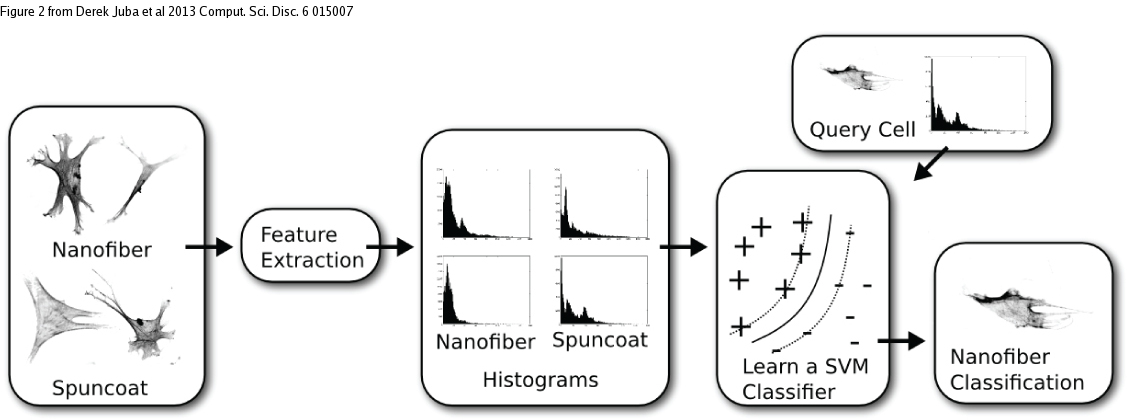
Recent work indicates that the physical structure of a
tissue engineering scaffold can direct stem cell
function by driving stem cells into morphologies that
induce their differentiation. Thus, we have developed
a rapid method for classifying cells based on their 3D
shape. First, random lines are intersected with 3D
Z-stacks of confocal images of stem cells. The
intersection lengths are stored in histograms, which
are then used to train a support vector machine (SVM)
learning algorithm to distinguish between stem cells
cultured on differentiation-inducing 3D scaffolds and
those cultured on non-differentiating flat
substrates. Our algorithm is accelerated by a parallel
GPU implementation and the trained SVM is able to
properly classify the 'new' query cells over 80% of
the time.
|
 |
Hierarchical Exploration of Volumes Using Multilevel Segmentation of the Intensity-Gradient Histograms
C.Y. Ip, A. Varshney, and J. JaJa
IEEE Transactions on Visualization and Computer Graphics
18(12), 2012, pp 2355 - 2363.
IEEE SciVis
Best Paper Award
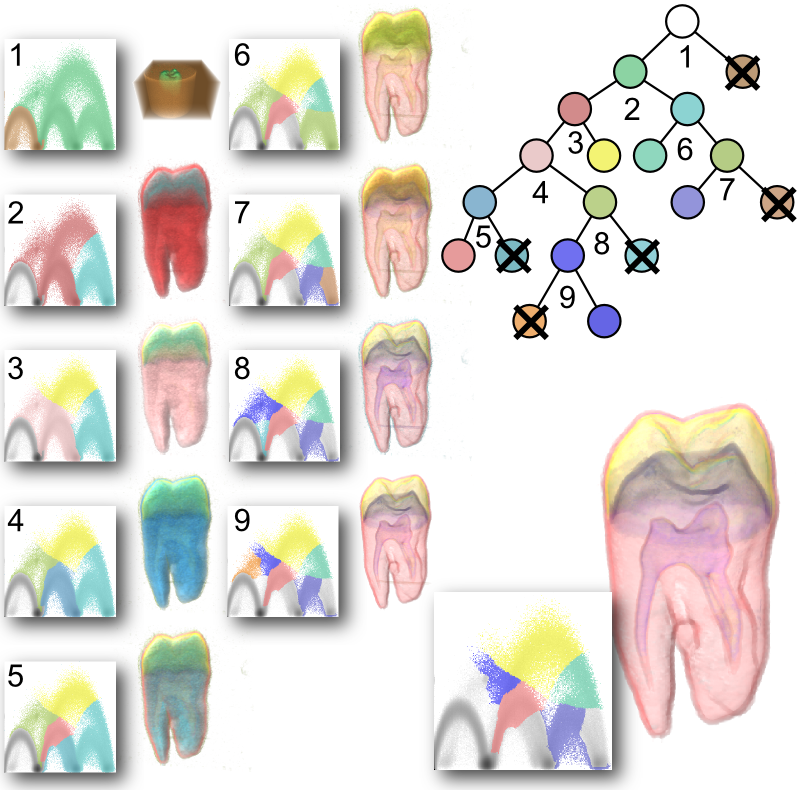
Visual exploration of volumetric datasets to
discover the embedded features and spatial structures
is a challenging and tedious task. In this paper we
present a semi-automatic approach to this problem that
works by visually segmenting the intensity-gradient 2D
histogram of a volumetric dataset into an exploration
hierarchy. Our approach mimics user exploration
behavior by analyzing the histogram with the
normalized-cut multilevel segmentation
technique. Unlike previous work in this area, our
technique segments the histogram into a reasonable set
of intuitive components that are mutually exclusive
and collectively exhaustive. We use
information-theoretic measures of the volumetric data
segments to guide the exploration. This provides a
data-driven coarse-to-fine hierarchy for a user to
interactively navigate the volume in a meaningful
manner.
|
 |
Saliency-Assisted Navigation of Very Large Landscape Images
C.Y. Ip, and A. Varshney
IEEE Transactions on Visualization and Computer Graphics
17(12), 2011, pp 1737 - 1746.
IEEE Visualization
Honorable Mention for the Best Paper Award
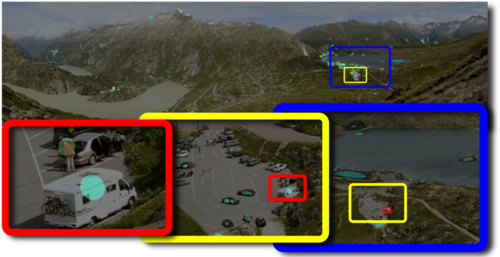
This work presents navigation of very large landscape
images from an interactive visualization
perspective. The grand challenge in navigation of very
large images is identifying regions of potential
interest. We show that our approach of progressive
elicitation is fast and allows rapid identification of
regions of interest. We validate the results of our
approach by comparing them to Internet user-tagged
regions of interest on several very large landscape
images.
|
 |
MDMap : A System for Data-Driven Layout and Exploration of Molecular Dynamics Simulations
R. Patro, C.Y. Ip, S. Bista, S.S. Cho, D. Thirumalai,
and A. Varshney
IEEE Symposium on Biological Data Visualization
2011, pp 111 - 118.
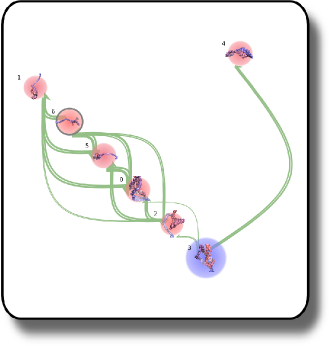
MDMap is an automated system to visualize MD
simulations as state-transition diagrams, and can
replace the current tedious manual layouts of
biomolecular folding landscapes with an automated
tool. The layout of the representative states and the
corresponding transitions among them is presented to
the user as a visual synopsis of the long-running MD
simulation.
|
 |
Social Snapshot: A system for temporally coupled social photography
R. Patro, C.Y. Ip, S. Bista, and A. Varshney
IEEE Computer Graphics and Applications
31(1), 2011, pp 74 - 84.
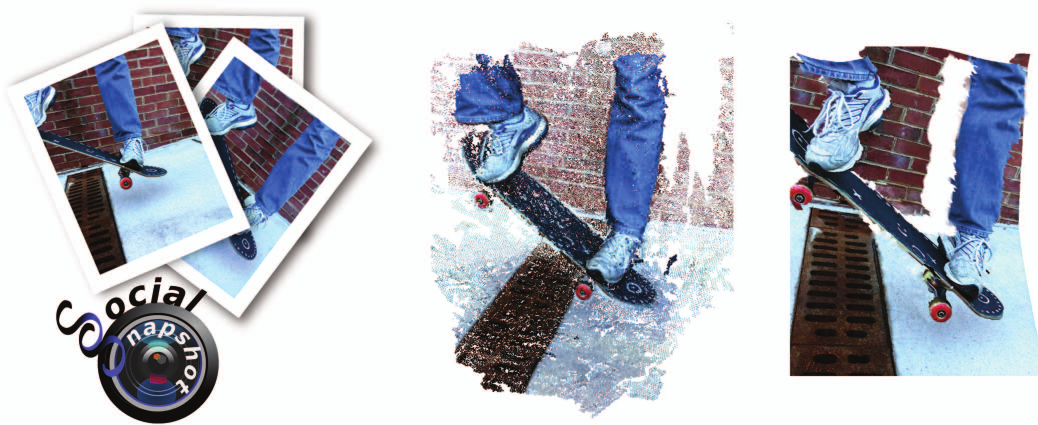
Social Snapshot actively acquires and reconstructs
temporally dynamic data. The system enables spatiotemporal 3D
photography using commodity devices, assisted by their auxiliary
sensors and network functionality. It engages users, making them
active rather than passive participants in data acquisition.
|
 |
Salient Frame Detection for Molecular Dynamics Simulations
Y. Kim, R. Patro, C.Y. Ip, D. P. O'Leary, A. Anishkin, S. Sukharev, and A. Varshney
Scientific Visualization: Interactions, Features, Metaphors, Dagstuhl Follow-Ups
2, 2011, pp 160 - 175.
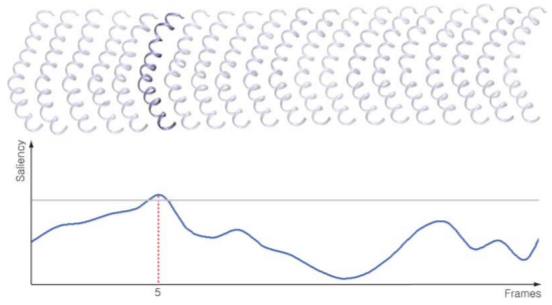
Saliency-based analysis can be applied to time-varying
3D datasets for the purpose of summarization,
abstraction, and motion analysis. As the sizes of
time-varying datasets continue to grow, it becomes more
and more difficult to comprehend vast amounts of data
and information in a short period of time. In this
paper, we use eigenanalysis to generate orthogonal basis
functions over sliding windows to characterize regions
of unusual deviations and significant trends. Our
results show that motion subspaces provide an effective
technique for summarization of large molecular dynamics
trajectories.
|
 |
Saliency Guided Summarization of Molecular Dynamics Simulations
R. Patro, C.Y. Ip, and A. Varshney
Scientific Visualization: Advanced Concepts, Dagstuhl Follow-Ups
1, 2010, pp 321 - 335.
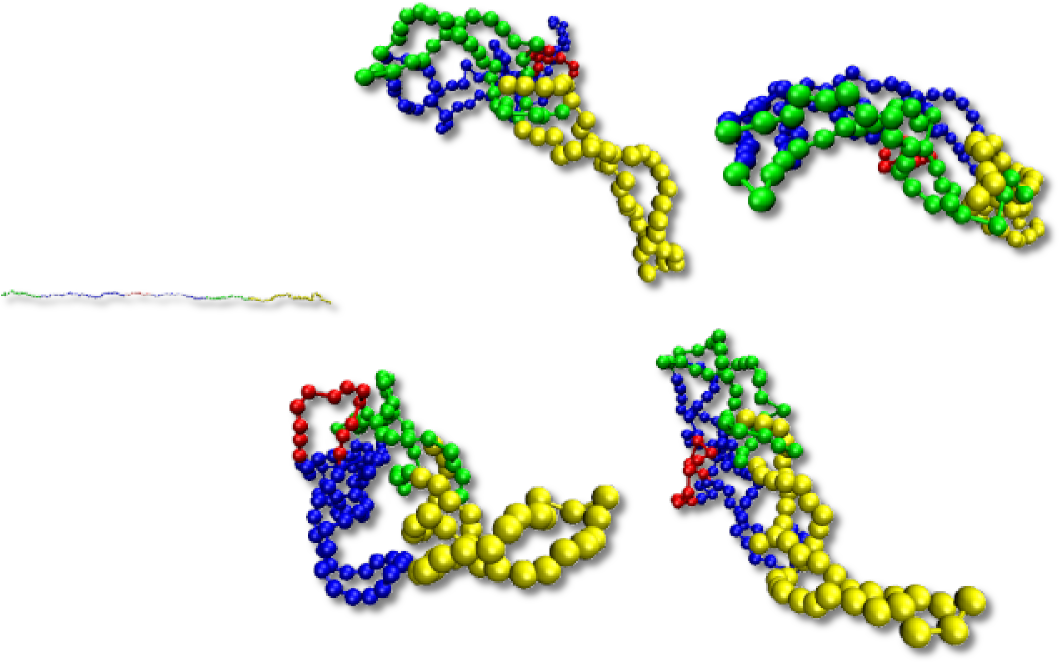
We present a novel method to measure saliency in
molecular dynamics simulation data. This saliency
measure is based on a multiscale center-surround
mechanism, which is fast and efficient to compute. We
explore the use of the saliency function to guide the
selection of representative and anomalous timesteps
for summarization of simulations.
|
 |
A 3D Object Classifier for Discriminating Manufacturing Processes
C.Y. Ip, and W.C. Regli
Computers & Graphics
30(6) pp 903 - 916
This work addresses the problem of manufacturing
process discrimination, i.e.,determination of the best
(or most likely) manufacturing process from shape
feature information. We introduce a new shape
descriptor with the statistics of surface curvatures.
We use support vector machines to learn a separator to
classify models that are "prismatic machined" and
"cast-then-machined".
|
 |
Benchmarking CAD Search Techniques
D. Bespalov, C.Y. Ip, W.C. Regli, and J. Shaffer
ACM Symposium on Solid and Physical Modeling
2005, pp 275 - 286
This work presents several distinctive benchmark
datasets for evaluating techniques for automated
classification and retrieval of CAD objects. These
datasets include (1) a dataset of CAD primitives (such
as those common in constructive solid geometry
modeling); (2) two datasets consisting of classes
generated by minor topological variation; (3) two
datasets of industrial CAD models classified based on
object function and manufacturing process,
respectively; (4) and a dataset of LEGO models from
the Mindstorms robotics kits.
|
 |
Automated Learning of Model Classifications
C.Y. Ip, W.C. Regli, L. Sieger, and A. Shokoufandeh
ACM Symposium on Solid Modeling and Applications
2003, pp 322 - 327
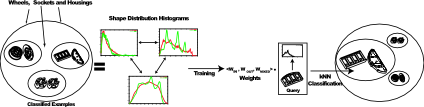
This work describes a new approach to automate the
classification of solid models using machine learning
techniques. We instroduce a shape learning algorithm
and a general technique for "teaching" the algorithm
to identify new or hidden classifications that are
relevant in many engineering applications.
|
 |
Using Shape Distributions to Compare Solid Models
C.Y. Ip, D. Lapadat, L. Sieger, and W.C. Regli
ACM Symposium on Solid Modeling and Applications
2002, pp 273 - 280
This work examines how to adapt shape distributions
techniques to comparison of 3D solid models. First,
we show how to extend basic distribution-based
techniques to handle CAD data in mesh
representation. These extensions address specific
geometries that occur in mechanical CAD data. Second,
we describe how to use shape distributions to directly
interrogate solid models. Lastly, we show how these
techniques can be put together to provide a "query by
example" interface to a large, heterogeneous, CAD
database.
|