UMD Students Present Startup Ideas at Annual Pitch Perfect Event
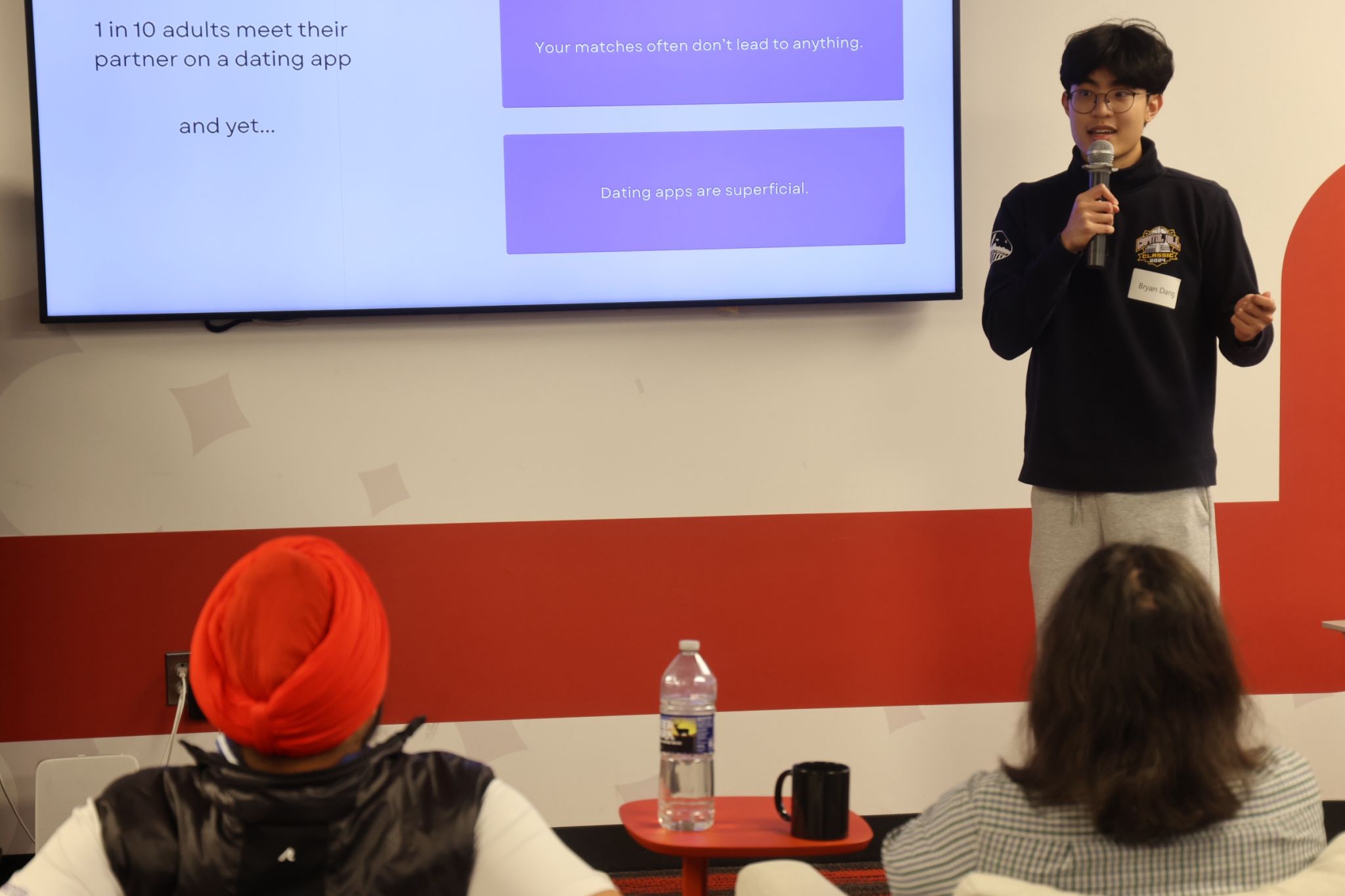
Student entrepreneurs at the University of Maryland presented business ideas to a panel of judges during the annual Pitch Perfect event, organized by the Department of Computer Science’s Mokhtarzada Hatchery program and Startup Shell. Held at the Idea Factory, the event allowed students to pitch startup concepts and respond to questions from entrepreneurs with experience in business and investing.
 This year’s judges included Manpreet Singh (B.S. ’03, finance), chief investment officer at Singh Capital Partners, and Zeki Mokhtarzada (B.S. ’01, computer science), a co-founder of the Hatchery program and an entrepreneur who has co-founded ventures including Webs.com, acquired by Vistaprint, and Truebill, acquired by Rocket Money.
Startups presented at the event included ideas focused on nutrition guides, an AI video editor, skills development tools and consumer applications, reflecting a range of approaches to addressing everyday needs and market gaps.
“These students are so passionate about their projects,” Mokhtarzada said. “UMD entrepreneurship continues to grow, and we’re excited to be a part of it.”
Among the presenters was Bryan Dang, a senior computer science major and founder of Rounds, a dating app built around a staged introduction process. Rather than immediately revealing users to one another, the platform is designed to guide them through multiple rounds of interaction first.
“The problem my startup addresses is the issues with modern dating apps,” Dang said. “A lot of them are focused on appearance first, and people don’t always get the chance to connect beyond that.”
Dang said the event provided an opportunity to gauge reactions outside of his immediate network. One suggestion from the judges, to introduce elements of gamification, stood out as a new direction for the app’s design.
“They just came up with one on the spot that I actually liked and would probably implement later,” Dang said.
 Austin Abarca, a senior computer science major, also presented at the event. His startup, Atlas Ascent LLC, is a fitness platform that uses AI to generate personalized plans based on a user’s data and goals.
“At the moment, our startup utilizes AI to ensure that every plan that it generates for you is customizable and also catered to your personal statistics,” Abarca said.
He said feedback from the judges prompted him to consider how users interact with fitness applications, particularly the potential for voice-based features that allow users to communicate with the platform more naturally.
“All apps in the fitness space utilize the on-screen keyboard,” Abarca said. “There is no app, at least to my knowledge, that has you speaking to the app as if it were a partner or a gym coach sitting by your side.”
Presenting to experienced entrepreneurs also shaped Abarca's approach to feedback.
“I took everything they said with the perspective that they’ve been in the game for many years, and I’ve got a lot to learn,” Abarca said. “Having the opportunity to present in front of people with that level of experience and hear their feedback gave me a better sense of how to move forward and think about the next steps for my startup.”
—Story by Samuel Malede Zewdu, CS Communications
The Department welcomes comments, suggestions and corrections. Send email to editor [-at-] cs [dot] umd [dot] edu.