Learning When to Pivot
Two weeks into an internship at Amazon, alum Ananth Sankaralingam (B.S. ’26, computer science) watched his assigned senior employee leave the company to start a business. The decision stayed with him because it challenged how he had been thinking about work and what he wanted from his own career.
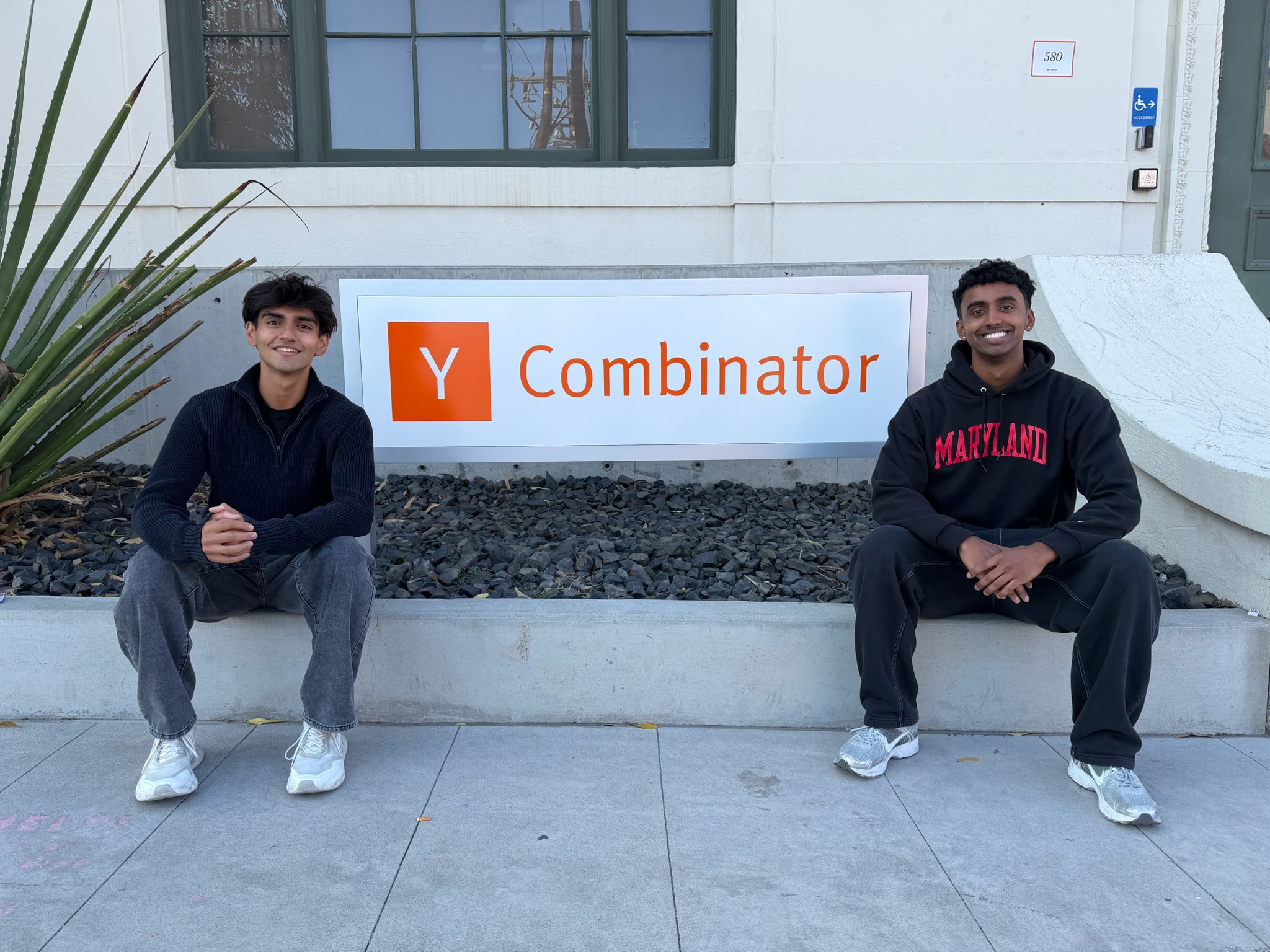
Several years later, Sankaralingam is building Chromie.dev, an artificial intelligence platform for government contractors, from San Francisco. The company was accepted into Y Combinator’s 2026 summer batch after changing direction several times and abandoning an earlier product that failed to attract sustained interest.
For Sankaralingam, the acceptance marked a turning point in a process that began with campus entrepreneurship events, personal software projects and an effort to find work driven by more than compensation.
“He shifted how I viewed work,” Sankaralingam said of his former Amazon mentor. “Instead of going after purely money, he showed me there’s more to it in the sense of following your passion and helping other people.”
Finding Direction
As a student in the University of Maryland Department of Computer Science, Sankaralingam attended events connected to Startup Shell and the Dingman Center for Entrepreneurship. Although he was not accepted into some of the organizations he sought to join, he continued meeting students, researchers and mentors interested in building companies.
Those relationships gave him a community in which he could test ideas and learn from people pursuing similar goals.
“I was increasingly surrounding myself with that entrepreneurship community at Maryland,” Sankaralingam said. “I started forming my own community of friends and mentors in entrepreneurship”
His interest in artificial intelligence developed alongside those early entrepreneurial efforts. A graduate-level course taught by Associate Professor Furong Huang gave him a closer look at large language models and the range of products that could be built around them.
“You realize there’s so much more possible at this moment,” Sankaralingam said. “The opportunity to be at the forefront of that, when the world is changing so drastically, is a once-in-a-lifetime opportunity that I didn’t want to pass up.”
Changing Course
Sankaralingam later co-founded Chromie.dev with Akshay Mistry, a friend from high school. The company initially developed an AI platform that allowed users to create and deploy Chrome extensions.
The product drew little sustained use, and potential customers showed limited willingness to pay. Sankaralingam eventually concluded that something had to change.
“It wasn’t something people really wanted,” he said. “At some point, I got real with myself, and it wasn’t something that I wanted either.”
The decision to move on did not come from a single conversation. Sankaralingam said founders often must evaluate users’ behavior, limited engagement and indirect responses rather than wait for someone to reject an idea outright.
“No one is going to be upfront and direct with you like that,” he said. “You have to reflect on everything you’re doing based on the conversations you’ve had.”
A new direction emerged when Sankaralingam began automating work for a government contractor. He created a system that searched government websites for requests for proposals matching the company’s services.
“I realized this was just the tip of the iceberg,” Sankaralingam said. “There was a larger opportunity underneath in building an AI workspace for government contractors.”
Chromie.dev now helps companies find and assess government opportunities while organizing parts of their business development and capture work.
Shifting Mindsets
Acceptance into Y Combinator brought Sankaralingam and Mistry to San Francisco, but it did not eliminate the daily work of finding customers. Sankaralingam said the program’s main effect was changing how he approached that work.
“You think once you get in, all the customers come knocking on the door,” he said. “That was completely false.”
He moved beyond LinkedIn messages and emails to cold calls, conferences and visits to contracting offices. During one trip, the founders flew to Virginia without booking return tickets and visited about 50 companies, bringing doughnuts and asking employees for brief conversations.
“It didn’t necessarily lead to all the results in the world,” Sankaralingam said. “But it was a mindset shift that I achieved from being around people who were doing whatever needed to be done.”
He now sets aside time each week to review customer conversations, product decisions and advice. The routine helps him assess the company’s direction while measuring progress through the work he can control.
“You can’t guarantee your revenue,” he said, “but you can guarantee your effort and how you’re approaching each day.”
—Story by Samuel Malede Zewdu, CS Communications
The Department welcomes comments, suggestions and corrections. Send email to editor [-at-] cs [dot] umd [dot] edu.