UMD CS Launches AI Premier to Address Evolving Workforce Needs
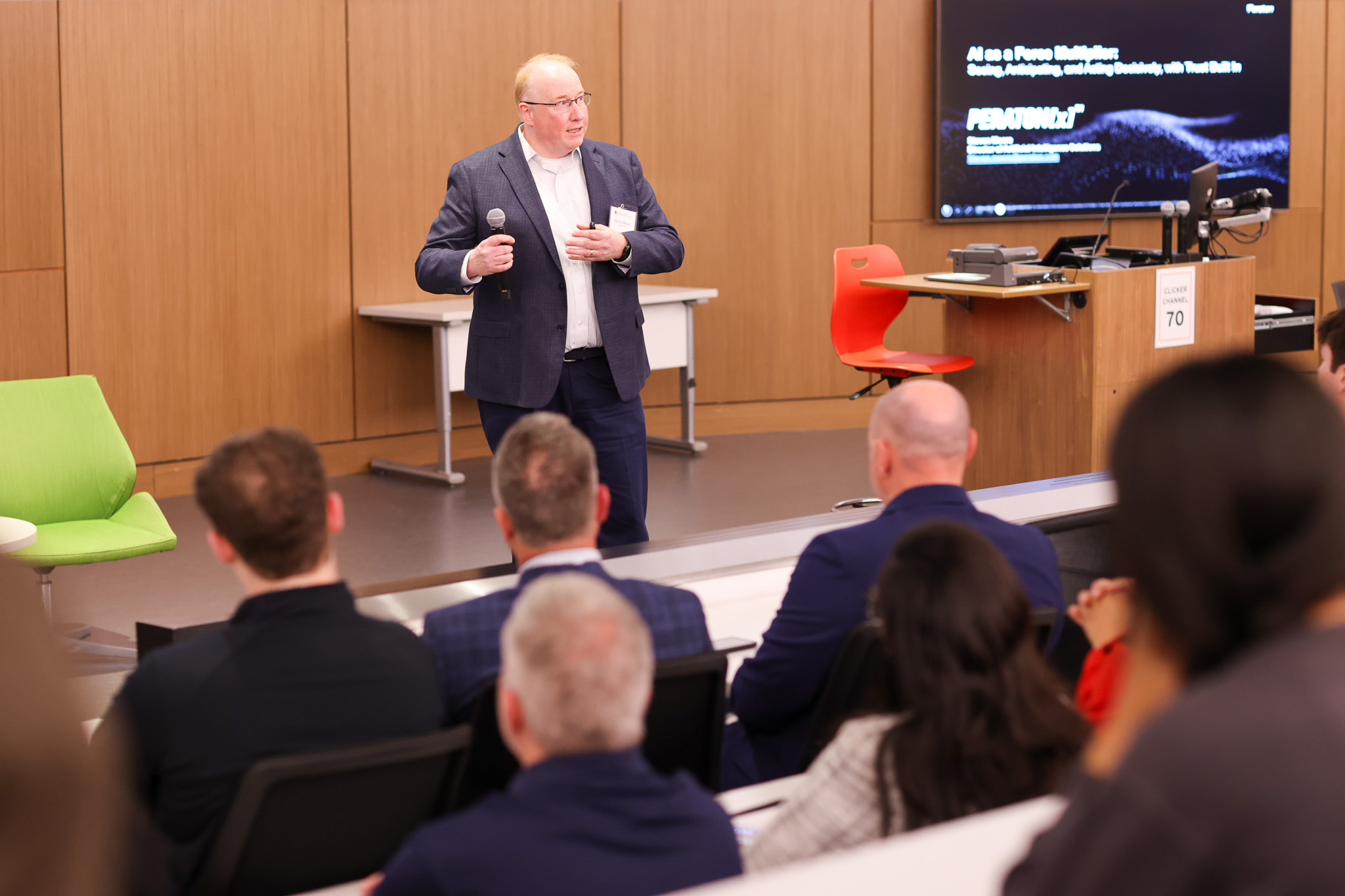
As AI becomes more integrated into workplace operations, employers are reconsidering the skills they expect from computer science graduates. For students preparing to enter the workforce, that means learning not only how to develop software but also how to incorporate AI into their work.
To help students navigate that transition, the University of Maryland Department of Computer Science launched AI Premier on Nov. 12 at Antonov Auditorium in the Brendan Iribe Center for Computer Science and Engineering.
Organized through the department’s Corporate Partners in Computing (CPIC) program, the event featured industry presentations and a fireside chat, followed by student research poster presentations and a networking reception. Students spoke with corporate representatives about industry applications of AI, recruitment practices and career opportunities.
 The event drew 87 students and 16 representatives from eight companies and federal agencies, including Peraton, CoStar, Laerdal, EY, Clarity, Fannie Mae, the National Security Agency and the National Geospatial-Intelligence Agency.
“We want to make sure that our students are working with our corporate partners to ensure that we are bridging any gaps in skills,” said Maria Johnson, the department’s director of corporate partnership development.
Johnson said AI Premier builds on the department’s existing corporate partnership program, which focuses on recruitment, brand visibility and industry engagement. The initiative also seeks to involve student organizations in developing workshops and other AI-focused educational activities.
Dylan Robinson, a university recruiter at Peraton, said the company’s involvement comes as it invests in developing the AI capabilities of its own workforce.
“Whatever Maryland is doing within the AI space, we’re also developing our own engineers and employees along the same lines,” Robinson said.
He added that Peraton hopes to expand its relationship with the university through internship and cooperative education opportunities that incorporate AI into students’ professional experiences.
During the event, discussions also examined how AI-powered coding assistants are changing software developers' day-to-day responsibilities.
 Steven Moore, director of artificial intelligence solutions at Peraton, said that while employers expect developers to use tools that automate parts of the coding process, they must also be able to review the work those tools produce.
“Some of the things that we still want them to be able to do, however, is to be able to read the code as well,” Moore said.
He explained that knowledge of software architecture, programming frameworks and technical standards enables developers to identify when AI-generated code needs modification and determine whether it meets project requirements.
For Arvin Adeli (B.S. ’28, computer science), who attended the event through his involvement with UMD’s Association for Computing Machinery student organization, the discussions provided insight into how employers are approaching productivity in software development.
Adeli said the use of AI coding assistants is shifting from an optional practice to an expectation, with developers increasingly being asked to complete tasks faster.
 As students incorporate these tools into their academic work, Adeli said it is important that they remain engaged in the problem-solving process.
“There’s always going to be people who will cruise through classes or cruise through problems and not be curious enough to solve it to the end,” Adeli said.
Adeli’s observations reflect the broader conversation AI Premier seeks to foster between academia and industry. Johnson sees the initiative as an opportunity to help students prepare for the future of computer science.
“We want to make sure that our students are able to fully participate in this future of AI, and that they’re fully prepared,” Johnson said.
—Story by Samuel Malede Zewdu, CS Communications
The Department welcomes comments, suggestions and corrections. Send email to editor [-at-] cs [dot] umd [dot] edu.