Recent News & Accomplishments
2026
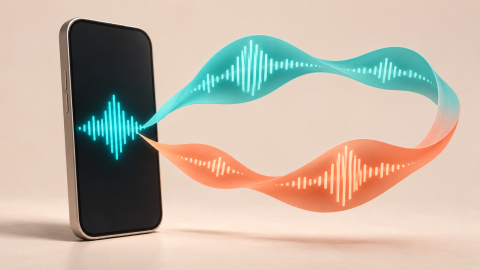
UMD alum Utkarsh Tyagi (M.S. ’25) draws on his research experience at Maryland to develop SteerDuplex, a model designed to make voice-based AI systems more responsive to spoken instructions.
Asking someone to slow down, speak louder or wait until a sentence is finished is a routine part of conversation. But when the listener is an artificial intelligence voice assistant, those simple requests may not produce the expected response. For alum Utkarsh Tyagi (M.S. ’25, computer science), that limitation raised a research question: Can AI systems learn not only what to say, but how and when to say it? Tyagi, advised by Distinguished University Professor Dinesh Manocha , led the development of SteerDuplex , a speech-to-speech AI model designed to adjust its speaking behavior in response... read more

With a new $150,000 grant, an interdisciplinary team that includes Jun Nishida and Nirupam Roy will develop wearable technology to give Deaf and hard-of-hearing audiences new ways to experience music.
A flute that feels like raindrops fluttering across the skin. A violin that registers as a looping sensation. Drums that arrive as an insistent, rhythmic pulse. That’s how Jill Bradbury, a Deaf scholar and director of the University of Maryland’s School of Theatre, Dance, and Performance Studies (TDPS), describes what live music could feel like for Deaf and hard-of-hearing audiences. Now, a $150,000 grant from the Artists Make Technology Lab (AMT Lab), an initiative supporting innovation in the performing arts, will help her and an interdisciplinary UMD team make that a reality. The team will... read more

He studies robot learning and manipulation, and how artificial intelligence can help machines better understand and interact with the physical world.
Humans learn how the physical world works long before they can explain it. Through play, they pick up objects, move them around, try different actions and learn from what happens next. Ruoshi Liu is exploring whether robots can learn in a similar way. Liu joined the University of Maryland’s Department of Computer Science as an assistant professor in fall 2026. His research focuses on robot learning, computer vision and machine learning, with a broader goal of developing systems that can understand their surroundings and use that knowledge to perform physical tasks. “I’m super excited overall... read more
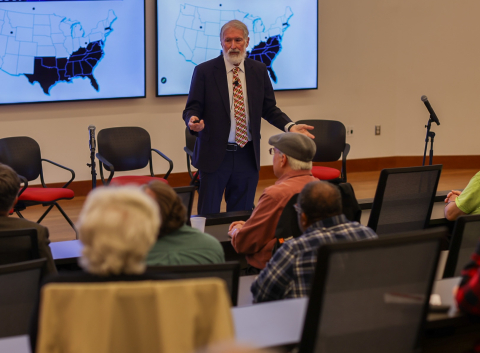
Alumni and former researchers revisit the University of Maryland’s role in developing early internet infrastructure and connecting academic institutions across the country.
“Our university and our region have been the hub of technological discovery and progress for more than a century,” said President Pines, as he and Vice President Patrick O’Shea kicked off the “When UMD Was the Center of the Internet” event on October 21. He noted that UMD established its “place in history as the first university in the world to fully connect by internet protocols, and home to the first internet exchange point between commercial, government, and academic computer networks,” placing those achievements as a key local milestone between the first local and trans-Atlantic telegraph... read more

Computer science major Oluwatoyin Olaniyi received a ‘life-changing’ scholarship from Brenda Fonseca (B.A. ’75, French).
One of the first things Oluwatoyin Olaniyi heard when she arrived at the University of Maryland was, “You belong in computing.” That message came from Computer Science Lecturer Elias Gonzalez (B.S. ’17, computer science; M.Ed. ’18, curriculum and instruction), who taught Olaniyi’s object-oriented programming course, CMSC131. “Elias was one of my favorite professors,” said Olaniyi, who is now a junior computer science major. “Coming into Maryland and having him as my first professor meant so much to me. He told us on that first day, ‘Don’t let anyone tell you that you don’t belong in computing... read more

Suho Shin and Zeyu Yan are recognized for research on algorithmic delegation and sustainable electronics.
The University of Maryland’s Department of Computer Science has announced alumni Suho Shin (Ph.D. ’26, computer science) and Zeyu Yan (Ph.D. ’26, computer science) as recipients of the 2026 Larry S. Davis Doctoral Dissertation Award. Shin is now a joint postdoctoral researcher at Stanford University and the Massachusetts Institute of Technology, while Yan is a postdoctoral research fellow at the Georgia Institute of Technology. The award recognizes dissertations for their technical depth, significance, potential impact and presentation quality. Named after Professor Emeritus Larry S. Davis ,... read more

Selected for UMD's Mokhtarzada Hatchery program, PulseFi is developing technology to monitor vital signs and movement patterns without wearable devices or cameras.
Monitoring an older adult's health often depends on devices they must remember to wear or cameras that can raise privacy concerns. A student-led startup at the University of Maryland is exploring another approach: using Wi-Fi signals to track vital signs and movement without requiring people to wear or carry anything. PulseFi , co-founded by UMD undergraduate Pranay Kocheta (B.S. ’30, computer engineering) and University of California, Santa Cruz doctoral student Nayan Bhatia (Ph.D. ’27, computer science and engineering), is developing a system intended to measure heart rate, breathing... read more

UMD researchers developed AV-MSF, a system that combines visual geometry and acoustic physics to generate realistic, responsive sounds for 3D digital objects.
Set a transparent glass vase next to an acrylic plastic replica, and from across the room, the eye can easily be deceived. Both objects share the same contours, reflecting light and casting shadows in nearly identical ways. Yet one light tap with a spoon reveals the difference: the glass rings out with a clear, sharp resonance, while the plastic produces a dull, muted thud. While modern computer graphics can render stunningly photorealistic 3D models, digital environments remain largely silent or rely on generic audio effects. Today’s digital objects typically reproduce appearance but omit... read more

UMD Researchers Identify Brain Signals Linked to Cybersickness in Immersive Environments
For years, developers of virtual reality (VR) and augmented reality (AR) technologies have worked to address an unwanted side effect many users experience: cybersickness, a type of motion sickness triggered by moving digital content. In a new study published on September 25, 2026, in the journal Virtual Reality , University of Maryland scientists used electroencephalography (EEG) to identify changes in brain wave activity while participants viewed virtual content designed to induce cybersickness. The findings offer real-time signals that could help designers detect and reduce cybersickness... read more

The annual hackathon brought more than 1,000 students together to develop technology projects, explore new skills and connect with industry mentors.
Students gathered at the College Park Marriott Hotel and Conference Center on Oct. 17-18 for Technica 2026, a student-organized hackathon that brought together participants with different levels of programming experience for a weekend of coding, workshops and collaboration. Now in its 12th year, the University of Maryland event welcomed over 1,000 in-person and virtual participants under the theme "Dare to Dive." Technica is the world’s largest hackathon celebrating underrepresented genders, giving beginners and experienced programmers a space to build projects and learn from one another... read more