News and Events
Recent News & Accomplishments
2026
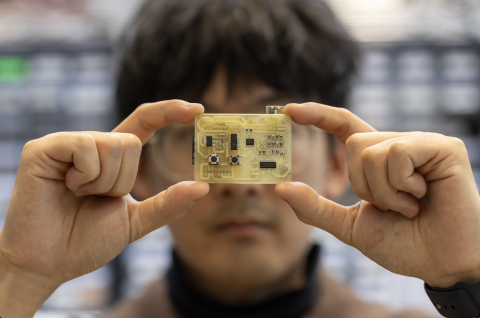
UMD Associate Professor Huaishu Peng and CS alum Zeyu Yan helped develop DissolvPCB, a recyclable circuit board designed to recover materials and electronic components for reuse.
Before an electronic device reaches its final form, engineers may build and test multiple versions of its circuit board. Those prototypes can help refine a design, but once they are no longer needed, recovering their materials and electronic components can be difficult. A research project led in part by the University of Maryland is exploring another approach: building circuit boards that can be dissolved and reused. DissolvPCB , developed by researchers at UMD, the Georgia Institute of Technology and the University of Notre Dame, received an honorable mention in the student category of Fast... read more

Modern security systems have a dangerous blind spot: a rogue wireless signal can leak sensitive data or disrupt critical infrastructure in less than a millisecond, yet conventional monitors consume too much power to remain constantly vigilant. A University of Maryland study published earlier this year shows how connected networks can be vulnerable to covert radio transmissions that disappear before standard security systems register them. Traditional wideband monitors require immense power to scan broad ranges of radio frequencies, allowing these fleeting transmissions to escape detection. To... read more
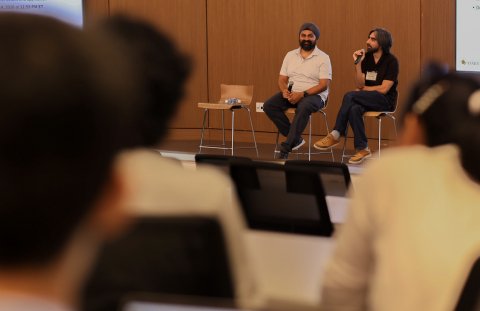
The annual event introduced students to Hatchery’s funding, mentorship and workspace, while offering a chance to hear from its alumni founders.
The University of Maryland’s Department of Computer Science held its annual Fall Mokhtarzada Hatchery Kick-Off Event on Sept. 8, giving students an opportunity to learn how the program supports student-led startups from early ideas through product development. Held at the Brendan Iribe Center for Computer Science and Engineering, the event featured discussions with UMD alumni Haroon Mokhtarzada (B.A. ’01, economics), one of the program’s funders and mentors, and Manpreet Singh (B.S. ’03, finance), a Hatchery mentor. Students learned about the program’s structure, asked questions about the... read more
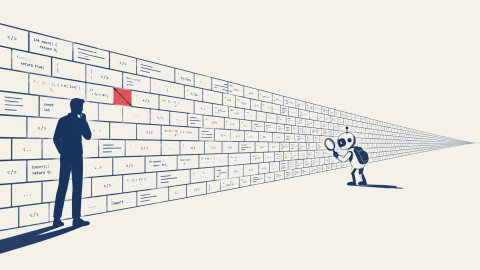
CS Ph.D. student Manan Suri and Professor Dinesh Manocha are part of a research team developing CyberForge, a framework that generates realistic vulnerabilities to train AI agents for software defense.
For a cyberattacker, one overlooked weakness can be enough. For a defender, the challenge is broader: find weaknesses and fix them before attackers exploit them. That imbalance is becoming more consequential as artificial intelligence agents improve at writing and analyzing code. Manan Suri , a University of Maryland computer science doctoral student, is studying the other side of that equation: how AI systems can be trained to repair software vulnerabilities, not just find them. Advised by Distinguished University Professor Dinesh Manocha , Manan’s recent work on CyberForge , developed... read more

New tenure-track and professional-track faculty bring expertise in high-performance computing, internet measurement, computer vision, artificial intelligence, data science and scalable systems.
The University of Maryland’s Department of Computer Science is welcoming six faculty members during the 2026-27 academic year, adding research and teaching expertise in high-performance computing, computer networks, computer vision, artificial intelligence, data science and software systems. The appointments include four tenure-track faculty members and two professional-track lecturers joining in fall 2026 and spring 2027. “We’re thrilled to welcome these new faculty members to the department,” said Department Chair Matthias Zwicker , who holds the Elizabeth Iribe Chair for Innovation and the... read more
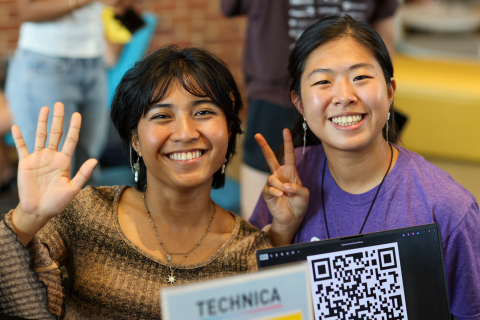
The annual fall event brought students, faculty and staff together at the Iribe Center to mark the start of the fall semester.
Students, faculty and staff gathered at the Brendan Iribe Center for Computer Science and Engineering on August 31 for the University of Maryland Department of Computer Science’s annual Fall Welcome Back Social. Held on the first day of classes, the social gave new and returning students an opportunity to meet classmates, connect with department representatives and student organizations, and learn about resources available throughout the academic year. The department begins the fall semester with about 3,300 undergraduate students and 612 graduate students. Previous Next —Portrait Article by... read more

A University of Maryland-led institute focused on robust quantum simulation will launch a new phase of research with a five-year U.S. National Science Foundation award expected to total $37.5 million. The renewal for the NSF Quantum Leap Challenge Institute for Robust Quantum Simulation (NSF RQS), which takes effect Sept. 1, reflects UMD’s long-term commitment to advancing quantum computing to take on society’s grand challenges and to spark a new era of scientific, technological and economic development, UMD President Darryll J. Pines said. “Our researchers in quantum simulation are an... read more

MATH 440: “Geometry and Data Science of Sports Analytics” gives students experience applying programming, data analysis and machine learning to careers in professional sports.
Growing up, Jason Lott (B.S. ’25, computer science and mathematics) was always fascinated by sports. So, when he was scrolling through Testudo during his junior year at the University of Maryland to sign up for classes, he was immediately attracted to MATH 498R: “Experiential Learning: Mathematics of Sports Performance Analytics,” designed and taught by Mathematics Professor Yanir Rubinstein . Lott needed a math elective to fulfill his major requirements, and with his lifelong passion for major league baseball, the class sounded like a perfect fit. “It didn’t seem like the usual math class,”... read more
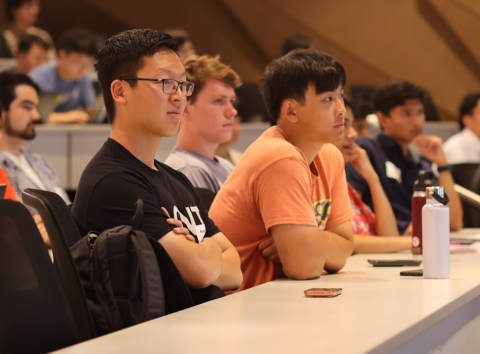
Five panels introduced the department’s 179 incoming graduate students to research in theory, artificial intelligence, robotics, systems and cybersecurity.
The University of Maryland’s Department of Computer Science organized its annual Computer and Computational Sciences Research Day on August 27, giving incoming graduate students an overview of research across computing fields and opportunities to connect with faculty. The event took place in Antonov Auditorium at the Brendan Iribe Center for Computer Science and Engineering . The department expects 179 incoming graduate students this fall. The cohort includes 78 doctoral students , 49 master ’s students and 52 students pursuing a combined bachelor’s and master’s degree. Faculty presentations... read more

Research co-authored by Gabe Kaptchuk found that combining ad targeting with campaign performance data can expose private user information despite technical safeguards.
Tech companies and browser developers have spent years pursuing a seemingly ideal solution to one of the web’s thorniest problems: using advanced cryptography to make online advertising useful without sacrificing user privacy. New research co-authored at the University of Maryland shows there is a fundamental limit to that goal. Perfect privacy and useful targeted advertising, the researchers found, simply cannot coexist. The findings, presented last month at the Privacy Enhancing Technologies Symposium (PETS) in Canada, challenge a foundational hope in privacy engineering. Rather than... read more
Featured Videos
When Transfer Learning Meets Deep Learning
Professor Qiang Yang, Hong Kong UniversityNovember 27, 2017
Video
Cryptographic Perspectives on the Future of Privacy
Jonathan Katz, Department of Computer Science, University of MarylandSeptember 06, 2017
An Expanding and Expansive View of Computing
Jim Kurose, National Science FoundationJanuary 30, 2017
Video
Data, Predictions and Decisions in Support of People and Society
Eric Horvitz, Technical Fellow and Director at MicrosoftOctober 24, 2016
Video
The One Hundred Year Study on Artificial Intelligence: An Enduring Study on AI and its Influence on People and Society
Eric Horvitz, Technical Fellow and Director at MicrosoftOctober 24, 2016