From Code to Campus Housing
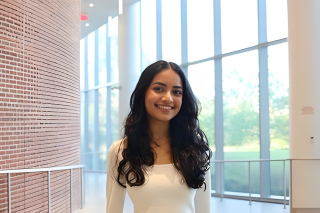
The search for off-campus housing has long been a source of uncertainty for University of Maryland students, often shaped by incomplete information, informal advice and tight timelines. As enrollment has grown and competition for nearby apartments has increased, students have increasingly relied on scattered online sources to guide major financial decisions. For Esha Singhai (B.S. ’26, computer science), those shared frustrations became the starting point for a project aimed at bringing clarity to a process many students find daunting.
That effort resulted in Diamondback Apartment Finder, a digital platform that helps UMD students compare nearby housing options in one place. The tool was developed by the student-run newsroom’s engineering team, including Alston Chan (B.S. ’26, computer science), Sameer Chawla (B.S. ’27, computer science; B.S. ’27, mathematics) and Nate Rubin (B.S. ’26, computer science), who worked closely with Singhai on product direction. Launched in early December, the platform surpassed 1,000 users in its first week with minimal marketing, signaling early interest from students navigating off-campus living.
Singhai, who also minors in business, focuses on setting product direction, coordinating development priorities and working across technical and nontechnical teams. While she does not write production code for the platform, she oversees feature planning and user experience decisions, drawing on her computer science background to bridge communication between developers and editorial staff.
“This project really reflects both what I’ve learned in computer science and my interest in product management, which I discovered during my time at UMD,” Singhai said.
Early Inspiration
Singhai’s introduction to computer science began outside the classroom. As a student, she explored basic programming through online platforms such as Khan Academy, where introductory HTML lessons first sparked her interest. That exposure led her to enroll in Advanced Placement computer science during high school.
What stood out was a teaching style that emphasized creativity alongside technical fundamentals. Rather than focusing exclusively on structured exercises, her teacher encouraged students to build interactive projects, including games.
“He had built this whole gaming world where we made our own spaceships and competed against each other,” Singhai said. “It didn’t feel like a typical class. I was learning a lot, but I was also having fun building things.”
The hands-on approach helped her see computer science as more than a technical subject. Discussions about real-world applications reinforced its relevance and showed how programming skills could translate beyond assignments.
“That was the first time it felt impactful to me,” she said. “It wasn’t just code for the sake of code. It felt like something you could actually use.”
Product Meets Journalism
Outside her coursework, Singhai gravitated toward roles that combined writing, technology and leadership. In high school, she served as an editor on her school newspaper, an experience that shaped her interest in journalism and storytelling.
When she arrived at UMD, she hoped to get involved with The Diamondback but initially assumed that role would be as a writer. That changed during her sophomore year when she met the publication’s then-product manager.
“He explained what product management at The Diamondback looked like, and it immediately clicked for me,” Singhai said. “I didn’t even know that role existed before.”
She joined the product team and has remained involved for about two and a half years. The position, she said, allowed her to work on digital tools that directly affect students and to collaborate closely with writers and editors.
Solving Housing Gaps
The idea for the platform grew from an apartment comparison project created by Rubin. He had explored an apartment comparison tool as a side project, demonstrating its feasibility.
After learning about the early prototype, Singhai reflected on her own experience navigating student housing as a freshman, which she described as overwhelming. Visiting leasing offices, comparing prices and evaluating distance from campus felt daunting without a centralized source of information.
“I remember being 19 and not really knowing where to start,” she said. “Even after talking to apartment representatives, I still didn’t feel confident about what choice to make.”
Over the years, she noticed that access to information varied widely among students. Some renewed leases early out of caution, while others waited and sometimes secured better options. Friends and family members entering the UMD community frequently turned to her for advice.
“Some people had someone guiding them, and others didn’t,” she said. “I kept thinking about how many students were just trying to figure it out on their own.”
The team saw an opportunity to address that gap by expanding Rubin's project into a single platform.
Building With Feedback
Rather than starting with code, Singhai focused first on understanding user needs. She conducted informal interviews, distributed surveys and gathered qualitative feedback to identify what students found most challenging about the housing search.
“I spent a lot of time just listening,” she said. “Before you build anything, you have to understand what people actually want.”
Students consistently pointed to the need for apartment comparisons, filtering options and guidance on timing. Translating those priorities into a functional product required close coordination with a small development team of three engineers.
As development progressed, the team shifted focus toward user experience and interface design. They conducted multiple rounds of testing and collaborated with editorial leadership to ensure the platform aligned with The Diamondback’s broader mission.
Early Results
Before launch, expectations were modest. Singhai said the team anticipated a few hundred users initially and did not expect significant retention until additional features were added.
The platform reached roughly 1,000 users within its first week. Promotion consisted primarily of an Instagram post, a story and a LinkedIn update.
“That response was honestly surprising,” she said. “It showed us that people were sharing it because they found it useful.”
Looking ahead, the team plans to expand features before considering broader adoption. Planned updates include saved listings, improved price tracking and a review system that allows students to share firsthand experiences.
“There’s still a lot we want to build,” Singhai said. “We see this as something that can keep improving over time.”
Lessons Learned
The project reshaped Singhai’s understanding of product development. What she initially expected to take a few months ultimately required about a year, as real-world constraints and edge cases emerged.
The experience also highlighted the importance of cross-team communication. Working with nontechnical stakeholders required balancing different expectations while maintaining a clear product vision.
“You have to be flexible,” Singhai said. “Things change quickly, and you have to adapt without losing sight of why you’re building something in the first place.”
As she prepares to graduate, Singhai said her computer science education gave her the technical foundation needed to lead complex projects, while her work at The Diamondback taught her how to translate that knowledge into tools designed for real users.
“Understanding both sides has changed how I think about building products,” she said. “It’s about solving real problems, not just making something that looks good.”
—Story by Samuel Malede Zewdu, CS Communications
The Department welcomes comments, suggestions and corrections. Send email to editor [-at-] cs [dot] umd [dot] edu.