Tracking Health Through Wi-Fi
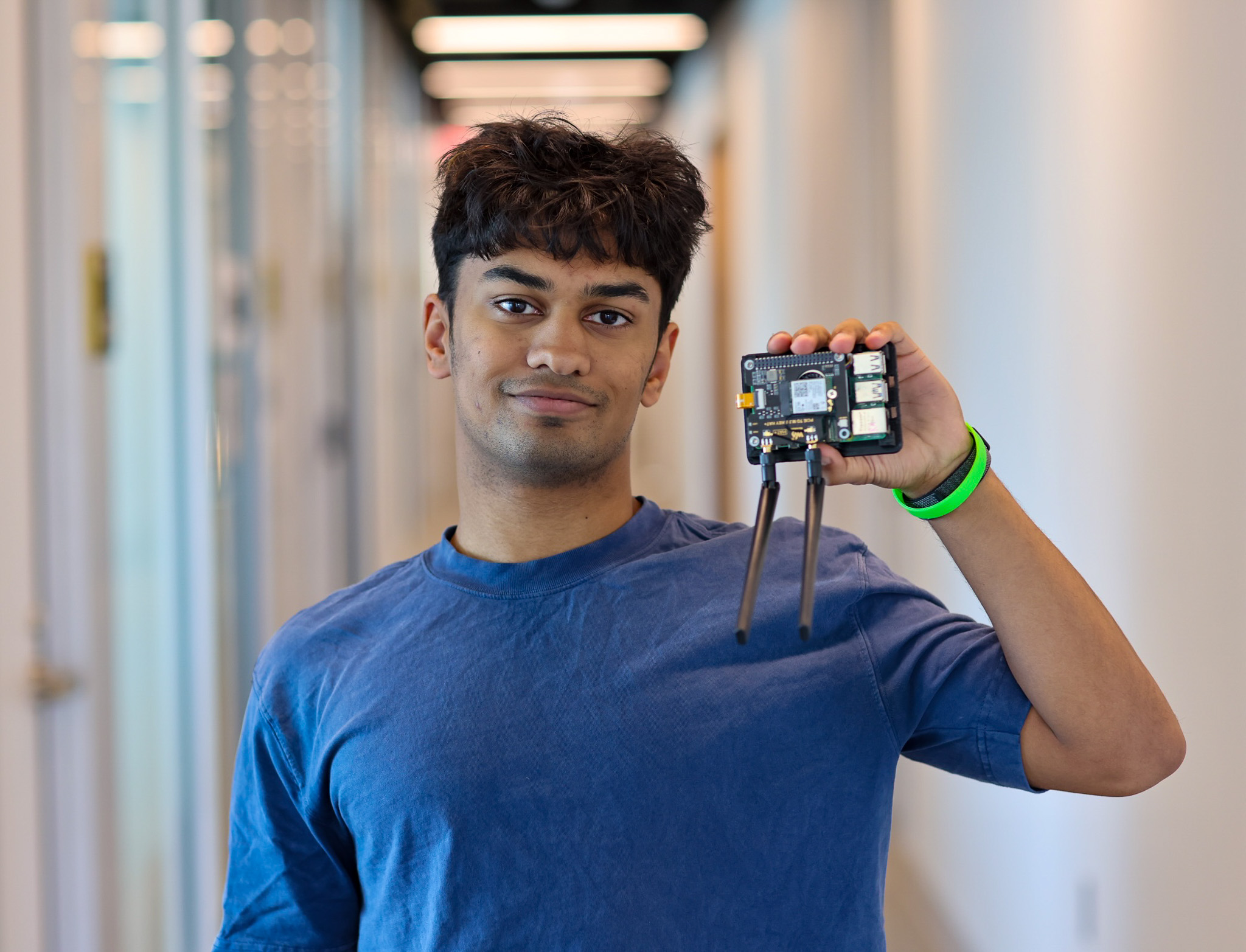
Monitoring an older adult's health often depends on devices they must remember to wear or cameras that can raise privacy concerns. A student-led startup at the University of Maryland is exploring another approach: using Wi-Fi signals to track vital signs and movement without requiring people to wear or carry anything.
PulseFi, co-founded by UMD undergraduate Pranay Kocheta (B.S. ’30, computer engineering) and University of California, Santa Cruz doctoral student Nayan Bhatia (Ph.D. ’27, computer science and engineering), is developing a system intended to measure heart rate, breathing patterns and movement. Its potential applications include monitoring older adults for falls, sleep apnea and changes associated with neurodegenerative conditions.
The system uses two wall-powered nodes that transmit and receive Wi-Fi signals. As those signals travel through a room, they interact with the human body, producing small changes that software can analyze to estimate physiological activity.
“The idea behind PulseFi is we're using Wi-Fi signals to continuously monitor health,” Kocheta said. “We're extracting these micro changes within the signal, and then using that, our algorithms are basically able to isolate those micro changes into different aspects of human physiology.”
The startup is one of five teams selected for the Department of Computer Science's 2026-27 Mokhtarzada Hatchery program, which provides student entrepreneurs with funding, mentorship and workspace.
From Research to Startup
PulseFi began more than two years ago, when Kocheta participated in a research program at UC Santa Cruz before entering his junior year of high school. There, he met Bhatia, whose doctoral research focused on wireless signals and indoor localization, a method for tracking positions within enclosed spaces.
After learning about wireless sensing, Kocheta began reviewing early research on using Wi-Fi signals to detect physiological activity. He wanted to investigate whether existing methods could be improved.
“I was like, this inherently sounds pretty cool that you can monitor vital signs with Wi-Fi. So I wonder if we can do it better,” Kocheta said.
The two continued their research, publishing two papers before hospitals, care facilities and individuals interested in potential applications reached out. Those responses prompted them to consider developing a product.
“We were like, maybe we should actually go commercialize this product,” Kocheta said. “And so we spent the next year actually building it and turning it into something that can be commercialized, something that can work outside of the lab.”
How It Works
Developing a system for use outside the laboratory presented technical challenges. Furniture, walls and movement can affect wireless signals, making it difficult to distinguish physiological activity from interference.
PulseFi analyzes channel state information, which describes how wireless signals change as they travel between devices. Its software filters environmental noise and uses a machine learning model trained on thousands of hours of data to estimate measurements such as heart rate and breathing rate.
A particular challenge has been ensuring the system performs consistently across different locations.
“When you train a model on an environment, it can learn where all the furniture is. It can learn where humans will typically be,” Kocheta said. “But then you switch it to a different room. Now suddenly everything's misplaced. All the signals are propagating in vastly different ways.”
To address the shortage of training data across different settings, the team uses simulations based on human video datasets. These generate wireless signal data that represent various environments and movements, letting researchers train the model before refining it with real-world measurements.
“In simulation, we can expose the model to hundreds of environments, hundreds of different people doing countless numbers of actions,” Kocheta said.
Beyond the technical challenges, the team is considering how PulseFi could address limitations of existing monitoring methods. Wearable devices require users to keep them on, while cameras can raise privacy concerns, particularly in bedrooms and bathrooms.
PulseFi is designed to operate without recording video or requiring physical contact.
“With Wi-Fi, we have the range,” he said. “We're able to penetrate walls, and it's like if a person's in the bathroom, we can still be monitoring if they have a fall or not.”
From Lab to Market
As the technology develops, the team is working toward potential clinical testing and commercial deployment through the Hatchery program.
Established in 2021 with support from UMD alumni Haroon, Idris and Zeki Mokhtarzada, the program provides selected teams with up to $10,000 in funding, startup mentorship and workspace in the Brendan Iribe Center for Computer Science and Engineering.
Kocheta said working alongside other student founders lets him exchange ideas, while weekly mentor meetings help the team set priorities and assess progress.
“I think one of the biggest things they do is keep you incredibly accountable,” Kocheta said of the mentors.
The program's funding also lets the team explore hardware options as it prepares the system for testing outside the lab.
In October, Kocheta said two clinical studies were approaching their start, with discussions underway about a potential pilot at another institution.
“We're now starting the process of reaching out to assisted living facilities, nursing homes, and talking to them about what features they want from us, how much they are willing to pay, and what it would take for them to pilot our technology,” Kocheta said. “I believe the next step is understanding how PulseFi can meet the needs of care facilities and become something they can use in practice.”
—Story by Samuel Malede Zewdu, CS Communications
The Department welcomes comments, suggestions and corrections. Send email to editor [-at-] cs [dot] umd [dot] edu.