Two Former Graduate Students Receive Larry S. Davis Dissertation Awards
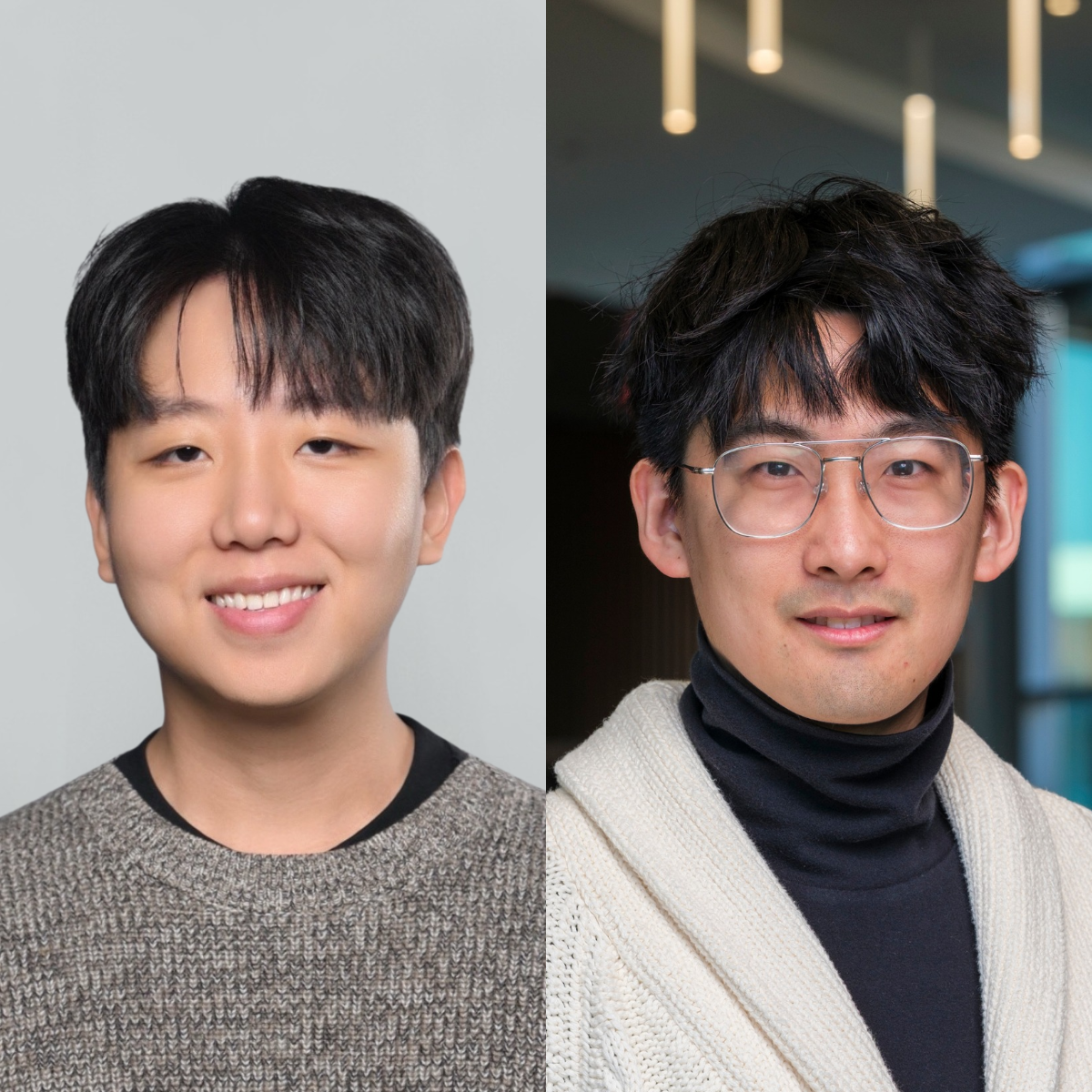
The University of Maryland’s Department of Computer Science has announced alumni Suho Shin (Ph.D. ’26, computer science) and Zeyu Yan (Ph.D. ’26, computer science) as recipients of the 2026 Larry S. Davis Doctoral Dissertation Award. Shin is now a joint postdoctoral researcher at Stanford University and the Massachusetts Institute of Technology, while Yan is a postdoctoral research fellow at the Georgia Institute of Technology. The award recognizes dissertations for their technical depth, significance, potential impact and presentation quality.
Named after Professor Emeritus Larry S. Davis, the award honors the former department chair, who served from 1999 to 2012 and conducted research in computer vision and high-performance computing.
Suho Shin
Shin’s doctoral research, advised by Jack and Rita G. Minker Professor of Computer Science Mohammad Hajiaghayi, examines how decision-makers can delegate responsibilities to other agents. His work combines computer science, economics and operations research, particularly algorithmic game theory and mechanism design, which study how rules and incentives shape decisions.
His dissertation focuses on algorithmic delegation, including when to assign a task, what to delegate and which agent should perform it. Those questions apply to arrangements in which people rely on other individuals or increasingly autonomous software systems to act on their behalf.
“As AI systems become more capable and autonomous, delegation is becoming an increasingly important part of how humans and systems interact,” Shin said.
He is now exploring how these principles apply to AI agents that collaborate, provide services or participate in digital marketplaces. Shin hopes the research will help establish frameworks for designing interactions between people and AI systems, as well as among multiple AI agents.
Shin also credited the people he worked with at UMD for supporting his research.
“I am especially grateful to my advisor, collaborators, and the staff in the department, whose guidance and support made this research possible,” he said. “It is truly encouraging to see our work recognized in this way.”
Zeyu Yan
Yan’s doctoral research, advised by Associate Professor Huaishu Peng, explores how to design computing technologies' physical components for reuse rather than disposal. He develops materials, fabrication techniques and computational tools that allow electronic devices to be modified, repaired, recycled or repurposed.
By making components easier to recover and reuse, Yan aims to reduce electronic waste and reliance on centralized production and supply chains.
One project, DissolvPCB, uses water-soluble materials and liquid metal conductors to create circuit boards whose components can be recovered. The approach illustrates how manufacturing choices can affect what happens to devices after their initial use.
“As computing and AI become increasingly embedded in our physical world, we need to rethink not only what technologies can do, but also how they are made, maintained and ultimately recovered,” Yan said.
At Georgia Tech, Yan continues working on physical computing systems and fabrication methods that let people customize and reconfigure technology. He also works with the Ulu Lāhui Foundation to develop computer science education materials for high school students.
Yan said the award underscored the importance of examining computing’s environmental consequences.
“I see this award not only as recognition of my research, but also as an affirmation of the importance of the questions it seeks to address,” he said. “I’m truly grateful for this recognition and hope it encourages more attention to how we can advance technology responsibly.”
—Story by Samuel Malede Zewdu, CS Communications
The Department welcomes comments, suggestions and corrections. Send email to editor [-at-] cs [dot] umd [dot] edu.