CS Ph.D. Student Kiarash Banihashem Receives 2026 Google Fellowship
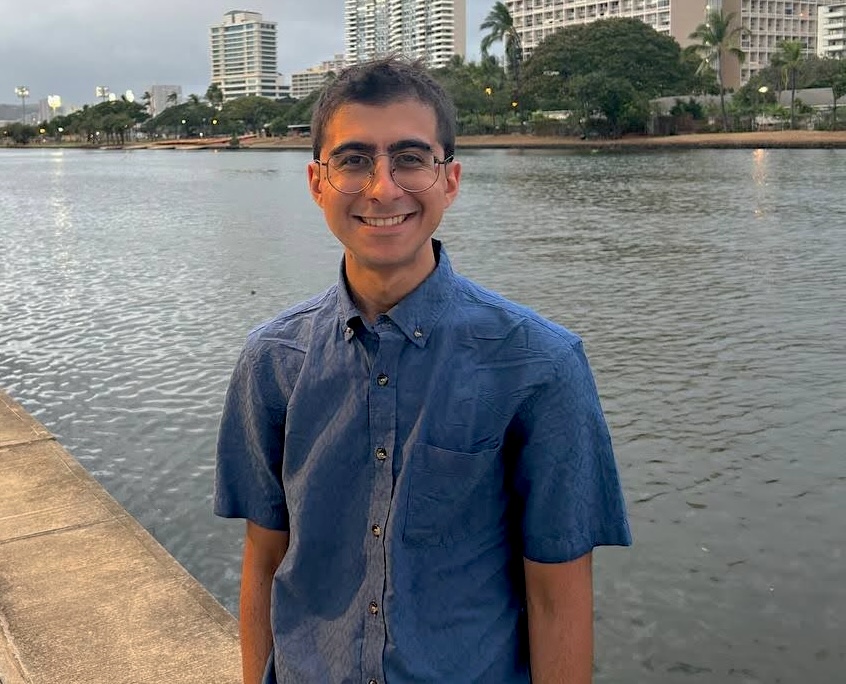
A machine learning algorithm can reach different conclusions when the data it receives changes, even when samples come from the same population. Understanding when to trust those results is central to the work of University of Maryland computer science Ph.D. student Kiarash Banihashem, who received a 2026 Google Ph.D. Fellowship in Algorithms and Optimization.
Banihashem, advised by Jack and Rita G. Minker Professor of Computer Science Mohammad Hajiaghayi, studies the mathematical foundations of machine learning, with an emphasis on how algorithms respond to changing information and different forms of human behavior.
The Google Ph.D. Fellowship Program supports graduate students conducting research in computer science and related fields. In 2026, Google.org is supporting 148 new fellows from 38 countries with $13 million in funding. Since its establishment in 2009, the program has supported more than 1,100 graduate students. Google evaluates candidates based on their research proposals, research impact, academic achievements and leadership potential.
According to the Google Ph.D. Fellowship team, Google research scientists and distinguished engineers involved in this year’s selection process endorsed Banihashem’s nomination.
“I feel incredibly honored and excited to receive this fellowship,” Banihashem said. “It is a wonderful feeling to see the questions I care deeply about recognized in this way. I am grateful to my advisor, collaborators, and the community at UMD for their support and for everything I have learned from them.”
One part of his work focuses on replicability: designing methods that reach consistent conclusions across independently collected datasets from the same population. For researchers working with limited samples, such guarantees can help distinguish findings that persist across datasets from results that depend heavily on which observations were collected.
He also studies dynamic algorithms that adjust as information changes and strategic behavior, where people’s decisions are influenced by their own interests. These issues arise in settings such as online marketplaces and recommendation platforms, where new information and user decisions can affect what an algorithm does next.
“As algorithms play a larger role in everyday decisions, we need to understand when we can rely on their results,” Banihashem said.
According to Hajiaghayi, Banihashem’s research contributions extend across machine learning and theoretical computer science.
“Kiarash has always been an exceptionally strong and diligent student, with an impressive record of publications,” Hajiaghayi said. “Most recently, he made a significant contribution to the important Matroid Secretary problem.”
The problem examines how to select valuable options as they arrive without knowing what choices will become available later, while following rules that limit which options can be chosen together. In a recent paper co-authored with Hajiaghayi and other researchers, Banihashem examined mathematical guarantees for algorithms addressing versions of that problem.
Hajiaghayi also discussed Banihashem's selection for the fellowship.
“Being selected in a fierce competition as one of only very few students worldwide in the ML + Algorithms area for this prestigious Google Fellowship is a remarkable achievement—and one he richly deserves,” Hajiaghayi said as Kiarash becomes his fifth student to receive the Google Fellowship.
Banihashem earned a bachelor’s degree in computer engineering from Sharif University of Technology and a master’s degree in computer science from UMD. He has also completed research internships at Microsoft Research, Adobe Research, Toyota Technological Institute at Chicago and the Max Planck Institute for Software Systems.
Looking ahead, Banihashem plans to explore how advances in artificial intelligence might help researchers move from mathematical findings to working systems. He said AI-based tools could make it easier to test ideas and tackle computational and engineering challenges in implementing new algorithms.
“I plan to use these new capabilities to turn insights about reliability, incentives, and changing data into algorithms that address real-world problems,” Banihashem said.
—Story by Samuel Malede Zewdu, CS Communications
The Department welcomes comments, suggestions and corrections. Send email to editor [-at-] cs [dot] umd [dot] edu.