Three CS Majors Receive CRA Honors for Undergraduate Research
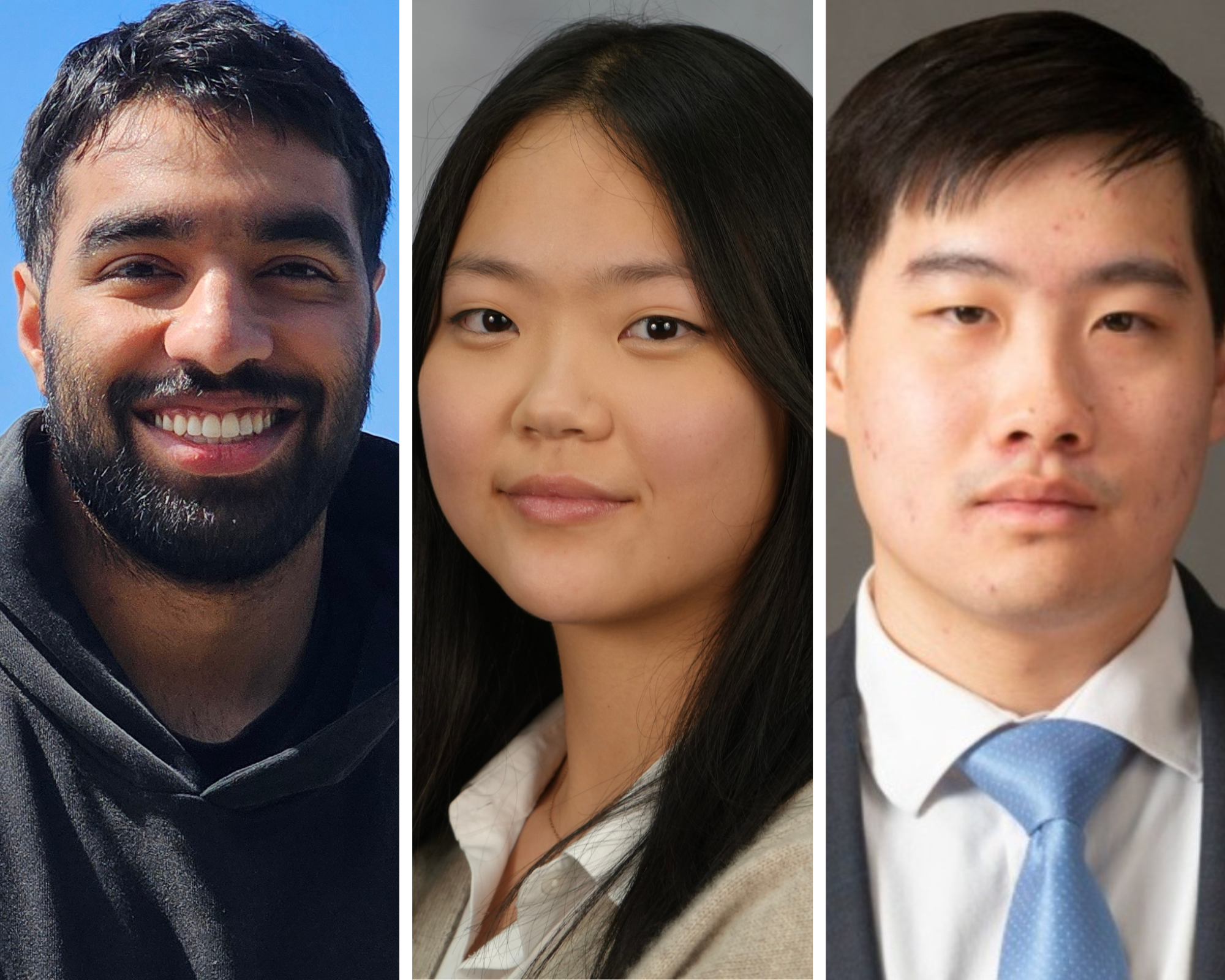
Three undergraduate students from the University of Maryland’s Department of Computer Science have received honorable mention recognition from the 2025–2026 Computing Research Association (CRA) Outstanding Undergraduate Researcher Award. Recent graduate Anirud Aggarwal (B.S. ’25, computer science; B.S. '25, mathematics) and seniors Grace Cai (B.S. '26, computer science; B.S. '26, physics) and Steven Su (B.S. ’26, computer science) were recognized for research projects addressing challenges in computer vision systems, micro-mobility modeling and online privacy and security.
The CRA Outstanding Undergraduate Researcher Award recognizes North American undergraduates who demonstrate strong research potential in computing. The program considers research contributions, academic performance and the ability to articulate the broader relevance of the work.
Anirud Aggarwal
 Aggarwal’s research focuses on computer vision, with particular attention to improving the efficiency of image and video-generation models and understanding how vision systems internally represent information. His work has examined methods to accelerate image generation using Diffusion Transformers and introduced a lightweight approach to upsampling latent features.
Much of Aggarwal’s research emphasizes computational efficiency, which can reduce the hardware resources required to generate images and videos. He said these approaches can make creative tools more accessible to users without specialized hardware and reduce energy use in large-scale deployments.
“I am honored to have been selected as an honorable mention by the committee,” Aggarwal said. He credited his advisor, Associate Professor of Computer Science Abhinav Shrivastava, and his former doctoral student, Matthew Gwlliam (Ph.D. ’25, computer science), for their mentorship throughout the research process.
His paper was recently accepted to the 2026 International Conference on Learning Representations. He said his advisors' mentorship helped him learn to frame research questions and approach problems from a research perspective.
Looking ahead, Aggarwal is working on neural video compression and exploring methods to accelerate diffusion-based language models. He plans to pursue a Ph.D. to continue his research in efficient machine learning systems.
Grace Cai
 Cai’s research integrates classical mechanics with modern control methods to model the dynamics of micro-mobility vehicles, including bicycles, scooters and skateboards, as well as wheeled robots such as delivery vehicles. She developed a generalizable, physics-based model that supports vehicles with arbitrary wheel configurations.
The model incorporates tire-level dynamics to capture effects such as tire slip, rider lean and load transfer. Through empirical validation, Cai and her collaborators found that the model reduced average displacement error across multiple vehicle types when compared with the widely used kinematic bicycle model.
The research has been accepted to the 2026 International Conference on Robotics and Automation (ICRA), one of the leading conferences in the field of robotics.
“I am very proud to be recognized for my work,” Cai said. She said the recognition affirmed the research's potential impact and reinforced her interest in pursuing graduate study. Cai thanked her advisors, Professor of Computer Science Ming Lin and Laura Zheng for their guidance and feedback.
Cai said Lin directed her to micro-mobility as a relevant yet underexplored research area, while Zheng provided guidance on simulation tools for model development and validation. She said her advisors also helped her learn how to define research problems, frame solutions and communicate results in academic writing.
According to Cai, the research can support more accurate traffic simulations, allowing urban planners to evaluate infrastructure designs and safety policies as micro-mobility vehicles become more common in cities. The model can also be integrated into autonomous control systems to improve navigation and safety in complex urban environments.
Currently, Cai is applying differentiable programming techniques to enable parameter optimization and extend the model to autonomous micro-mobility control. She plans to integrate the work into a state-of-the-art traffic simulator to study interactions between micro-mobility vehicles and other road users.
Steven Su
 Su’s research focuses on security and privacy, examining how publicly available data can be used to infer sensitive information about individuals. His recent work identified a privacy vulnerability in online auctions that allows the locations of buyers and sellers of Wi-Fi access points to be tracked at scale.
The research demonstrated how publicly available application programming interfaces and machine learning models can extract unique device identifiers from online marketplace listings. By combining these identifiers with data from Apple’s Wi-Fi positioning system, Su and his collaborators showed that it is possible to track the location and movement of buyers and sellers over time.
“I am deeply honored to have received this recognition,” Su said. “It encourages me to continue performing research and to work on projects that positively impact society. I would like to thank my advisors, family and friends for their support throughout this journey.”
Su said the work highlights how seemingly minor technical details can have significant privacy implications.
“Our work highlighted a privacy vulnerability that impacts everyday users,” he said. “We hope it raises awareness of how a seemingly innocuous device identifier can lead to surprisingly large privacy implications and encourages auction platforms and device manufacturers to implement mitigations.”
Su was advised by his co-authors, Associate Professor of Computer Science Dave Levin, Erik Rye (Ph.D. ’25, computer science) and Robert Beverly. He said their guidance was especially influential as the project was his first research effort completed from start to finish.
Looking ahead, Su plans to continue conducting research in security and privacy. He is currently working on a project to better understand the botnet landscape.
—Story by Samuel Malede Zewdu, CS Communications
The Department welcomes comments, suggestions and corrections. Send email to editor [-at-] cs [dot] umd [dot] edu.