Nirupam Roy Connects AI and the Physical World
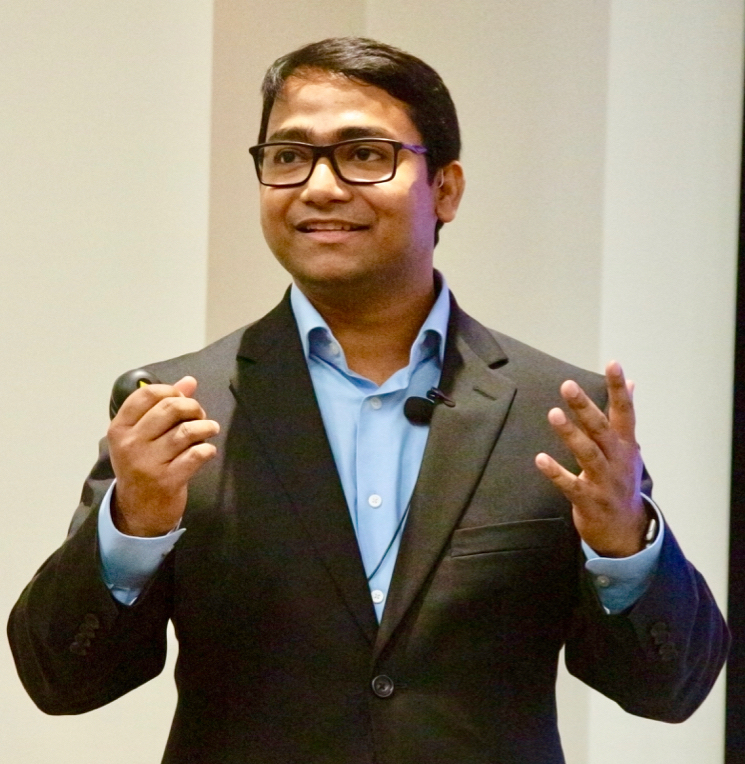
Nirupam Roy is an associate professor in the University of Maryland’s Department of Computer Science, where he leads research at the intersection of artificial intelligence and physical sensing. Affiliated with the iCoSMoS Lab, Roy’s work focuses on what he describes as “physical intelligence,” systems that integrate AI with real-world signals to enable more context-aware, secure and energy-efficient technologies.
In this Q&A, he reflects on the experiences that led him to academia, the evolution of his research focus and the broader impact he hopes his work will have.
What initially led you to pursue a career in computer science, and was there a moment that shaped your decision to enter academia?
After completing my undergraduate degree, I took a research and development job that many students at the time considered a strong outcome. It was the kind of role people actively aimed for, and initially, I felt that I had taken the right path. As I spent more time there, however, I realized that the work did not fully satisfy my desire to explore new scientific questions. I wanted more freedom to learn, to ask open-ended questions and to pursue ideas over a longer horizon. That realization developed gradually rather than through a single defining moment. Over time, it became clear that academia would allow me to do that kind of exploration, which ultimately led me back to research-focused work.
How has your research focus evolved since then?
My research has changed significantly over time. What I worked on during my Ph.D. was different from my early years as a faculty member, and it has continued to evolve during my time at UMD. Currently, my group focuses on physical intelligence. The core idea is that computing systems should not exist separately from the physical world. Instead, they should be able to sense, understand and interact with their surroundings. We saw early versions of this idea when smartphones began integrating sensors into everyday computing. With advances in AI, we now have new opportunities to deepen that connection between computation and physical environments.
What does “physical intelligence” mean in practical terms?
In practical terms, it means developing systems that combine physical sensing, signal processing and AI-based reasoning. Traditional approaches focused on understanding physical signals using handcrafted models, while newer AI systems often abstract away the physical layer entirely. Our goal is to bridge those two approaches. By doing so, we can enable systems that not only interpret data but also understand the physical context in which that data is generated.
Can you describe a project that illustrates this approach?
One project involves spatial sound reasoning. We developed a small 3D-printed meta-material device that captures information about where a sound originates and how far away it is. We then connect that information to a language model so the system can reason about both the content of the sound and its physical location. This kind of capability could support applications ranging from assistive technologies for pedestrians to robots that can respond more naturally in dynamic environments.
What are the main research directions your research group is currently pursuing?
Our work can be broadly grouped into three areas. The first is integrated sensing, which focuses on designing sensors and algorithms that can reason about physical signals in a meaningful way. The second area is power efficiency. Many sensing systems cannot rely on constant battery replacement, especially at scale. We are working on low-power and energy-aware systems, such as lightweight localization technologies that function in environments where GPS is unreliable. The third area is security. As systems become more capable of sensing and interpreting physical signals, it becomes increasingly important to ensure that these capabilities are not misused.
How does security intersect with physical intelligence in your work?
Physical signals often contain more information than users intend to share. For example, voice data includes not only spoken words but also biometric and emotional cues. Our research looks at how to protect users by controlling what information can be extracted from such signals. The goal is to allow systems to function as intended while preventing unintended or abusive use of sensitive data.
What challenges have you encountered while pursuing this research?
Research is inherently challenging, and I see those challenges as part of the process. Beyond technical hurdles, one of the most significant challenges is building and sustaining a shared vision among collaborators. Research depends on people, students, colleagues and partners working toward common goals. Aligning motivations and being mindful of the broader implications of our work are essential aspects of the research process.
What societal impact do you hope your work will have?
Several aspects of our work have direct or near-term societal relevance. Security-related projects aim to help users better protect their data and navigate digital systems safely. We are also involved in educational efforts designed to help older adults and teenagers understand and avoid online threats such as phishing. Other projects explore health-related applications, including early detection of respiratory conditions through sound analysis, as well as sustainability-focused work that reduces reliance on disposable batteries in sensing systems.
What drew you to UMD, and what have you valued most about your time here?
The people were a major factor in my decision to join Maryland. I value being part of a department with faculty and students who are engaged and thoughtful. That environment was appealing when I joined, and it continues to be a motivating part of my work.
What advice would you offer students interested in this area of research?
Research involves uncertainty, and that can be difficult, especially early on. I encourage students to develop a sense of hope and perseverance. Not every idea works immediately, and outcomes are often unclear at the start. Learning to work through that uncertainty is an essential part of research and of tackling complex problems more broadly.
—Story by Samuel Malede Zewdu, CS Communications
The Department welcomes comments, suggestions and corrections. Send email to editor [-at-] cs [dot] umd [dot] edu.