From UMD to Silicon Valley
When mobile & web apps release updates, engineers must ensure new features work properly without disrupting existing ones. That process often involves writing and maintaining detailed test scripts, which frequently break as apps evolve. Fixing those scripts can slow development and consume valuable engineering time.
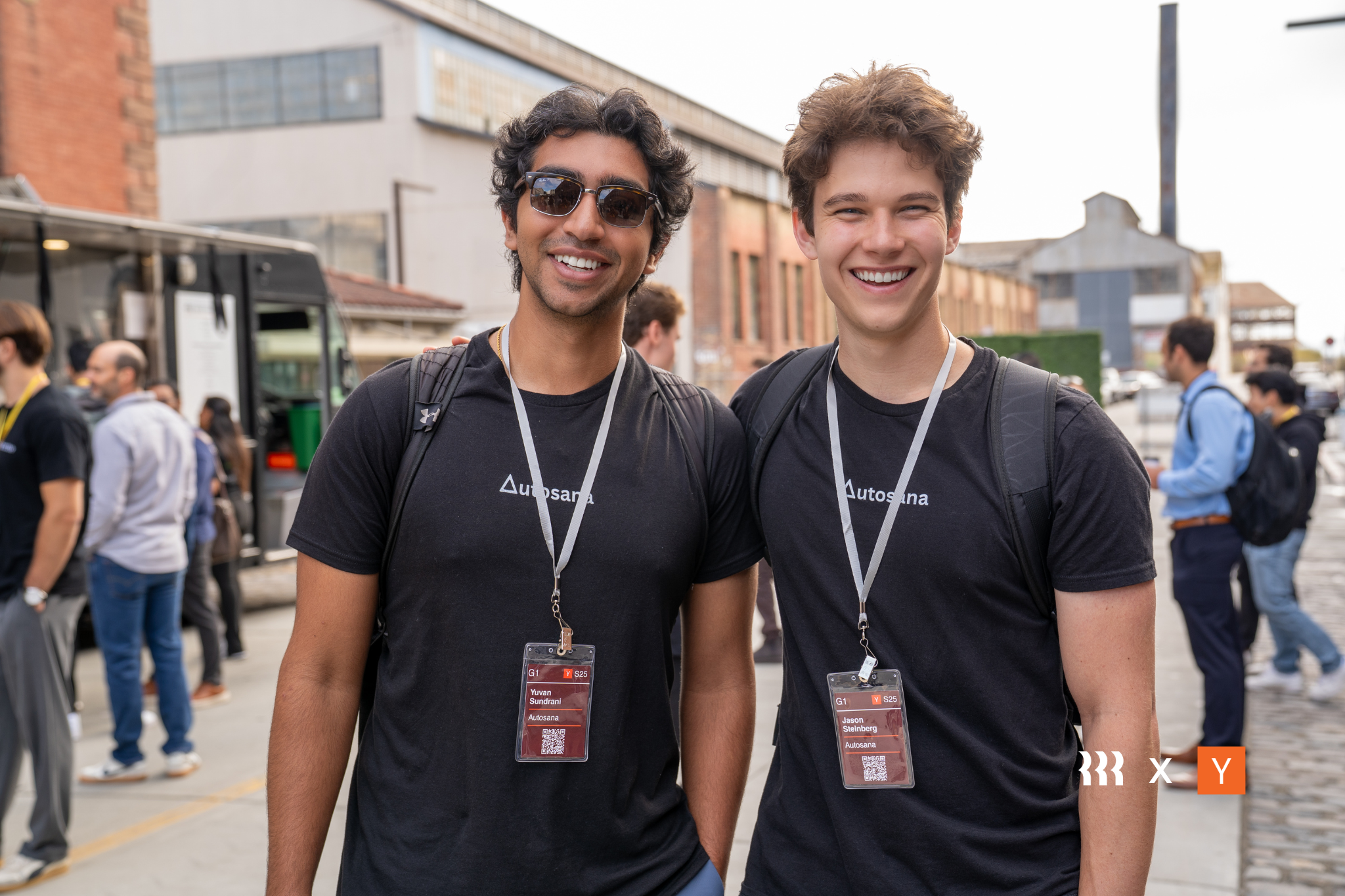
University of Maryland Department of Computer Science alums Yuvan Sundrani (B.S. ’24, computer science; B.S. ’24, information science) and Jason Steinberg (B.S. ’24, computer science; B.S. ’24, general business) saw those challenges firsthand. In 2025, they launched Autosana, a platform that uses artificial intelligence agents to automatically test mobile and web applications. Engineers can describe test scenarios in plain English, and the system simulates user behavior, identifies issues and reports results.
Sundrani serves as Autosana’s chief executive officer, overseeing product development and company direction, while Steinberg serves as chief technology officer, leading engineering. The company was accepted into Y Combinator’s summer 2025 batch, a startup accelerator that provides early-stage companies with funding and mentorship. Following their acceptance, the founders relocated to San Francisco to continue building the platform.
“We realized this was something every engineering team struggled with,” Sundrani said. “Testing was slowing people down, and it didn’t have to be that way.”
Early CS Exposure
Autosana grew out of a partnership that began long before the founders entered the startup world. Sundrani and Steinberg grew up in Montgomery County, Maryland, attending the same schools before enrolling at the University of Maryland. Their early collaboration was shaped by a shared interest in building and experimenting with technology.
Sundrani was drawn to engineering through hands-on projects, often designing and assembling physical prototypes.
“I liked taking something from an idea to something real,” Sundrani said. “Something was exciting about building something yourself and seeing it actually work.”
Steinberg discovered programming later but quickly became interested in creating software. As their technical skills developed, the two began working together more frequently, forming a partnership built on experimentation and problem-solving.
That collaboration continued in college, where they launched Soshi, a mobile app designed to simplify contact sharing. Although the app did not become a lasting business, it introduced them to the realities of building software products.
“It was our first company together, and it was a lot of fun. Nobody really used the app, but it was a great learning experience,” Sundrani said. “More importantly, we learned that you need to validate your idea asap when building a company.”
They later joined StoryIt as the first engineers and within months became CTO & CPO, where they were responsible for building all the tech from the ground up. The experience exposed them to production environments and the technical demands of scaling software.
Experience Gained
 After graduating in 2024, both joined Shift Health as engineers. It was there that they encountered a problem that would eventually define their startup.
Automated tests, designed to ensure software worked correctly, often failed for reasons unrelated to actual bugs. Maintaining those tests required constant updates, which slowed development and created additional work for engineers.
“We found ourselves spending more time fixing tests than building new features,” Sundrani said. “It didn’t make sense that something meant to help engineers was creating so much extra work.”
That frustration led them to explore whether AI could approach testing differently. Instead of relying on rigid scripts, they began experimenting with vision-language models that interact more dynamically with applications.
In early 2025, they committed fully to the idea. Working from home, they began developing Autosana while speaking with engineers to better understand the problem's scope.
“We were talking to anyone who would give us feedback,” Sundrani said. “We wanted to make sure we were solving something real.”
Autosana allows engineers to describe workflows, such as signing in or completing transactions, using natural language. The platform then performs those actions automatically and verifies whether the software behaves correctly.
Turning Point
 The founders applied to Y Combinator multiple times with different ideas before Autosana was accepted. This time, they entered the interview with a working product.
“We showed them the system running live,” Sundrani said. “It wasn’t just a concept anymore. It was something teams are using and paying for right now.”
Their acceptance marked a major milestone, giving them access to mentorship, funding and a network of experienced founders. The program also brought them to San Francisco, where they began working alongside other early-stage startups.
Steinberg said the Y Combinator environment pushed founders in a good way.
“The batch was intense but very rewarding,” Steinberg said. “There’s a lot of pressure to gain traction in a short period of time, and it forces you to stay focused on building and improving the product. We’ve also met many talented founders through the experience.”
Maryland Foundation
The start-up now has a small team that exclusively includes UMD computer science students and alums. Founding engineer Aayush Gupta (B.S. ’25, computer science) and software engineers Siddhant Kumar (B.S. ’26, computer science) and Cartor Hancock (B.S. ’26, computer science) contribute to development.
Sundrani said his experience at Maryland, especially Startup Shell, played an important role in preparing him for startup work. Beyond technical skills, the environment encouraged experimentation and collaboration.
“You’re constantly around people who are building things,” Sundrani said. “That kind of environment makes you want to push yourself further.”
Continuing Forward
Autosana remains in its early stages, with the founders focused on improving the platform and expanding its capabilities.
Steinberg said the goal is to keep on building a reliable platform for their customers.
“We’re focused on making sure our customers have a good experience over time,” Steinberg said. “We recently added web app support and plan to expand into other areas based on where we see demand.”
He said their experience building Autosana has reinforced the importance of consistency and long-term focus when developing tools intended for real users.
“One thing is that building a great company is about doing ordinary things over an extraordinary amount of time,” Steinberg said. “Most companies will fizzle out, and the ones that last are the ones that find sustainability.”
When it's all said and done, for longtime friends, Autosana represents the continuation of a partnership shaped by years of shared technical curiosity and persistence.
“We’ve been building things together for years,” Sundrani said. “Autosana is the result of everything we’ve learned along the way.”
—Story by Samuel Malede Zewdu, CS Communications
The Department welcomes comments, suggestions and corrections. Send email to editor [-at-] cs [dot] umd [dot] edu.