Recent News & Accomplishments
2026
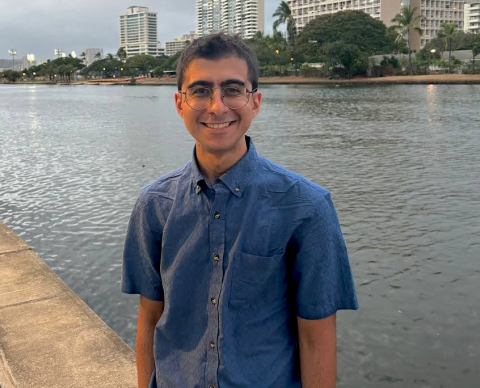
His research focuses on developing algorithms that produce consistent results, adapt to changing data and account for human behavior in machine learning systems.
A machine learning algorithm can reach different conclusions when the data it receives changes, even when samples come from the same population. Understanding when to trust those results is central to the work of University of Maryland computer science Ph.D. student Kiarash Banihashem , who received a 2026 Google Ph.D. Fellowship in Algorithms and Optimization. Banihashem, advised by Jack and Rita G. Minker Professor of Computer Science Mohammad Hajiaghayi , studies the mathematical foundations of machine learning, with an emphasis on how algorithms respond to changing information and... read more

Uzi Vishkin's invention of building parallel processing into a computer's CPU is present in billions of devices worldwide.
For the United States' 250th anniversary, the University of Maryland's Terp magazine set out to highlight " 25 Terp Innovations That Changed History ." In a recent follow up story featuring inventions that they missed, an invention by Uzi Vishkin , a professor of electrical and computer engineering and long-time UMIACS faculty member, was at the top of that list. From the story: "Parallel computing — the technology that lets computers, tablets and smartphones juggle on-screen graphics, a YouTube video and other tasks – stems from research by Vishkin. Of all the game-changing technologies we... read more
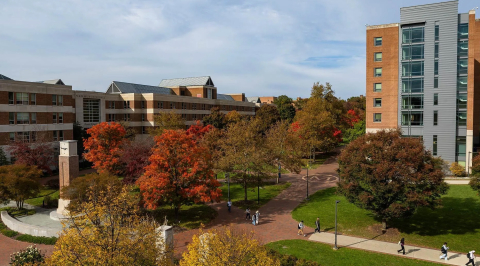
Annual list also places UMD No. 1 in the mid-Atlantic and No. 3 among public institutions.
The University of Maryland has risen to an all-time high of No. 4 in the nation for undergraduate entrepreneurship education, according to 2027 rankings released Tuesday by The Princeton Review and Entrepreneur magazine. UMD also placed No. 3 among public universities and has the No. 1 undergraduate entrepreneurship program in the mid-Atlantic and Big Ten. In addition, the university ranks No. 15 overall among graduate entrepreneurship programs and No. 2 in the mid-Atlantic. This marks the second time UMD has been named in the top five and 12th consecutive year in the top 10 of the Top... read more

Information Science major Francis Ametewee developed a campus navigation platform with guidance from Computing Catalyst’s TechStart program.
When Francis Ametewee arrived at the University of Maryland, finding his classrooms often meant deciphering building abbreviations before he knew where to go. After repeated searches and requests for directions, he had an idea: build a campus guide that starts with what students already know. Ametewee, a junior majoring in information science in UMD’s College of Information , developed TerpNav , a free website that helps people find campus buildings and understand parking restrictions. As he worked to improve the platform, he participated in TechStart , a summer program taught by UMD Lecturer... read more

UMD computer science faculty members Jordan Boyd-Graber and Rachel Rudinger, along with doctoral student Neha Srikanth, were recognized for research examining how people and AI systems respond to questions.
University of Maryland Department of Computer Science Professor Jordan Boyd-Graber and Associate Professor Rachel Rudinger , along with doctoral student Neha Srikanth , received a Best Paper Award at the 2026 Conference on Empirical Methods in Natural Language Processing (EMNLP) for research examining how humans and artificial intelligence systems respond to questions. Their paper , titled "DiscoTrace: Representing and Comparing Answering Strategies of Humans and LLMs in Information-Seeking Question Answering," was one of two papers selected for the award. The conference was held Oct. 24-29... read more
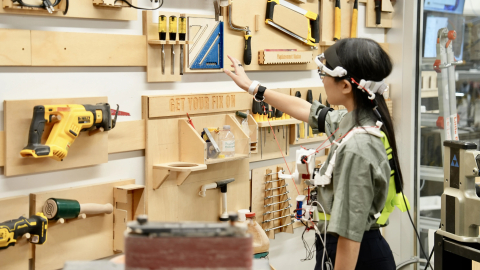
UMD researchers developed an AI exosuit that intercepts human errors mid-motion to accelerate physical skill learning.
A home cook finishes chopping vegetables, pauses for a moment, and reaches for the soy sauce when the recipe called for salt. Small slips like this happen in the brief gap between one step and the next, and for beginners they add up, slowing learning and chipping away at confidence. AI assistants can already guide people through a task on a screen or by voice. Guiding the body itself, at the moment a mistake is about to happen, calls for a different approach. To catch these physical mistakes before they happen, University of Maryland researchers created a wearable artificial intelligence... read more
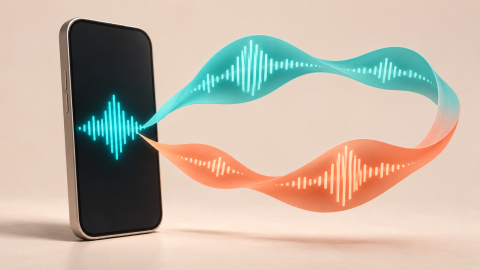
UMD alum Utkarsh Tyagi (M.S. ’25) draws on his research experience at Maryland to develop SteerDuplex, a model designed to make voice-based AI systems more responsive to spoken instructions.
Asking someone to slow down, speak louder or wait until a sentence is finished is a routine part of conversation. But when the listener is an artificial intelligence voice assistant, those simple requests may not produce the expected response. For alum Utkarsh Tyagi (M.S. ’25, computer science), that limitation raised a research question: Can AI systems learn not only what to say, but how and when to say it? Tyagi, advised by Distinguished University Professor Dinesh Manocha , led the development of SteerDuplex , a speech-to-speech AI model designed to adjust its speaking behavior in response... read more

With a new $150,000 grant, an interdisciplinary team that includes Jun Nishida and Nirupam Roy will develop wearable technology to give Deaf and hard-of-hearing audiences new ways to experience music.
A flute that feels like raindrops fluttering across the skin. A violin that registers as a looping sensation. Drums that arrive as an insistent, rhythmic pulse. That’s how Jill Bradbury, a Deaf scholar and director of the University of Maryland’s School of Theatre, Dance, and Performance Studies (TDPS), describes what live music could feel like for Deaf and hard-of-hearing audiences. Now, a $150,000 grant from the Artists Make Technology Lab (AMT Lab), an initiative supporting innovation in the performing arts, will help her and an interdisciplinary UMD team make that a reality. The team will... read more

He studies robot learning and manipulation, and how artificial intelligence can help machines better understand and interact with the physical world.
Humans learn how the physical world works long before they can explain it. Through play, they pick up objects, move them around, try different actions and learn from what happens next. Ruoshi Liu is exploring whether robots can learn in a similar way. Liu joined the University of Maryland’s Department of Computer Science as an assistant professor in fall 2026. His research focuses on robot learning, computer vision and machine learning, with a broader goal of developing systems that can understand their surroundings and use that knowledge to perform physical tasks. “I’m super excited overall... read more
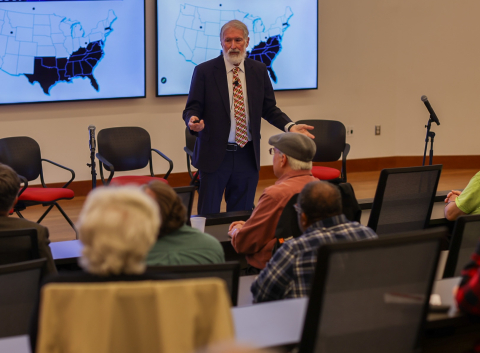
Alumni and former researchers revisit the University of Maryland’s role in developing early internet infrastructure and connecting academic institutions across the country.
“Our university and our region have been the hub of technological discovery and progress for more than a century,” said President Pines, as he and Vice President Patrick O’Shea kicked off the “When UMD Was the Center of the Internet” event on October 21. He noted that UMD established its “place in history as the first university in the world to fully connect by internet protocols, and home to the first internet exchange point between commercial, government, and academic computer networks,” placing those achievements as a key local milestone between the first local and trans-Atlantic telegraph... read more