UMD CS Organizes 2026 Research Day
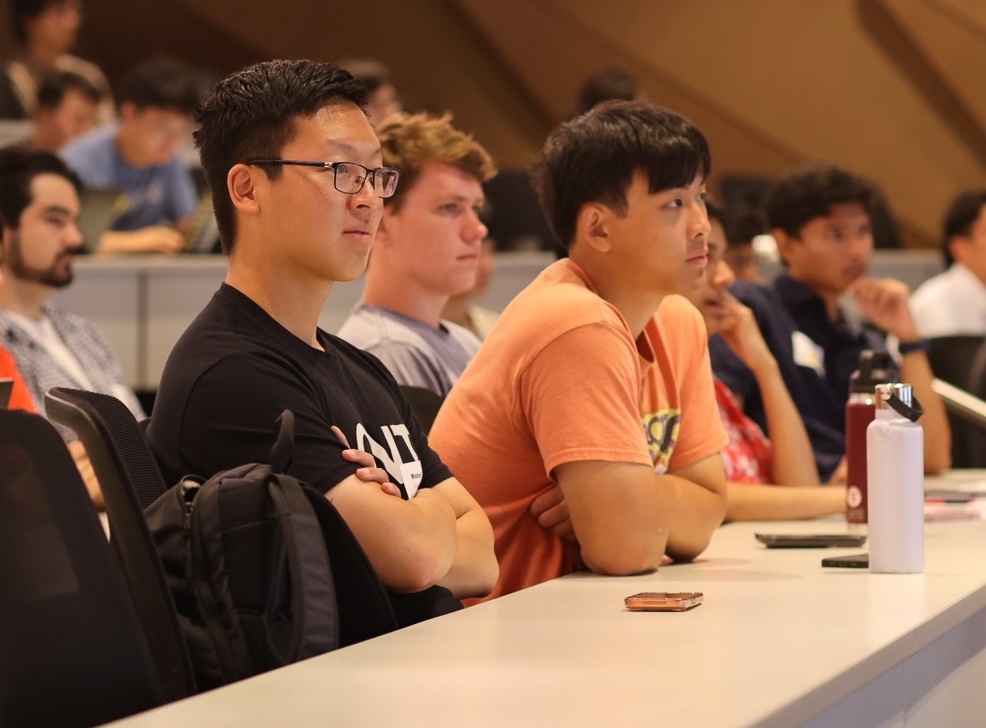
The University of Maryland’s Department of Computer Science organized its annual Computer and Computational Sciences Research Day on August 27, giving incoming graduate students an overview of research across computing fields and opportunities to connect with faculty. The event took place in Antonov Auditorium at the Brendan Iribe Center for Computer Science and Engineering.
The department expects 179 incoming graduate students this fall. The cohort includes 78 doctoral students, 49 master’s students and 52 students pursuing a combined bachelor’s and master’s degree.
Faculty presentations were organized into five panels: “Foundations: Theory, Language, Quantum & Parallelism”; “AI for Science, Society & Real-World Impact”; “Machine Perception & Sensing”; “Robotics, Autonomy & Embodied Intelligence”; and “Systems, Networking & Cybersecurity.” Breaks between sessions gave students time to discuss the presentations with faculty members and one another.
The event featured research from the Department of Computer Science and several UMD institutes, centers and laboratories, including the University of Maryland Institute for Advanced Computer Studies (UMIACS), the Maryland Cybersecurity Center (MC2), the Human-Computer Interaction Laboratory and the Center for Bioinformatics and Computational Biology.
Amol Deshpande, a computer science professor and the department’s associate chair for graduate education, described how the format introduces students to several subjects.
“Research Day gives incoming graduate students an opportunity to learn about work taking place across the department,” Deshpande said. “For those who have not already narrowed their interests, it is a chance to meet faculty members and other students, ask questions, and begin identifying potential advisers or research groups.”
David Mazi, an incoming master’s student planning to study artificial intelligence and machine learning in health care, said the foundations panel prompted him to consider AI’s computing infrastructure. He previously studied electrical and computer engineering at the University of Arizona.
Mazi said Affiliate Professor of Computer Science Uzi Vishkin’s presentation introduced him to parallel computing in a simpler way than he had previously examined.
“I would like to not just understand what I want to focus on, but understand every kind of adjacent piece of technology around it,” Mazi said. “Knowing about hardware greatly informs the kind of software you should be writing to take advantage of that.”
The AI panel also connected with Mazi’s interest in health care. He cited Assistant Professor Ritwik Gupta’s discussion of disaster analysis and another presentation on using AI in education as possible connections outside his primary area.
Nishit Anand entered UMD’s doctoral program after completing his master’s degree in computer science at the university in 2026. He worked with professors Dinesh Manocha and Ramani Duraiswami on benchmarking and training large audio-language models that process speech, music and background sounds.
Anand said the range of subjects was the main feature that stood out to him during Research Day.
“It was not limited to just one area,” Anand said.
He pointed to presentations on computer vision, robotics, natural language processing, audio processing, dexterous manipulation and diffusion models. Anand said he plans to examine diffusion models, audio understanding and audio processing while determining a specific doctoral research direction.
The department’s graduate program is No. 12 overall and No. 7 among public institutions in U.S. News & World Report’s 2027 Best Graduate Schools rankings. Artificial intelligence ranks No. 16, systems No. 17 and theory No. 19.
—Story by Samuel Malede Zewdu, CS Communications
The Department welcomes comments, suggestions and corrections. Send email to editor [-at-] cs [dot] umd [dot] edu.