Dissolvable Circuit Board Designed for Reuse Earns Design Recognition
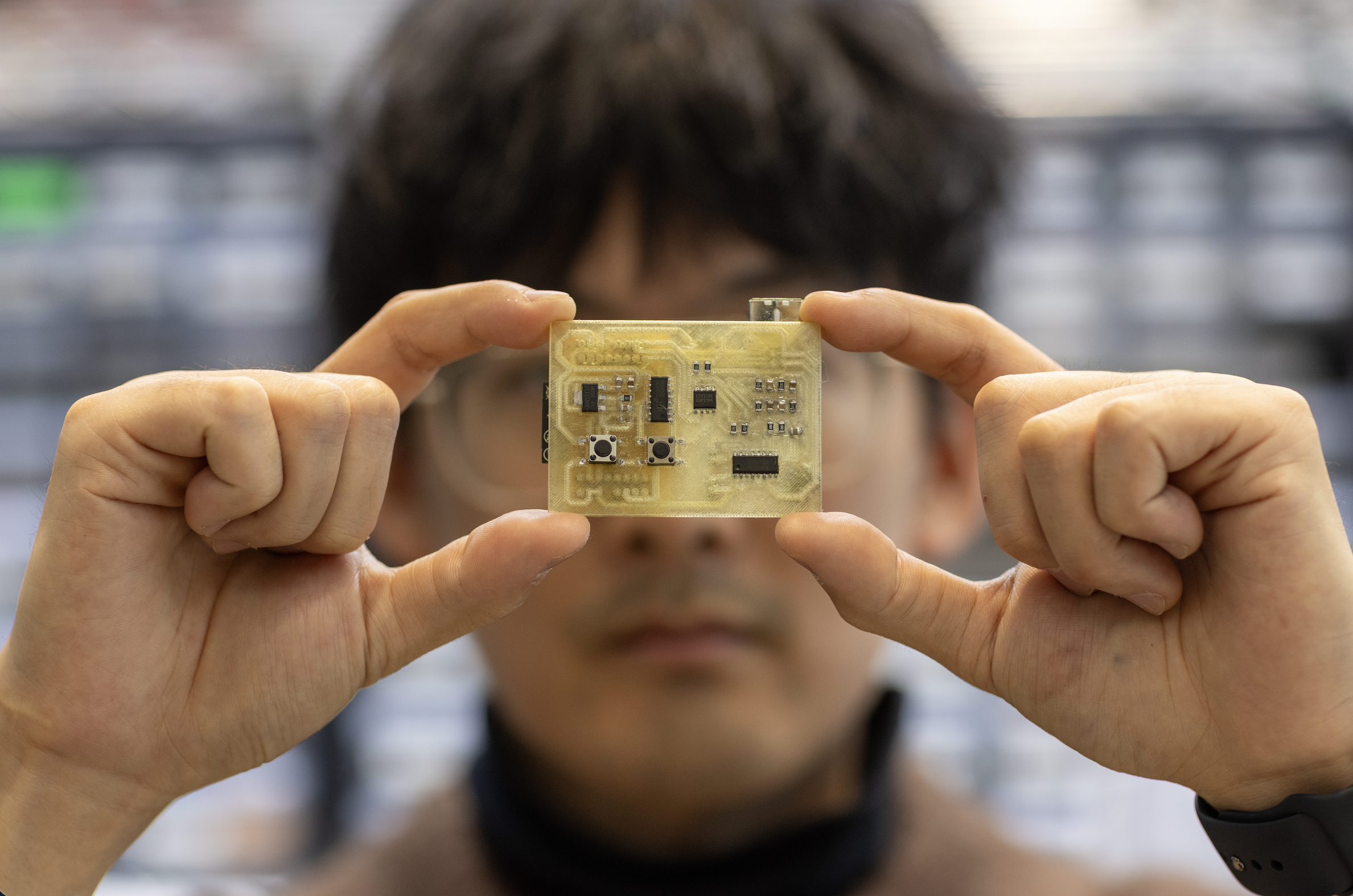
Before an electronic device reaches its final form, engineers may build and test multiple versions of its circuit board. Those prototypes can help refine a design, but once they are no longer needed, recovering their materials and electronic components can be difficult.
A research project led in part by the University of Maryland is exploring another approach: building circuit boards that can be dissolved and reused.
DissolvPCB, developed by researchers at UMD, the Georgia Institute of Technology and the University of Notre Dame, received an honorable mention in the student category of Fast Company’s 2026 Innovation by Design Awards, announced Sept. 14. Department of Computer Science Associate Professor Huaishu Peng worked on the project with UMD computer science alum Zeyu Yan (Ph.D. '26, computer science), the study’s first author, and collaborators from the three universities.
The project focuses on printed circuit boards used for rapid prototyping, when engineers build early versions of electronic devices to test and refine their designs. Instead of using conventional circuit board materials, DissolvPCB uses a water-soluble plastic called polyvinyl alcohol, or PVA, as its base and a liquid metal alloy to conduct electricity.
When a board is no longer needed, it can be placed in water. The PVA dissolves, while the liquid metal forms into a bead that can be collected. Electronic components can also be removed and reused. In testing, the researchers reported recovering more than 98% of the materials used to make the boards.
The Fast Company recognition follows a Best Paper Award for the research at the 2025 ACM Symposium on User Interface Software and Technology (UIST). Peng said the latest recognition places the project in a different context.
“This award feels different because it comes from the international design community,” Peng said. “It reflects our goal for this research to break down disciplinary silos and be truly interdisciplinary.”
Beyond reducing discarded materials, the researchers are examining whether reusing circuit board materials and components could lower prototyping costs.
“If we approach sustainability smart enough, it should also generate economic benefits,” Peng said. “With DissolvPCB, the ability to reuse most of the materials and electronic components repeatedly can save circuit designers a large amount of money while also lowering the cost of each design iteration.”
The project brought together Yan, SuHwan Hong and Peng at UMD, Josiah Hester at Georgia Tech and Tingyu Cheng at Notre Dame. Peng said the researchers jointly planned the project and worked through technical challenges as they developed and evaluated the fabrication process.
Yan has since graduated from UMD and looks to join Georgia Tech as a postdoctoral researcher, where he continues research on recyclable electronics.
“Electrification and smartification have been going on for decades, and that will continue with advances in AI and platform technologies,” Yan said. “That also means we’re going to need a lot more electronics and have a lot more e-waste to deal with. We don’t want sustainability to slow that progress down. With such projects, we’re trying to make it practical to manufacture, recover and remake electronics locally.”
The team also developed an open-source software plugin that converts conventional circuit board design files into models that can be produced with a standard 3D printer. Researchers used the method to build and recycle several working devices, including a Bluetooth speaker and a shape-changing gripper.
For now, Peng said DissolvPCB is primarily intended for rapid prototyping.
“In the longer term, it could potentially be extended to the mass production of PCBs if several remaining technical limitations can be overcome,” Peng said.
—Story by Samuel Malede Zewdu, CS Communications
The Department welcomes comments, suggestions and corrections. Send email to editor [-at-] cs [dot] umd [dot] edu.