UMD CS Announces Hatchery Teams for 2026-2027
The University of Maryland’s Department of Computer Science has selected five student teams, Pinloop, NexFlow, Shelf, Simulace and PulseFi, for the 2026-2027 academic year of the Mokhtarzada Hatchery Program.
The Hatchery provides selected teams with up to $10,000 in funding, access to startup mentors and workspace in the Brendan Iribe Center for Computer Science and Engineering. Teams use the academic year to develop and test ideas, identify potential users and refine products and business models.
Funded by UMD alumni and siblings Haroon (B.A. ’01, economics), Idris (B.S. ’10, computer science) and Zeki Mokhtarzada (B.S. ’01, computer science), the program was established in 2021 to give student founders a structured environment to explore and test ideas.
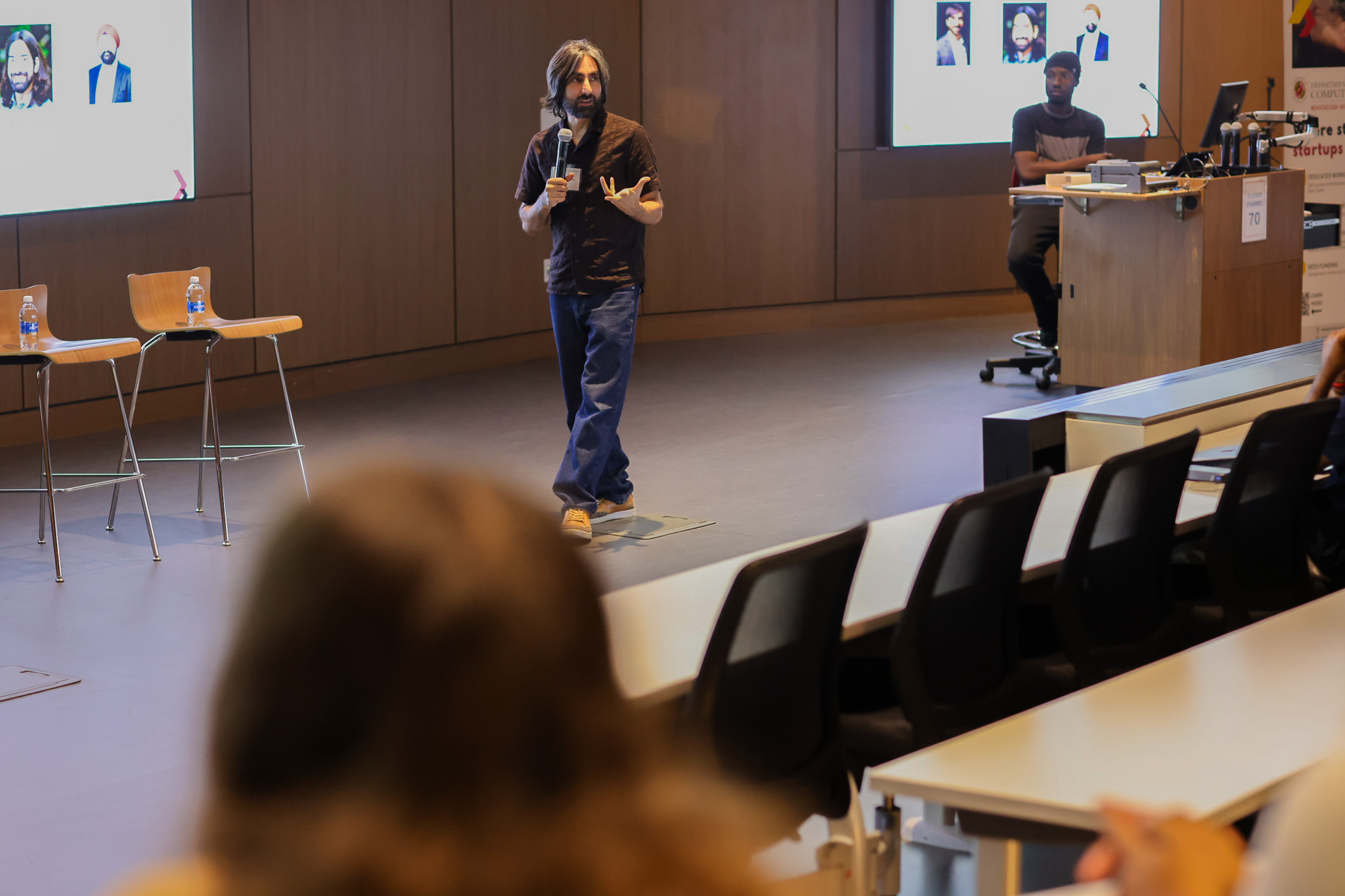
Each team is expected to present its progress at the program’s annual showcase at the end of the spring semester.
Pinloop is developing a platform to reduce the time spent searching for and applying for jobs. The system combines a job database with tools that allow artificial intelligence agents to search listings, complete application forms and track outcomes.
The platform is also designed to collect information about employer responses and the types of applications or outreach that lead to interviews or offers. The team says those results could help users identify employers and application approaches associated with higher response rates.
Pinloop is led by UMD undergraduate Andrew Allen (B.S. ’28, computer science).
NexFlow
NexFlow is developing an AI voice receptionist for small home-service businesses, including HVAC, plumbing and locksmith companies. The system is designed to answer calls when owners or technicians are unavailable, respond to basic questions about services and pricing and book appointments into a business’s calendar.
According to the team, the system can also identify urgent calls, such as reports of a burst pipe or a lack of heat, and escalate them to the owner based on customized rules.
The NexFlow team includes UMD undergraduate Aditya Kaushik (B.S. ’30, computer science) and Northeastern University student Deepanshu Kaushik (B.S. ’28, computer science).
Shelf is a neighborhood marketplace for borrowing equipment that owners may use only occasionally, including ladders, leaf blowers and pressure washers. Users can list items and make them available to nearby residents for short-term use.
The platform uses Stripe for payments and identity verification. According to the team, Shelf is available through the App Store in 10 neighborhoods and includes listings across more than 15 item categories. The team aims to offer an alternative to buying equipment you may use infrequently.
The Shelf team includes UMD students Ranita Rajkumar (B.S. ’27, information science) and Arush Jain (B.S. ’27, computer science).
Simulace is developing a software-neutral system intended to manage handoffs among engineering tools used in hardware design. Hardware teams may move models among computer-aided design, thermal, structural and optical software as they evaluate design changes.
The platform is designed to automate those transfers while working with software a company already uses and operating within the company’s network. Its developers say the system is intended to make each step reproducible while reducing manual data movement between programs.
The Simulace team includes UMD students Rowand Zara (B.S. ’29, aerospace engineering and applied mathematics) and Shreyan Pasham (B.S. ’29, computer engineering).
PulseFi is developing a passive Wi-Fi-based system intended to monitor health-related signals and movement patterns without requiring wearable devices or cameras. The system uses two wall-powered nodes and analyzes changes in Wi-Fi signals as they interact with a person’s body.
According to the team, the technology is being developed to measure signals including heart rate and breathing rate and to identify events or changes related to apnea, falls and gait. The team is focusing on potential applications involving older adults and neurodegenerative decline.
The PulseFi team includes UMD undergraduate Pranay Kocheta (B.S. ’30, computer engineering) and University of California, Santa Cruz doctoral student Nayan Bhatia (Ph.D. ’27, computer science and engineering).
—Story by Samuel Malede Zewdu, CS Communications
The Department welcomes comments, suggestions and corrections. Send email to editor [-at-] cs [dot] umd [dot] edu.