Welcome

Recent News

UMD computer science faculty members Jordan Boyd-Graber and Rachel Rudinger, along with doctoral student Neha Srikanth, were recognized for research examining how people and AI systems respond to questions.
University of Maryland Department of Computer Science Professor Jordan Boyd-Graber and Associate Professor Rachel Rudinger , along with doctoral student Neha Srikanth , received a Best Paper Award at the 2026 Conference on Empirical Methods...read more
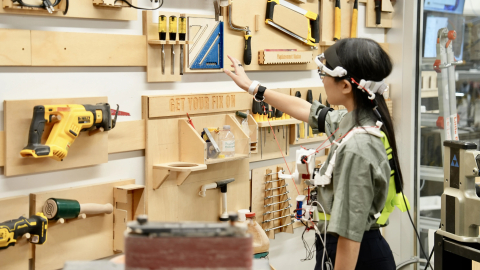
UMD researchers developed an AI exosuit that intercepts human errors mid-motion to accelerate physical skill learning.
A home cook finishes chopping vegetables, pauses for a moment, and reaches for the soy sauce when the recipe called for salt. Small slips like this happen in the brief gap between one step and...read more

UMD alum Utkarsh Tyagi (M.S. ’25) draws on his research experience at Maryland to develop SteerDuplex, a model designed to make voice-based AI systems more responsive to spoken instructions.
Asking someone to slow down, speak louder or wait until a sentence is finished is a routine part of conversation. But when the listener is an artificial intelligence voice assistant, those simple requests may not...read more

With a new $150,000 grant, an interdisciplinary team that includes Jun Nishida and Nirupam Roy will develop wearable technology to give Deaf and hard-of-hearing audiences new ways to experience music.
A flute that feels like raindrops fluttering across the skin. A violin that registers as a looping sensation. Drums that arrive as an insistent, rhythmic pulse. That’s how Jill Bradbury, a Deaf scholar and director...read more

He studies robot learning and manipulation, and how artificial intelligence can help machines better understand and interact with the physical world.
Humans learn how the physical world works long before they can explain it. Through play, they pick up objects, move them around, try different actions and learn from what happens next. Ruoshi Liu is exploring...read more
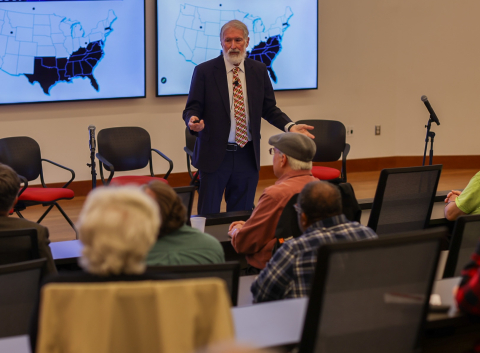
Alumni and former researchers revisit the University of Maryland’s role in developing early internet infrastructure and connecting academic institutions across the country.
“Our university and our region have been the hub of technological discovery and progress for more than a century,” said President Pines, as he and Vice President Patrick O’Shea kicked off the “When UMD Was...read more

Computer science major Oluwatoyin Olaniyi received a ‘life-changing’ scholarship from Brenda Fonseca (B.A. ’75, French).
One of the first things Oluwatoyin Olaniyi heard when she arrived at the University of Maryland was, “You belong in computing.” That message came from Computer Science Lecturer Elias Gonzalez (B.S. ’17, computer science; M.Ed...read more

Suho Shin and Zeyu Yan are recognized for research on algorithmic delegation and sustainable electronics.
The University of Maryland’s Department of Computer Science has announced alumni Suho Shin (Ph.D. ’26, computer science) and Zeyu Yan (Ph.D. ’26, computer science) as recipients of the 2026 Larry S. Davis Doctoral Dissertation Award...read more
Upcoming Events
Talk
11.09.2026 11:00 to 12:30
PhD Defense: Auditing and Steering Foundation Models for Safety and Reliability
Mehrdad Saberi Kamarposhti
IRB-4105 https://umd.zoom.us/j/3139558953
PhD Defense: Auditing and Steering Foundation Models for Safety and Reliability
Mehrdad Saberi Kamarposhti
Talk
11.11.2026 11:00 to 12:00
MS Thesis Defense: RSS and RTT Fusion for WiFi-Based Indoor Localization
Mehak Gupta
CS Department, University of Maryland
IRB 4107
MS Thesis Defense: RSS and RTT Fusion for WiFi-Based Indoor Localization
Mehak Gupta
CS Department, University of Maryland
Talk
11.11.2026 13:30 to 14:30
AI for Real-World Visual Intelligence: Seeing, Reasoning, and Synthesis
Yu Gan and Ming Lin
Register https://docs.google.com/forms/d/e/1FAIpQLScWYA7fGGp5FcS-pXsIQJFHBZE4sSQ7...
AI for Real-World Visual Intelligence: Seeing, Reasoning, and Synthesis
Yu Gan and Ming Lin
Event
Event
Talk
11.19.2026 11:00 to 12:00
Groundwork for Open Speech Foundation Models: Data, Recipes, and Task-Specific Models
Shinji Watanabe
Carnegie Mellon University
IRB 4105
Groundwork for Open Speech Foundation Models: Data, Recipes, and Task-Specific Models
Shinji Watanabe
Carnegie Mellon University
Event
Event
Event
Event
11.09.2026 11:00 to 12:30
PhD Defense: Auditing and Steering Foundation Models for Safety and Reliability
IRB-4105 https://umd.zoom.us/j/3139558953
PhD Defense: Auditing and Steering Foundation Models for Safety and Reliability
11.10.2026 14:00 to 15:00
Towards (More) Principled Decision-making LLM Agents: A Regret-based Perspective
CSI 2120 or https://umd.zoom.us/j/93960331973?pwd=tVQ7gtFucJEkSYna38zePzkPpHm3J7.1
Towards (More) Principled Decision-making LLM Agents: A Regret-based Perspective
11.11.2026 11:00 to 12:00
MS Thesis Defense: RSS and RTT Fusion for WiFi-Based Indoor Localization
4107
MS Thesis Defense: RSS and RTT Fusion for WiFi-Based Indoor Localization
11.11.2026 13:00 to 15:00
PhD Defense: Quantum error correction: from physical encodings to fault-tolerant gates
PSC 3150 and Virtual Via Zoom: Zoom Link: https://umd.zoom.us/j/9137887602?pwd=ei84WW1MZG9aUWtiempMWVNCWVY3dz09&om... Meeting ID: 913 788 7602 Passcode: 542956
PhD Defense: Quantum error correction: from physical encodings to fault-tolerant gates
11.12.2026 10:30 to 11:30
Discovering state-of-the-art quantum circuits with large language models
Virtual Via Zoom: https://umd.zoom.us/j/9893676372?pwd=VVNOd2xNZ3FCblk4aFdTMjkzTllvQT09&om... Meeting ID: 989 367 6372 Passcode: abc123
Discovering state-of-the-art quantum circuits with large language models
11.16.2026 14:00 to 15:00
Query-Optimal and Gate-Efficient Time-Dependent Hamiltonian Simulation
ATL 3100A and Virtual Via Zoom: https://umd.zoom.us/j/93081761228?pwd=fhsBUzsdeVOgaNspZfSrZXBXG7oQGu.1
Query-Optimal and Gate-Efficient Time-Dependent Hamiltonian Simulation
11.17.2026 14:00 to 15:00
Deriving normative constraints from precedent decisions: A hierarchical model
CSI 2120 or https://umd.zoom.us/j/93960331973?pwd=tVQ7gtFucJEkSYna38zePzkPpHm3J7.1
Deriving normative constraints from precedent decisions: A hierarchical model