27 Undergraduates Complete UMD REU Program
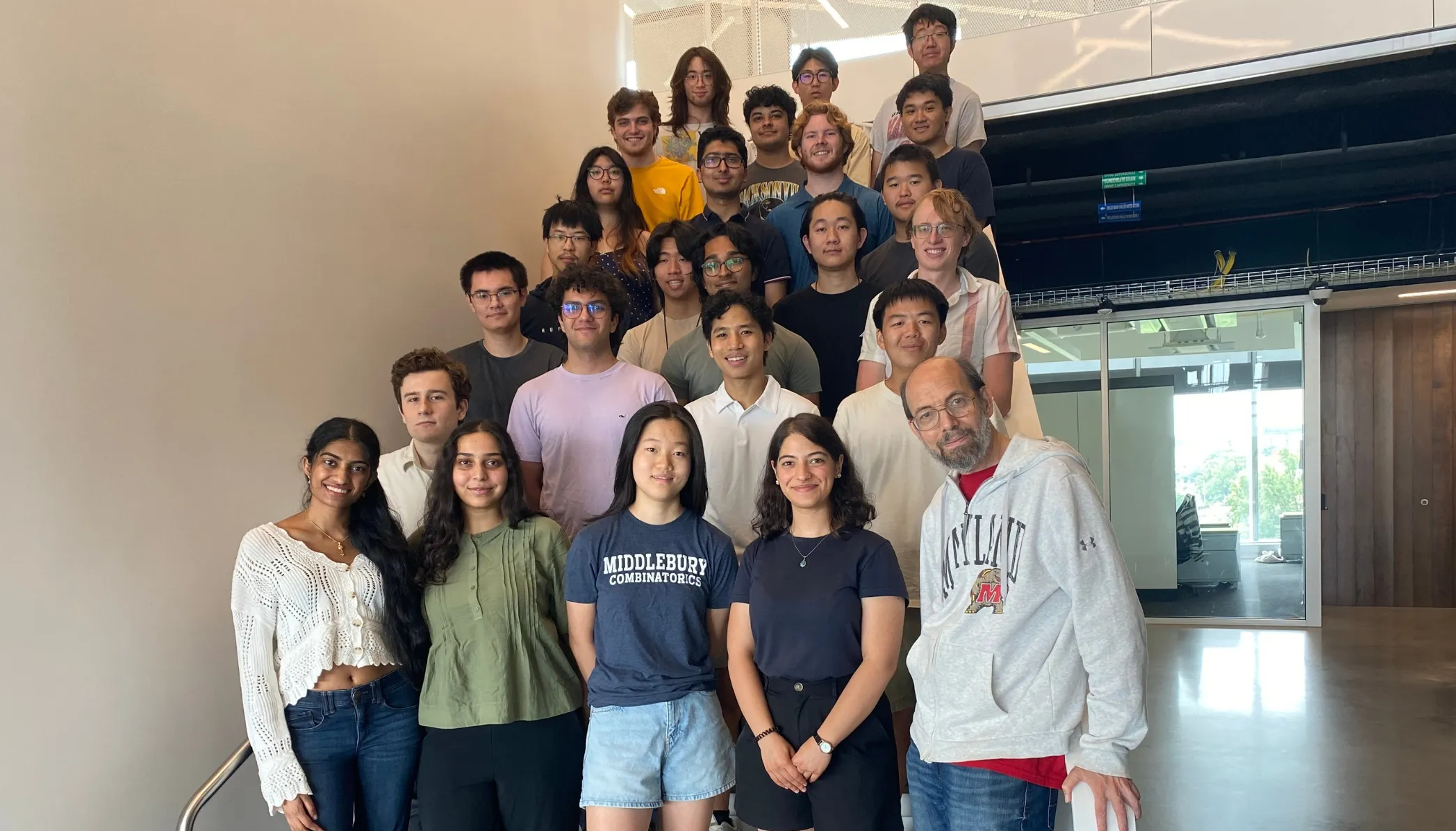
27 undergraduate students concluded 10 weeks of research at the University of Maryland’s Department of Computer Science on Aug. 7, completing projects that ranged from artificial intelligence evaluation to mathematical theory as part of the department’s summer Research Experiences for Undergraduates (REU) Combinatorics, Algorithms, and AI for Real Problems (CAAR) program. Selected from nearly 400 applicants, this year’s cohort worked alongside UMD faculty and graduate student mentors across seven research teams.
The REU-CAAR is an NSF-funded research program that brings together students from UMD and universities across the country for an extended introduction to academic research. Participants spend the summer learning the foundations of a research area, developing questions, conducting experiments or theoretical work and presenting their findings.
William Gasarch, a professor of computer science who has helped organize the program since 2013, said students increasingly arrive with prior exposure to research and some familiarity with the subjects they plan to study.
“The cohorts get better and better every year in that students are starting research earlier and earlier,” Gasarch said. “Many of them started doing research in high school, which would have been unusual the first year I ran the program.”
That preparation helped students move from studying existing work early in the summer to investigating questions of their own as the program progressed. The process differed by project, with some teams working on theoretical problems and others examining computational systems and applications.
One group studied Ramsey theory, an area of combinatorics that examines when patterns must appear within sufficiently large mathematical structures. The project led by Gasarch initially focused on understanding established results and developing clearer ways to explain them, including material that could eventually be presented to high school students.
As the group worked through those problems, the project moved beyond its original educational focus and led to new mathematical findings.
Charlie Klawitter, a junior mathematics major at the University of Wisconsin-La Crosse, was part of the Ramsey theory team. He said working alongside students with different backgrounds gave him a broader view of how others approach mathematical research.
“Working with my team was an invaluable experience that provided me with a whole new mindset in the field of research and academia,” Klawitter said. “I learned a lot about the different processes and mindsets of other young academics in the same field as me.”
Klawitter said the experience extended beyond his assigned project. Weekly seminars and organized group activities gave participants opportunities to hear about other research areas and interact with students working on different problems.
Those exchanges were also part of Nghia Truong’s experience. Truong, a junior double majoring in computer science and mathematics, worked on a project led by Professor Jordan Boyd-Graber, examining how artificial intelligence systems respond to challenging questions that combine visual and language information.
The research looks beyond whether an AI system produces a correct or incorrect answer. Instead, the team is studying where systems perform well, where they encounter difficulty and how their capabilities compare with human performance.
Truong said more detailed evaluation methods could give researchers a clearer understanding of what current AI systems can and cannot do.
“More meaningful and fair evaluations can help researchers make more honest claims about AI progress and identify areas that still need improvement,” Truong said. “Ultimately, this work could contribute to building AI systems that are more reliable and work more effectively alongside people.”
Carrying out that research also required students to coordinate their individual responsibilities with the goals of a larger team. Truong’s group met weekly to discuss progress, work through challenges and determine the next steps for the project.
“Working with the group taught me the importance of being organized, communicating clearly and connecting my individual work to a shared research goal,” Truong said.
He also pointed to interactions with students from other institutions as an important part of the summer. Participants entered the program with different academic experiences, giving them opportunities to compare approaches to research and problem-solving.
“Hearing their perspectives and seeing how they approached research broadened the way I think about solving problems,” Truong said.
Across the seven teams, participants learned how research develops from early reading and discussion into more focused investigation. Seminars supplemented that work by introducing participants to faculty research and providing opportunities to discuss graduate study and academic careers.
Gasarch said the program is also intended to expose students to a defining feature of research: unlike coursework, the problem being studied may not have a predetermined solution and can change as new information emerges.
“They will learn how to work in a group and learn that when doing research, the answers are not known, and sometimes the questions change,” Gasarch said.
Other 2026 REU projects:
• Laxman Dhulipala led a project on I/O-efficient parallel algorithms. Students explored theoretical and practical approaches for designing parallel algorithms that reduce the amount of data transferred between main memory and external storage while maintaining high levels of parallelism. The project included developing data structures and algorithms for working with large amounts of data distributed across external memory devices such as solid-state drives.
• Erin Molloy led a computational biology project focused on errors in phylogeny reconstruction. Students examined how errors introduced during genomic data processing can affect algorithms used to reconstruct evolutionary relationships among species or cells. The project included studying error propagation, developing algorithms that are more robust to uncertain inputs and exploring machine learning methods for detecting errors.
• Bill Regli and Bill Gasarch led a project exploring alternative approaches to computing beyond traditional transistor-based systems. Students investigated technologies including memristors, phononic systems, Ising machines and analog computers to understand how they could address computationally difficult problems. The project examined the potential advantages and limitations of these approaches for problems such as Boolean satisfiability, fast Fourier transforms and simulations of physical systems.
• Ming Lin led a machine learning project focused on autonomous driving. Students examined how machine learning systems can use human driving data to better anticipate behavior in environments where autonomous and human-driven vehicles operate together. The project focused on high-risk driving scenarios and applying machine learning techniques to improve understanding of driving dynamics and vehicle safety.
• Sarah Miller led a project exploring alternative neural network architectures for solving games, puzzles and real-world reasoning problems. Students used ideas from combinatorial game theory to build and train neural networks designed to reason efficiently in unfamiliar situations. Depending on their interests, students could extend the work to physical systems, formal verification using Lean or quantum computing while comparing the approaches with transformer-based and reinforcement learning methods.
—Story by Samuel Malede Zewdu, CS Communications
The Department welcomes comments, suggestions and corrections. Send email to editor [-at-] cs [dot] umd [dot] edu.