Recent News & Accomplishments
2026

The projects aim to predict hospital readmissions in high-risk heart failure patients and establish reliable methods for evaluating the safety and performance of AI-enabled medical imaging systems.
University of Maryland computer scientist Heng Huang is part of two new federally funded projects aimed at improving the use of artificial intelligence in healthcare: a four-year, $1.2 million award to develop a wearable device that predicts hospital readmission in high-risk heart failure patients and a $750,000 contract to create a platform for evaluating AI-enabled medical imaging systems. “AI has so much potential to help us address human health problems, and developing these kinds of real-world tools is one important way forward,” said Huang, the Brendan Iribe Endowed Professor of... read more

Watch someone pour almonds into a bowl, and the action is easy to follow: a container moves, tilts and releases its contents. Teaching a robot to do the same can require costly demonstrations specifying how its joints and gripper should move. University of Maryland researchers have developed an artificial intelligence model that learns from videos how hands, tools and objects move and then uses those patterns to help robots perform tasks. Called μ₀, or Mu Zero, it is a type of AI called a world model, which predicts how a scene will change during an activity. Given an image and an instruction... read more

The Fall 2026 event brought 1,169 students together with representatives from 59 employers seeking candidates for internships and full-time positions.
The University of Maryland Department of Computer Science brought 1,169 students and representatives from 59 employers together at its Fall 2026 Career and Internship Fair on Sept. 28. Held at the Adele H. Stamp Student Union, the event gave students direct access to recruiters seeking candidates for internships and full-time positions in computer science and related fields. For students, the fair offered a chance to speak directly with employers and better understand how their coursework and experiences translate to the workplace. Senior Sofia Santiago , who is pursuing a double degree in... read more

Jared Wolinsky (B.S. ’09, computer science) credits his University of Maryland education and the QUEST Honors Program for preparing him for his current role as group vice president of software engineering at SiriusXM.
He started tinkering with computers in elementary school. Using an old IBM machine his grandfather passed down to his family, Wolinsky learned Visual Basic—an early programming language developed by Microsoft for Windows. At first, he built apps to play pranks on his friends through AOL’s messaging platform. “I had a little mischievous streak at the time,” he said, laughing. “It was never anything nefarious—just doing the things that would sound fun for a middle schooler.” But his love for coding grew into something bigger. He sought resources to develop his skills and found like-minded... read more

Computing Catalyst’s annual event brought students together with campus organizations, UMD programs and industry representatives at Hornbake Plaza.
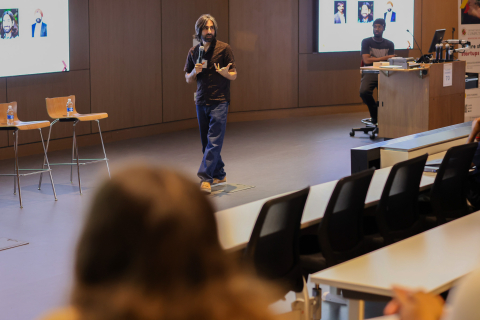
About 400 students gathered at Hornbake Plaza on Sept. 25 for Computing Catalyst’s annual Tech Block Party, where they connected with student organizations, UMD programs and technology companies. The images below capture scenes from the event and the connections students made throughout the afternoon. Previous Next —Portrait Article by Samuel Malede Zewdu, CS Communications figure img { border: 2px solid #e8e9ea; width:100%; height:auto; } figcaption { font-size: .8em; text-transform: uppercase; text-align: center; font-weight: bold; border-top: 3px double #fed31e; border-bottom: 3px double #... read more

Philip Resnik and Rebecca Resnik used computer-assisted analysis to examine more than 16,000 personal accounts describing reasons people choose to continue living.
What can thousands of personal stories tell us about the reasons people keep going during their darkest moments? University of Maryland computational linguist Philip Resnik and clinical psychologist Rebecca Resnik recently joined CBS News correspondent Natalie Brand to discuss new research examining that question. Philip Resnik, who is also an affiliate professor in the Department of Computer Science, is the lead author of the forthcoming Scientific Reports paper “16,648 Reasons to Live Instead of Dying by Suicide: Insights from a Computer-Assisted Content Analysis.” A professor of... read more
The five student-led startups focus on job searches, home-service calls, neighborhood equipment sharing, engineering workflows and passive health monitoring.
The University of Maryland’s Department of Computer Science has selected five student teams, Pinloop, NexFlow, Shelf, Simulace and PulseFi, for the 2026-2027 academic year of the Mokhtarzada Hatchery Program. The Hatchery provides selected teams with up to $10,000 in funding, access to startup mentors and workspace in the Brendan Iribe Center for Computer Science and Engineering. Teams use the academic year to develop and test ideas, identify potential users and refine products and business models. Funded by UMD alumni and siblings Haroon (B.A. ’01, economics), Idris (B.S. ’10, computer... read more

The eight-member body will provide industry perspectives, support student programming and strengthen connections among students, alumni and professionals.
The University of Maryland Computing Catalyst has formed its inaugural advisory board, bringing together eight professionals from technology, government, consulting and engineering. The board met for the first time in late August. Computing Catalyst provides mentoring, professional development, scholarships and community-building programs for UMD students in computing, along with outreach for local K-12 students. During the 2025-26 academic year , more than 300 UMD students and 116 local middle and high school students participated in its programs. “Pursuing excellence in computing means... read more
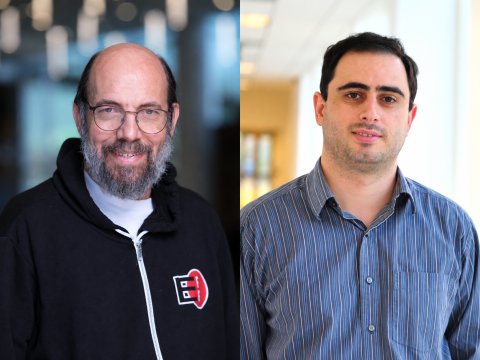
Their new book, co-authored with MIT professor Erik Demaine, examines how computer scientists determine the limits of solving computational problems.
University of Maryland Department of Computer Science faculty members William Gasarch , a professor of computer science, and Mohammad Hajiaghayi , the Jack and Rita G. Minker Professor of Computer Science, have co-authored a forthcoming book examining how computer scientists determine how difficult problems are to solve and whether faster solutions are possible. Computational Intractability: A Guide to Algorithmic Lower Bounds, co-authored with Massachusetts Institute of Technology Professor Erik Demaine, is scheduled for publication on Oct. 13 by MIT Press. The book focuses on algorithmic... read more

The program ranks in the Top 10 among public institutions overall and for the specialties of artificial intelligence and cybersecurity, according to U.S. News & World Report.
The University of Maryland’s undergraduate computer science program ranks No. 17 overall in the 2027 edition of U.S. News & World Report ’s “ Best Colleges .” UMD ranks in the Top 10 among public institutions overall and for the specialties of artificial intelligence and cybersecurity. “Undergraduate computer science programs have only been ranked by U.S. News & World Report for the past seven years, and the University of Maryland has ranked in the top 20 every year," said Matthias Zwicker , chair of UMD’s Department of Computer Science and holder of the Elizabeth Iribe Chair for... read more