CS Majors Rethink How Users Interact With AI
Large language models have become standard tools for students navigating coursework, research projects and independent study. They can explain concepts quickly, summarize dense material and respond to follow-up questions in real time. As their use has expanded, however, a recurring limitation has emerged: information generated through AI often remains buried in long chat histories that are difficult to revisit, compare or connect.
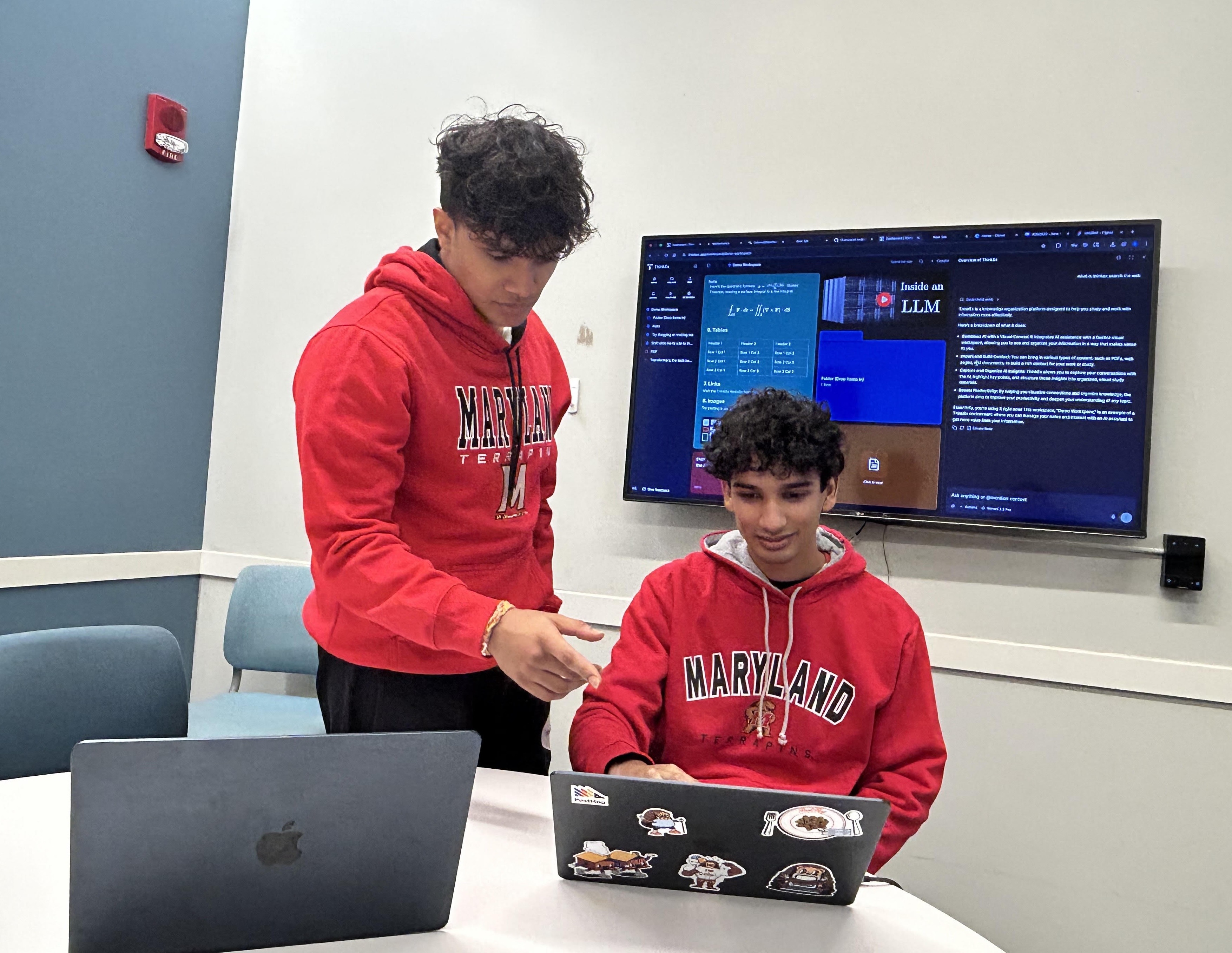
That challenge is central to ThinkEx, a digital platform developed by University of Maryland computer science students Ishaan Chakraborty (B.S. ’27, computer science) and Urjit Chakraborty (B.S. ’29, computer science). As one of four teams in this year’s Mokhtarzada Hatchery Program, the pair designed ThinkEx as a workspace that integrates large language models into an environment in which notes, documents, and media remain visible and organized. Rather than relying on a single chat thread, the platform allows users to work across multiple sources simultaneously, preserving context as they read, annotate and ask questions.
For Ishaan, the idea arose from a broader question about learning rather than from a specific technical shortcoming.
“The way I think about it is, what is the use of having all the information in the world if you cannot make sense of it?” he said. “Large language models let you talk to information, but understanding comes from being able to ask questions and connect the answers in a way that actually sticks.”
Rethinking Understanding
That perspective shaped the team's approach to the problem. They viewed understanding as something users actively construct through questioning, comparing, and interpreting information, rather than as something delivered in a single response.
As they studied how people currently use AI tools, the team focused on the limits of chat-based interfaces. While conversational formats are intuitive, Ishaan said they encourage a linear flow that makes insights easy to lose over time.
“You ask a question, you get an answer, and maybe you feel like you learned something,” he said. “But unless you are taking notes while you chat, it all just turns into a long log that you do not really return to.”
That observation led the team to distinguish between merely saving information and actively managing it.
Beyond Linear Chat
ThinkEx was built around that distinction. Users can begin working immediately in a demo workspace without creating an account. Within the platform, users can write notes, upload PDFs, organize folders and import external media, such as YouTube videos. Longer AI-generated research outputs open as editable documents rather than disappearing into chat history.
The interface allows users to split their view so that multiple items remain visible simultaneously. Notes can be kept alongside the source material while an AI chat processes questions regarding the duplicate content. According to the team, the structure reflects how people already move between tabs and windows, while reducing the constant context switching that often disrupts focus.
Urjit stated that the design addresses what he sees as a core constraint in most AI tools.
“Linear chat interfaces fundamentally limit you,” he said. “You cannot interact with your sources at the same time. That is why we designed ThinkEx to be modular, where you control what is in context and how it is organized.”
That flexibility, he added, is essential because users approach information in different ways.
“There is no one-size-fits-all solution,” Urjit said. “Everyone thinks differently, so the platform had to give people control instead of forcing them into one flow.”
Iterating With Users
Development followed an iterative process. Urjit said the team spent part of the summer brainstorming before building an early version once the semester began. They applied to the Hatchery Program with a preliminary prototype and continued refining the platform in response to user feedback.
“We went through a lot of iterations,” he said. “A big part of the work was listening to users and trying to understand what they wanted, even when they could not easily explain it.”
The founders said the Program played a central role in helping them move from concept to a working product, providing both structure and mentorship throughout the process.
“Everyone in Hatchery is really talented and brings something different to the table, from sharing expertise to inspiring new ideas,” Urjit said. “The mentorship, especially from the Mokhtarzada brothers, helped us focus on the right things, like getting users and collecting feedback. Without the Hatchery, we probably would have been running in circles and might not have made much progress at all, if we even continued working on it.”
During the past semester, ThinkEx was tested primarily with students. The platform reached more than 50 users, with activity increasing when students shared workspaces and studied together.
As the team looks ahead, they plan to continue refining the platform and exploring opportunities beyond the Hatchery.
“One of our main goals is to grow our user base and begin seeking revenue,” said Urjit. “This summer, we are also looking to join another accelerator, similar to paths some Hatchery teams have taken, whether that is Y Combinator or raising support from independent venture capital. That would be a major step for us and something we likely would not have been positioned to pursue without the Hatchery.”
—Story by Samuel Malede Zewdu, CS Communications
The Department welcomes comments, suggestions and corrections. Send email to editor [-at-] cs [dot] umd [dot] edu.